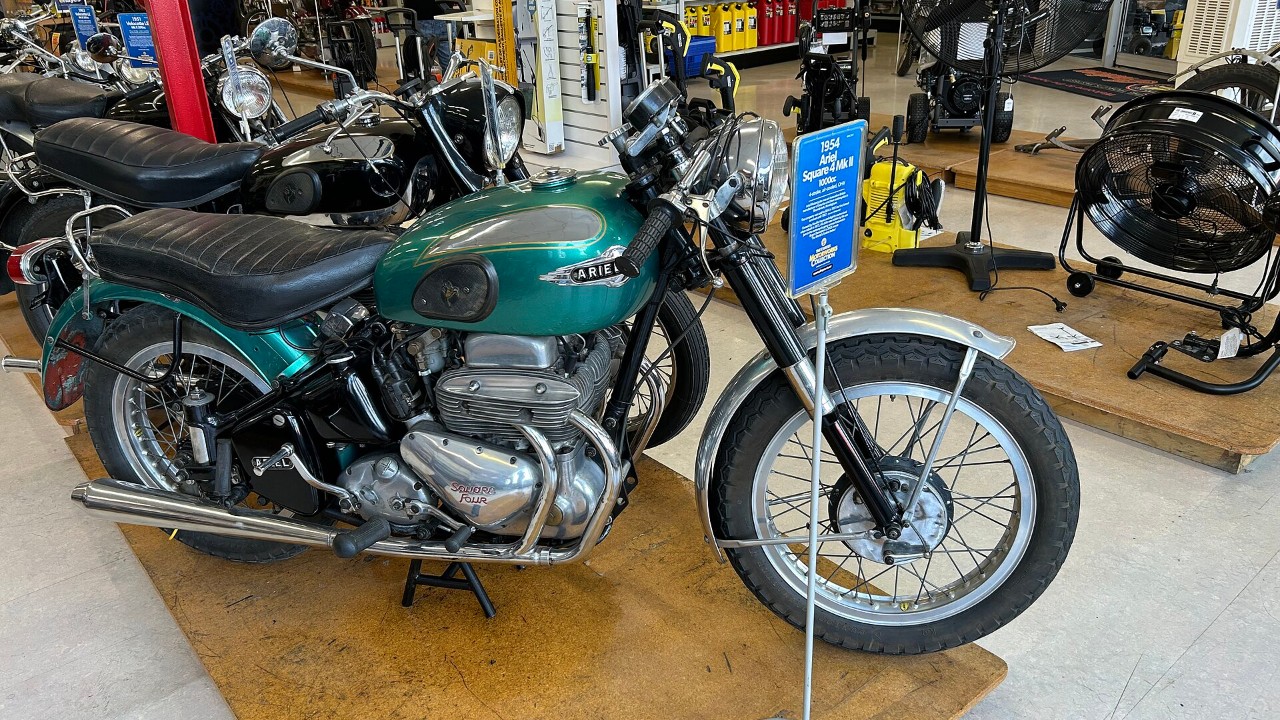
The Ariel Square Four packed four cylinders into a square block and ran them on two crankshafts geared together. It started life in 1931 as a 500 cc machine. By the 1937 model year, the same basic idea had grown to 1,000 cc, and Ariel kept building it into the late 1950s.
Instead of four cylinders in a row, the engine set them two by two, like the four corners of a square. That layout gave the bike its name. However, it also created a cooling problem the factory spent years solving.
Here is how the engine worked, how it grew, and how many Ariel built. The facts come from Ariel North America’s club history, an Old Bike Australasia feature and the references they cite.
Edward Turner’s square idea
The design came from Edward Turner, then a young freelance designer. According to Ariel North America’s history, Turner proposed the square-four engine in 1928. Other makers, including BSA, turned it down before Ariel bought the design.
Ariel then showed the Square Four to the public at the Olympia Motorcycle Show in late 1930, the same history says. It describes the debut as a huge sensation. Meanwhile, Old Bike Australasia’s Jim Scaysbrook writes that Ariel owner Jack Sangster gave Turner a drawing office and an assistant, Bert Hopwood.
How the two crankshafts worked
The heart of the Ariel Square Four is its pair of crankshafts. Ariel North America explains that the two crankshafts were coupled by geared central flywheels. As a result, the two cranks turned in opposite directions.
Wikipedia’s Square Four entry, which cites sources including Motor Cycle magazine, also describes the early engine this way. It had two transverse crankshafts under a single four-cylinder block and head.
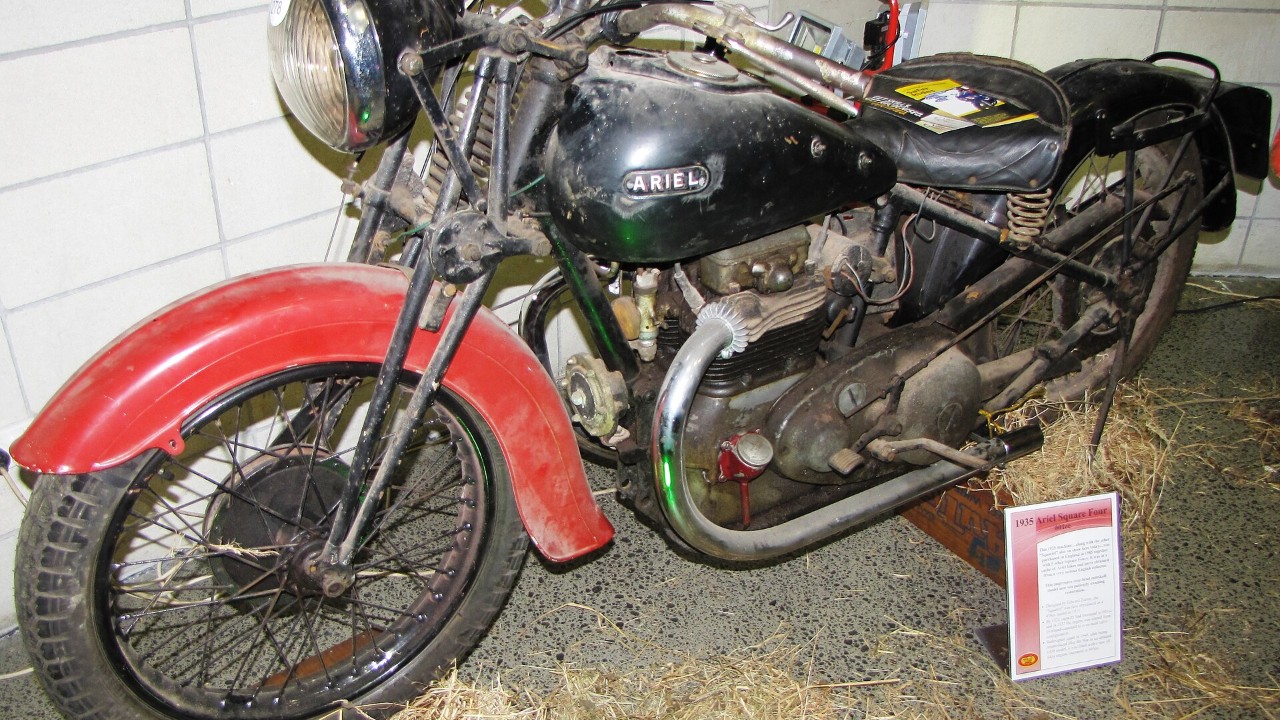
The gearing changed later. When Ariel redesigned the engine in late 1935, it used full crankshafts coupled by gears on the left-hand side rather than in the center, according to Old Bike Australasia. That redesign also replaced the original chain-driven overhead camshaft with pushrod-operated overhead valves.
From 500 cc to 1,000 cc
The first production models were 500 cc touring bikes for 1931, Ariel North America says. Wikipedia gives their exact size as 498 cc. However, the public wanted more power, so Ariel introduced a 600 cc version in 1932. Production of the 500 ended that year.
Next came the big step. Ariel showed the 1,000 cc 4G in late 1935 and released it for the 1937 model year, according to Ariel North America. Wikipedia gives its size as 995 cc. A pushrod 600, the 4F, also returned for the 1939 and 1940 model years, the club history notes.
After the war, Ariel kept refining the 1,000 cc engine. In 1949 it switched from a cast-iron engine to an all-alloy one, which saved 33 pounds, Ariel North America says. Old Bike gives the same 33-pound saving and adds that this version also gained telescopic front forks. This version later became known as the 4G Mk I, and it stayed in production until 1953.
The four-pipe Mk II
Cooling had long been the engine’s weak spot. Old Bike reports that early examples suffered from insufficient cooling around the cylinder head and rocker box, which often led to blown head gaskets. In fact, Wikipedia says the original engine’s rear cylinder heads earned a reputation for overheating.
For 1953, Ariel answered with the Mk II. Ariel North America says its redesigned head carried four exhaust pipes to improve cooling. Old Bike describes two pipes per side, running from polished alloy manifolds to a single muffler on each side. Those four pipes are the quickest way to tell a Mk II from the earlier bikes.
Riders also gave the bike a nickname. Old Bike quotes a 1956 Motor Cycle road test that referred to the “driver of a ‘Squariel’.” The same test praised the machine’s power and flexibility, according to Old Bike.
How many Ariel Square Fours were built
Ariel’s four-stroke range wound down in the late 1950s, and the Square Four went with it. Old Bike says Ariel replaced its four-strokes with Val Page’s twin-cylinder Leader two-stroke.
Old Bike’s production table breaks the run down by model. It lists 927 of the 4F-500, 2,674 of the 4F-600 and 4,288 of the 4G-1000. Then it counts 3,922 of the alloy Mk I and 3,828 of the four-pipe Mk II. Ariel North America gives the same grand total: 15,639 Square Fours built from 1931 to 1958.
More from Fast Lane Only
- Unboxing the WWII Jeep in a Crate
- 15 rare Chevys collectors are quietly buying
- 10 underrated V8s still worth hunting down
- Police notice this before you even roll window down
This article was created with the help of AI and was reviewed and edited by Fast Lane Only editors before publication.