The Back to the Future refrigerator is the time machine audiences never saw. In early drafts, Doc Brown built his invention into an old fridge, and Marty rode it home on a nuclear blast. Then Steven Spielberg worried about what kids might copy, and the idea gave way to a stainless-steel DeLorean.
That swap changed movie history and car culture at once. A sports car whose maker had already gone bankrupt suddenly became a movie star.
Here is what the fridge version looked like, why it died, and how a gull-winged coupe from Northern Ireland took its place.
The Back to the Future refrigerator in early drafts
Co-writer Bob Gale has described the original plan more than once. “The time machine was built into an old refrigerator, and Doc had to carry it around on the back of a pickup truck,” he told GamesRadar+ in 2019. To get home, the heroes had to take the refrigerator to a nuclear test site.
In fact, the fridge was not the machine itself. “It was a time ray that shot into a time chamber,” Gale told Moviefone in 2015. He added that Doc “converted a refrigerator and put lead lining in,” so Marty would survive the blast inside it.
The idea went surprisingly far. According to a 2009 SlashFilm report, art director Andrew Probert storyboarded the Nevada test-site sequence from the third draft. Gale also told Moviefone the device “was not intended to be mobile.”
Why Spielberg wanted the fridge gone
Two problems sank the refrigerator. The first was safety. Spielberg, the film’s executive producer, feared that children would climb into refrigerators and get trapped, Robert Zemeckis said in interviews, as SlashFilm reported. BGR gave the same reason in a 2026 retrospective.
That fear had a real basis. Early refrigerators used a latch to keep the door shut, No Film School notes, and several children died after they became stuck inside. So a film that showed a hero hiding in one carried an obvious risk.
The second problem was money. Gale told GamesRadar+ the nuclear finale “was expensive, so we ended up not doing it.” SlashFilm adds that Industrial Light & Magic wanted $1 million for the bomb effect alone.
Still, the fridge did not die completely. As BGR points out, the lead-lined refrigerator finally reached the screen in 2008. Spielberg used the idea in Kingdom of the Crystal Skull, where Indiana Jones survives a nuclear test inside a fridge.
How the DeLorean got the job
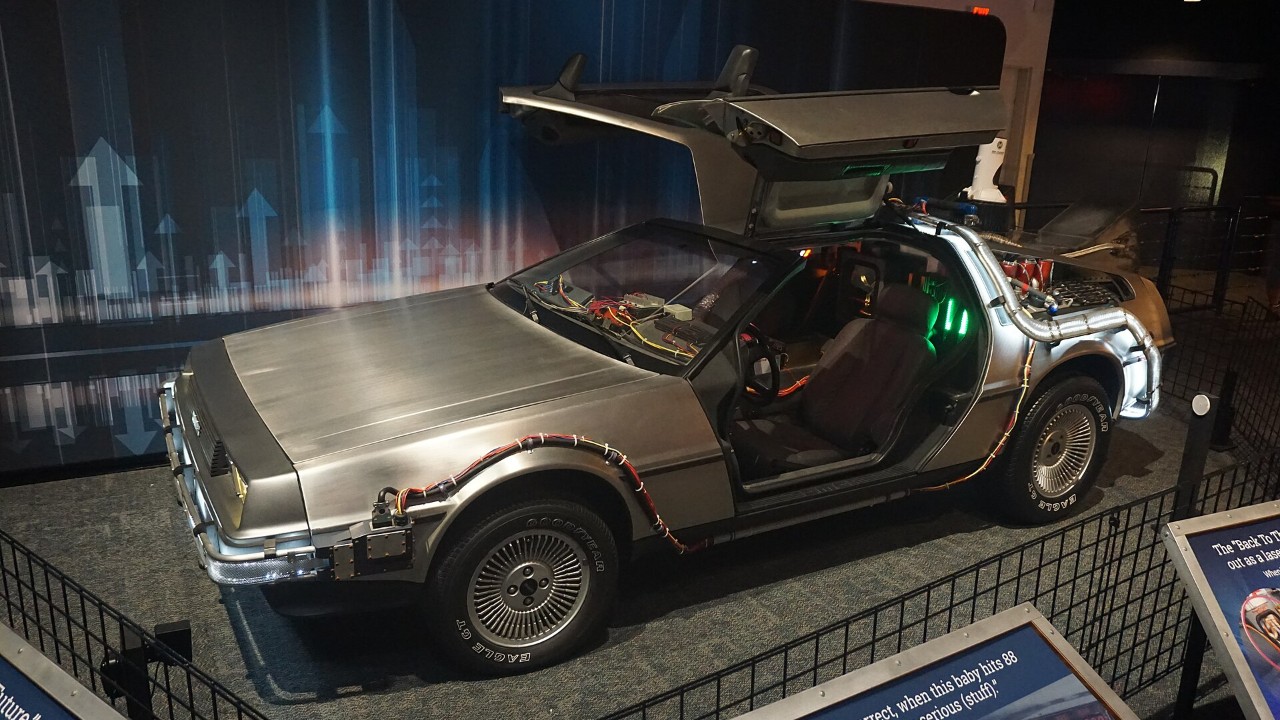
Zemeckis came up with the fix. “Hey, Bob, wouldn’t it make more sense if Doc Brown had built the time machine into a car?” he asked, as Gale recalled to GamesRadar+. A car could move, and that made the logistics much easier.
Gale says this happened in mid-1984. At that time, John DeLorean was on trial on cocaine charges, which gave the car a “bad-boy image.” The team also considered a gull-wing Mercedes, Gale said, but it lacked the DeLorean’s cool factor.
Above all, the doors sold it. “We came up with the idea of the DeLorean simply because it had gullwing doors,” Zemeckis says in the documentary Back in Time, as quoted by Moviefone. Those doors set up a key joke, too. When the car arrives at the Peabody farm in 1955, the family takes it for a spaceship.
Not everyone agreed with the choice. Gale told Moviefone that someone promised him $40,000 if he changed the car to a Ford Mustang. He turned it down flatly, insisting that Doc Brown would never drive one.
The real car behind the time machine
The DeLorean DMC-12 was a genuine oddity before Hollywood found it. Auto Express says workers at Dunmurry, near Belfast, finished the first car on January 21, 1981. Giorgetto Giugiaro penned the shape.
Underneath, the body was mostly thin stainless steel skin over glass-reinforced plastic. Power came from a detuned 2.8-liter V6 making roughly 130 to 135 horsepower, Auto Express reports. Then the company went into receivership in February 1982, after only around 9,000 cars.
That modest engine caused problems on set. Gale told GamesRadar+ that the stock speedometer “only went up to 85 miles an hour.” Of course, the script needed 88. For the sequels, he said, the team switched to eight-cylinder engines to get more speed.
Building the movie cars
The film’s crew turned production DeLoreans into time machines. According to the AFI Catalog, special effects supervisor Kevin Pike modified three 1981 DeLoreans for the first film. The crew also cut one open for interior shots.
Pike’s team added “firejets” that shot flames before takeoff. Meanwhile, Michael Scheffe served as DeLorean construction coordinator, and Ron Cobb consulted on the time travel design. Even the “Mr. Fusion” reactor had a humble start, since the AFI says the crew built it from a Krups coffee grinder.
The gamble paid off. Back to the Future opened on July 3, 1985, on an $18 million budget, the AFI Catalog records. By 1990, it had taken $208 million at the domestic box office.
More from Fast Lane Only