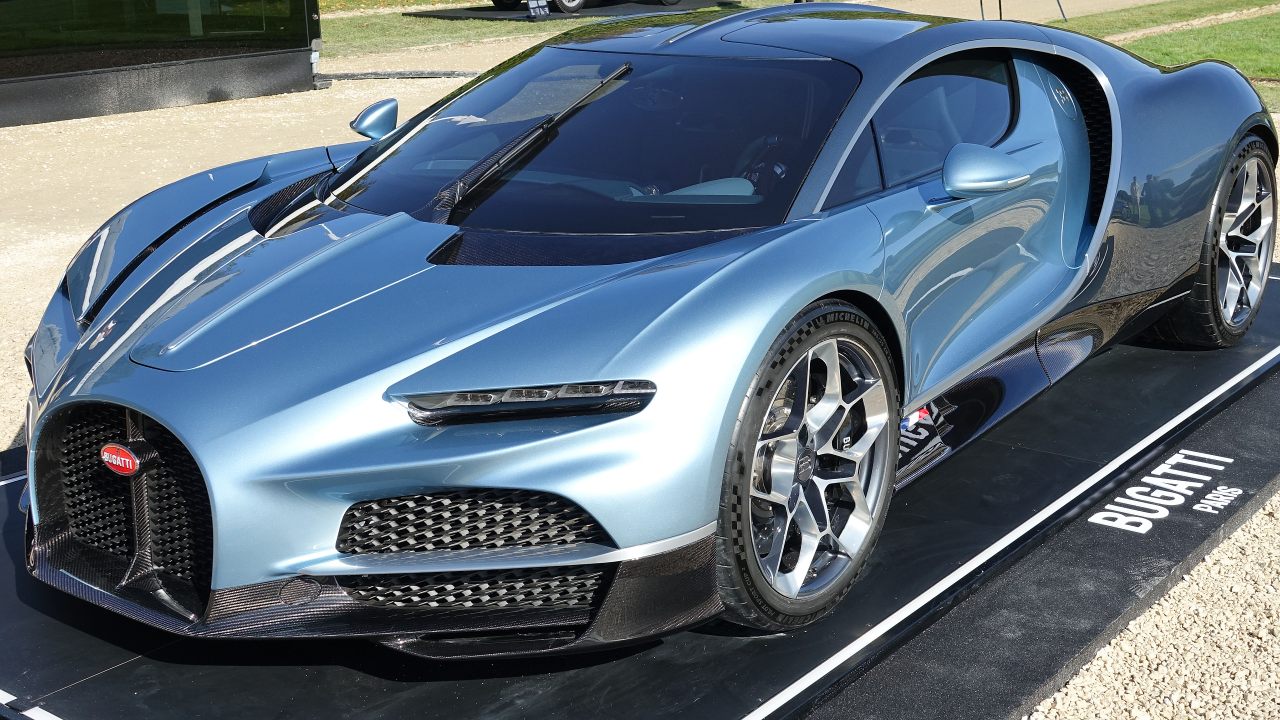
The Bugatti Tourbillon is supposed to be the next great hypercar for the ultra wealthy, yet its latest public appearance involved being dug out of deep snow on a Croatian back road. Winter testing has thrown the upcoming hybrid into conditions that would humble ordinary crossovers, let alone a low, mid engined machine with a price tag around four million dollars. Watching one of the world’s most expensive prototypes fight through snowdrifts offers a rare look at how Bugatti is trying to make extreme performance usable even when the weather is anything but perfect.
From desert debut to frozen shakedown
The Bugatti Tourbillon arrived as a statement piece, first shown in dramatic fashion against the stark landscape of the Zekreet Desert in Doha, where the bold hyper sports car was positioned as a new chapter for Bugatti. That debut emphasized sculpture, craftsmanship and the theatre of a mid engined flagship, with the newly unveiled Bugatti Tourbillon presented as a fusion of traditional coachbuilding and cutting edge performance. The setting underlined the brand’s comfort with excess, a car designed to look at home in a curated desert tableau as much as on a private autobahn.
Winter testing in Croatia could not be further from that controlled reveal, yet it is just as revealing about what the Tourbillon really is. The upcoming Bugatti Tourbillon has been spotted battling heavy snowdrifts on public roads in Croatia, its sleek bodywork almost comically at odds with the plumes of powder around it. One prototype has been photographed with snow piled halfway up the wheels, while video clips show the car clawing for traction as its hybrid powertrain tries to meter out power on ice. The contrast between Zekreet Desert glamour and Croatian slush is deliberate, a way for Bugatti to prove that its next halo model is engineered for more than climate controlled garages.
A prototype buried to its sills

The most striking images from this winter campaign involve a Bugatti Tourbillon prototype sitting half submerged in snow, the front end and flanks packed in as if the car had been parked in a snowbank overnight. One of the vehicles involved is Verification Prototype 1, known internally as VP1, which has been seen operating on public roads as Bugatti prepares the Tourbillon for production. In some shots the snow reaches halfway up the wheels, a depth that would challenge many SUVs, let alone a low slung hypercar with intricate aero surfaces and massive brakes that need cooling air.
Another clip, shared with the caption that the upcoming four million dollar Bugatti Tourbillon has been spotted battling heavy snowdrifts in Croatia, shows the car pushing through rutted, icy lanes rather than pristine test tracks. A separate post frames the scene with the line that the Bugatti Tourbillon earns its reputation in snow, ice and real world environments, not in a boardroom or on a perfect road. Together, these glimpses suggest a test program that is intentionally harsh, using public road conditions to expose weaknesses in traction control, cooling and hybrid energy management long before customer cars arrive.
Why Bugatti is torturing a four million dollar hybrid
There is a clear engineering logic behind sending such an expensive prototype into conditions that look tailor made to strand it. The Bugatti Tourbillon is an upcoming mid engine hybrid sports car manufactured by French marque Bugatti, and it represents the company’s first electrified production model. Earlier reporting on the brand confirms that the Chiron era, defined by the Bugatti Chiron designed by Achim Anscheidt, is giving way to this new generation, with the Tourbillon already confirmed as the successor. That shift raises the stakes for reliability and usability, because the car is not just another limited run variant but the foundation of Bugatti’s next decade.
Under its sculpted bodywork, the Tourbillon uses a centerpiece powertrain that combines an 8.3-liter naturally aspirated V16 from Cosworth producing 1,000 horsepower with three electric motors for a total system output of around 1,800 horsepower. The hybrid layout makes this the first Bugatti electrified hypercar, a move that Bugatti itself has described as an important decision for the team as it chose a hybrid over a full battery electric layout. Testing such a complex system in deep snow is a way to validate how the combustion engine, electric motors and battery pack behave when temperatures plunge, from cold starts and lubrication to regenerative braking on slick surfaces.
When 1,800 horsepower meets a snowbank
Raw power is only part of the story, and winter testing has already shown how even 1,800 horsepower can be humbled by physics. One account of the Tourbillon’s real world trials notes that the 1,800 HP Bugatti Tourbillon is great in snow, until it is not, describing how the car can surge forward confidently on packed powder before suddenly bogging down when the drifts get too deep. In one sequence, the prototype is seen working its way along a snowy road, only to end up stuck enough that it needs a tow, a reminder that low ride height and wide performance tires are always going to be at a disadvantage once the snow exceeds a certain depth.
From a development perspective, those moments of failure are as valuable as the clean runs. Engineers can watch how the traction and stability systems respond when the rear wheels spin uselessly, how the hybrid system apportions torque between axles, and how the cooling systems cope when snow and slush clog intakes. The Instagram caption that the Bugatti Tourbillon earns its reputation in snow and ice is more than marketing flourish, it reflects a test philosophy that accepts the embarrassment of a stuck prototype as the price of building a car that will feel composed when an owner encounters a surprise snowstorm on a mountain pass.
What winter testing reveals about Bugatti’s next chapter
Seen from a distance, the snowy images of the Tourbillon might look like simple social media fodder, but they also hint at how Bugatti wants this car to be perceived. The Bugatti Tourbillon has already sold out before production begins, with all planned examples spoken for despite a price in the region of four million dollars and a powertrain that blends that 8.3-liter V16 with three electric motors. That level of demand suggests buyers are not just chasing numbers, they are buying into the idea of a hypercar that can deliver ultra luxury performance in a broader range of conditions than the previous generation.
By showing a Verification Prototype buried in snow in Croatia rather than only polished studio shots, Bugatti is signaling that it understands the expectations of those customers. The company has spent five years working on the V16 powered Tourbillon hybrid, and now the car is finally on real roads, dealing with the same ruts, ice patches and snowbanks that any driver in a cold climate might face. For a brand whose recent history has been defined by the Chiron and its carefully curated image, watching the Bugatti Tourbillon grind through winter slush is a subtle but telling shift, one that suggests the next Bugatti will be judged as much on how it copes with bad weather as on how fast it can run in perfect conditions.
More from Fast Lane Only: