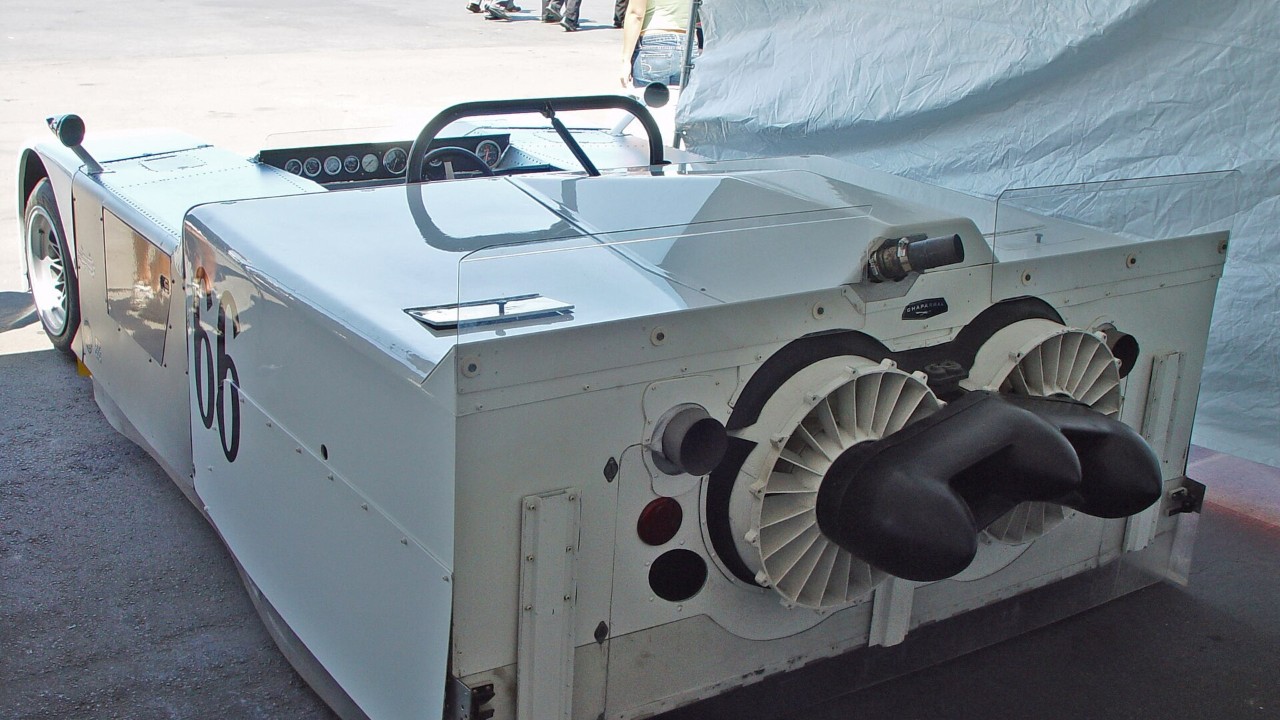
At Riverside in 1970, Vic Elford put the Chaparral 2J on Can-Am pole with a lap of 1 minute 32.49 seconds. Denny Hulme, next fastest in a McLaren, was 2.2 seconds slower. The Chaparral 2J got that grip from two fans that sucked the car down onto the track.
It was the last race of the 1970 Can-Am season, and it was also the car’s last race. The 2J never won. Yet it went fastest in qualifying everywhere Elford drove it, and it was banned after the 1970 season.
Here’s how Jim Hall’s fan car worked, what it did on track, and why it disappeared.
How the Chaparral 2J worked
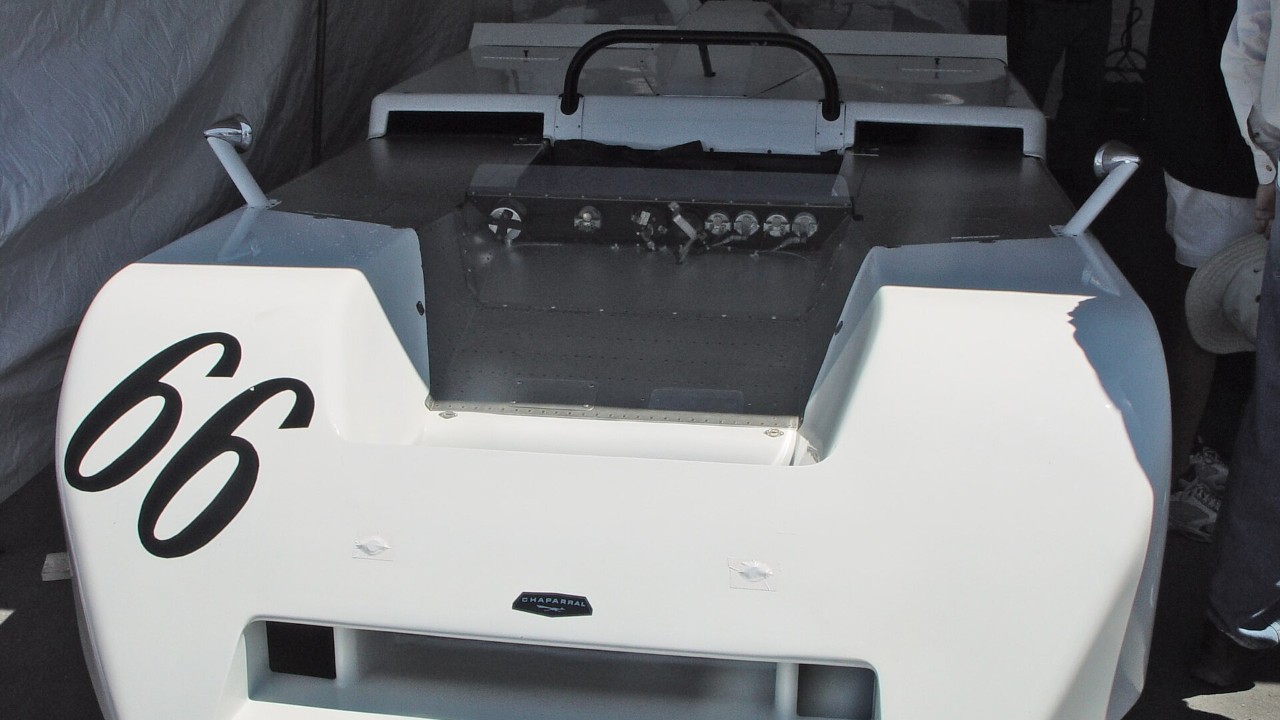
The idea was to pull air out from under the car. According to the Permian Basin Petroleum Museum, which houses the Chaparral collection, the 2J carried two 17-inch axial-flow fans at the back. A second engine drove them: a Rockwell two-stroke, two-cylinder unit rated at 55 bhp.
To hold the low pressure in, the car used sliding skirts. The museum says they were made of .09-inch polycarbonate sheet. In addition, the International Motor Racing Research Center describes them as Lexan “skirts” that sealed the space under the car.
Meanwhile, the main engine was pure Can-Am. The museum lists a 465-cubic-inch aluminum Chevrolet big-block V8, rated at 680 horsepower at 7,000 rpm. It also gives the car’s weight as 2,030 pounds dry. On top of that, the IMRRC notes that Stewart had to adapt to a two-pedal, automatic transmission.
A first race with Jackie Stewart
The 2J debuted at Watkins Glen on Sunday, July 12, 1970. Jackie Stewart drove it for Hall, according to the International Motor Racing Research Center. After practice, Stewart said: “Adhesion is second to none, and is like comparing the road-holding of a touring car to that of a Formula One machine.”
Stewart started third. However, a long pit stop for vapor lock came on lap 14, and the car retired seven laps later with a near-complete loss of brakes. Even so, Stewart set the fastest lap at an average of 125.86 mph, which earned a $1,000 bonus.
Before that, Stewart had been running second among the cars chasing the McLarens, the IMRRC says. It adds that debris from the breaking-up track surface hampered the auxiliary motor and fan drive. In short, the idea worked, but the hardware was fragile.
Three poles for the Chaparral 2J with Elford
Vic Elford drove the car for the rest of its outings, according to RACER. At Road Atlanta, he took pole by 1.26 seconds. Ignition trouble with the snowmobile engine then slowed him to sixth. That sixth place was the 2J’s best finish in the outings RACER lists.
At Laguna Seca, Elford again took pole, this time by 1.8 seconds. But the main Chevrolet engine blew in the warm-up, so he did not start. RACER also quotes Hall: “didn’t get to win a race with it.”
Riverside: more than two seconds clear
Riverside was the tenth and final round of the 1970 series. Motor Sport magazine reported that Elford set a new qualifying record of 1:32.49 on the 3.3-mile course, an average of 128.446 mph. Hulme was “over two seconds slower” at 1:34.69, and Revson followed at 1:35.10.
Unfortunately, the race went badly from the start. Motor Sport says the auxiliary engine broke its crankshaft before the race, and repairs took about three hours. Then Hulme passed Elford before the first turn. Elford was sixth by the end of lap one. By the end of lap two, the Chaparral was in the pits with its fan engine dead.
Hulme went on to win in a McLaren M8D, covering the race in 1 hour, 40 minutes and 24.7 seconds at 120.284 mph. Meanwhile, Motor Sport noted that the Chaparral’s pace “again sparked controversy over its legality.”
Why the fan car went away
Rival teams pushed back, however. RACER says McLaren and others lobbied the SCCA, which ran the Can-Am, to ban the 2J on safety grounds and over its movable skirts. Hall told RACER the SCCA had earlier ruled it legal: “They said it was legal.”
In the end, the 2J was banned after the 1970 season. The museum cites the rule against a “movable aerodynamic device” as the reason. It also quotes Hall from October 1970: “If I can come up with a better mousetrap that is within the regulations, I ought to be allowed to use it.”
More from Fast Lane Only
- Unboxing the WWII Jeep in a Crate
- 15 rare Chevys collectors are quietly buying
- 10 underrated V8s still worth hunting down
- Police notice this before you even roll window down
This article was created with the help of AI and was reviewed and edited by Fast Lane Only editors before publication.