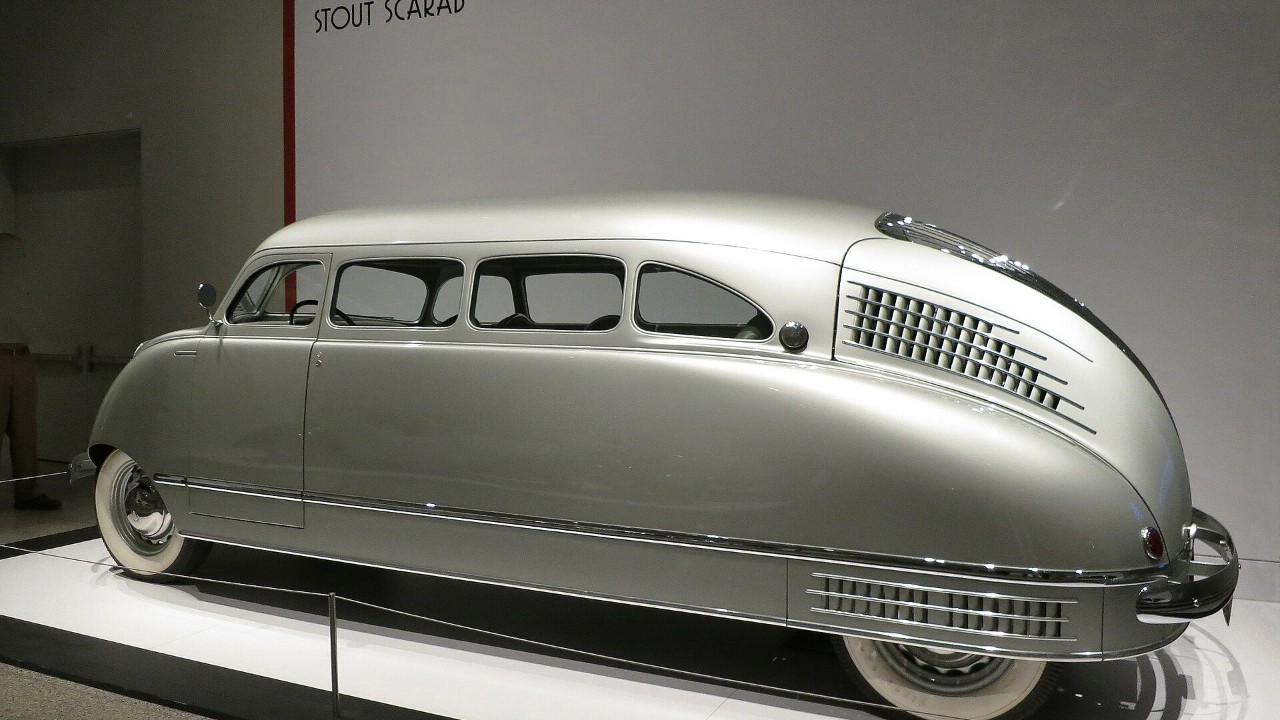
The Stout Scarab was a streamlined 1930s sedan with its Ford V8 in the back and a cabin built like a small lounge. Aircraft designer William Stout created it in Detroit, and the usual estimate is that his company built only nine. Inside, the driver’s seat stayed fixed while the passenger seats moved around, and a small card table could sit between them.
That layout looks familiar today. However, it arrived decades before family vans made a moving living room normal, and that is why the car still draws a crowd.
Even the production count comes with a caveat. In fact, the museum that owns two Scarabs has published two different numbers, so the exact total remains open.
Who built the Stout Scarab
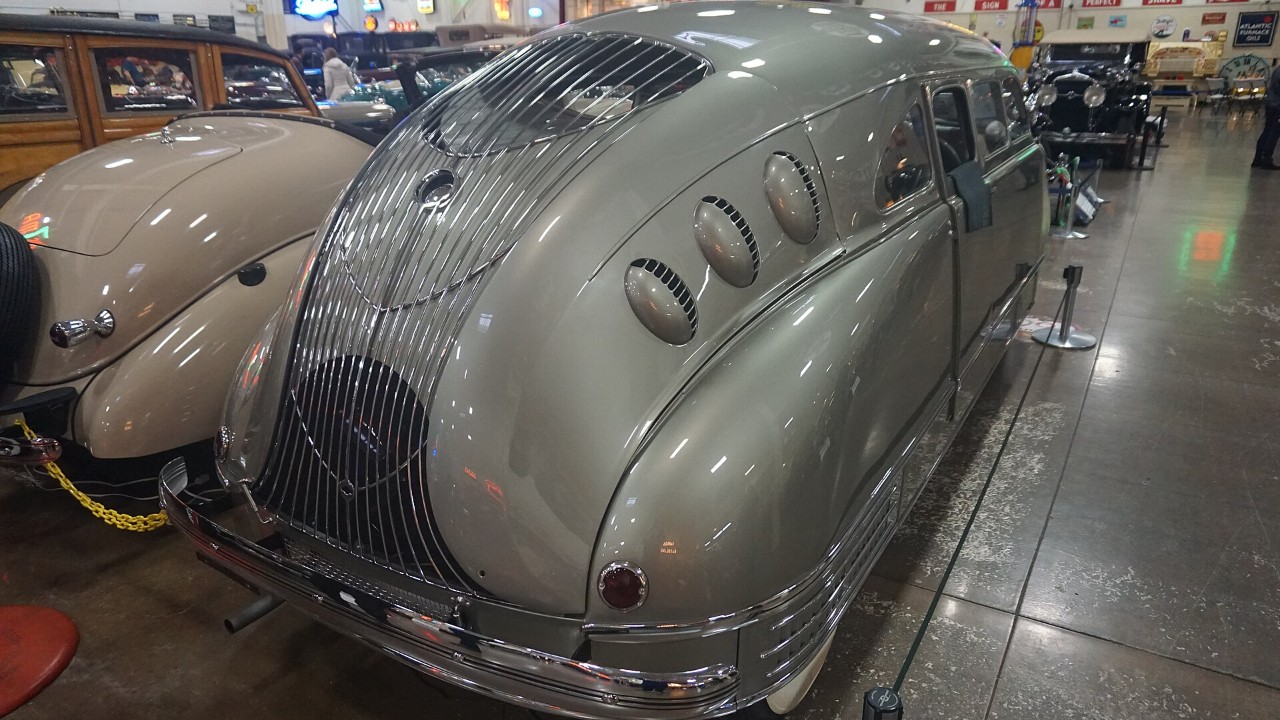
William Bushnell Stout came to cars from aviation. According to Prewarcar’s history of the Scarab, he developed the all-metal Ford Tri-Motor airplane in the 1920s. Later, the same history adds, members elected him president of the Society of Automotive Engineers in early 1935.
Stout built a first drivable prototype in 1932 and a second in 1935, according to Wikipedia’s entry on the car. Dutch engineer John Tjaarda styled the body. Prewarcar also dates the Scarab’s unveiling to 1935, a few months after the Chrysler Airflow.
Stout never meant to build it in volume. Instead, he planned up to 100 cars a year, sold by invitation only, as Wikipedia describes the plan.
A rear engine and aircraft thinking
The Detroit Historical Society’s fact sheet on its 1935 Scarab lists a Ford flathead V8 rated at 95 horsepower. That engine drove the rear wheels through a three-speed manual gearbox. Then the museum gives a top speed of 80 mph and a 0–60 mph time of 15 seconds.
Because the engine sat behind the passengers, the cabin had no driveshaft tunnel to work around. The fact sheet lists a 137-inch wheelbase, an overall length of 195.5 inches and a weight of 3,300 pounds. Meanwhile, Wikipedia notes independent coil springs at all four corners, plus a rear swing axle inspired by aircraft landing gear.
Stout clearly believed in the design. According to Wikipedia, he drove his own Scarab more than 250,000 miles around the United States.
Movable chairs and a card table
The Stout Scarab’s cabin is the reason people remember it. Prewarcar explains that only the driver’s seat stayed fixed to the floor in the usual spot. The other seats were movable chairs. At the rear, owners could move a wide sofa aside and pair it with a wall extension to form a full-length sleeping couch.
In addition, Wikipedia says owners could fit a small card table among the passenger seats as needed. Similarly, the Detroit Historical Society’s blog post on Philip Wrigley’s Scarab describes “a large bench, a table, and another movable chair” in the passenger area.
The comfort features went further than the furniture. For example, the museum’s fact sheet lists filtered air, ambient lighting, thermostat-controlled heating and power door locks.
Was it the first minivan?
The “first minivan” label follows the Scarab everywhere, but it is a description rather than a record. The Detroit Historical Society blog says the car is “sometimes called the ‘first minivan.’” Likewise, Wikipedia says it is “credited by some as the world’s first production minivan.”
However, the museum’s fact sheet is more careful. It says the long wheelbase and rear engine created a roomy interior “reminiscent of minivans developed a half-century later.” That is a fair way to put it, since nobody built Scarabs in anything like minivan numbers.
How many Stout Scarabs exist
The production figure is where the sources part ways. On one side, the Detroit Historical Society’s fact sheet counts nine built and five known to exist. Prewarcar also counts nine cars from 1935–36, and it says five survive.
By contrast, the same museum’s blog says “about seven scarabs were built (no one knows for sure how many)” and that six are known to survive. Wikipedia hedges: it uses the word “believed” for nine cars and reports that up to five survive. As a result, “about nine” is the most common answer, but not a settled one.
Even the price stood out in the 1930s. The museum’s fact sheet lists $5,190 in 1935. Prewarcar and Wikipedia give $5,000, while Wikipedia notes that a Chrysler Imperial Airflow cost $1,345.
What came after
Stout returned to the idea after World War II. According to Prewarcar, his later Project Y was one of the first automobiles built with a fiberglass-reinforced plastic body. The Detroit Historical Society’s fact sheet also mentions a fiberglass-bodied Scarab built after the war.
Some of the original cars went to wealthy backers. For instance, the museum’s blog says businessman Philip Wrigley was a prominent investor in Stout’s company. Today, two Scarabs sit in the Detroit Historical Society’s collection, including Wrigley’s personal car.
More from Fast Lane Only
- Unboxing the WWII Jeep in a Crate
- 15 rare Chevys collectors are quietly buying
- 10 underrated V8s still worth hunting down
- Police notice this before you even roll window down
This article was created with the help of AI and was reviewed and edited by Fast Lane Only editors before publication.