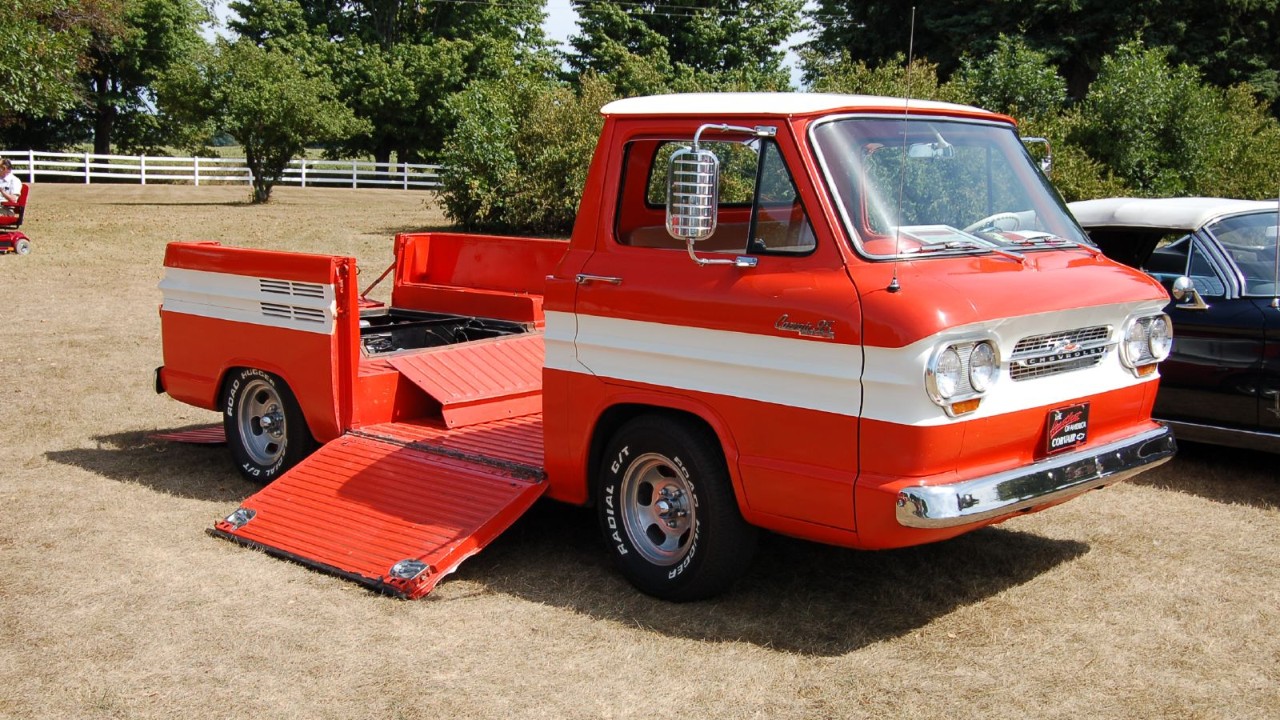
Chevrolet built 10,787 Corvair Rampside pickups for 1961, the truck’s first season. By 1964, the final year, output had fallen to 851. The Corvair Rampside was a small rear-engine pickup with a door in the side of its bed that dropped down to become a loading ramp. That one idea gave the truck its name, but it could not keep buyers coming back.
The Rampside belonged to the Corvair 95 family, Chevrolet’s vans and trucks built on the rear-engine Corvair. Like the Corvair car, it carried an air-cooled six-cylinder engine in the back. That layout put the driver right up front over the wheels. However, it also put a hump in the cargo floor.
Here is how the truck worked, what it could carry and how its production fell away in four model years. The figures come from Old Cars Weekly, Sports Car Market and other references linked below.
What the Corvair Rampside was
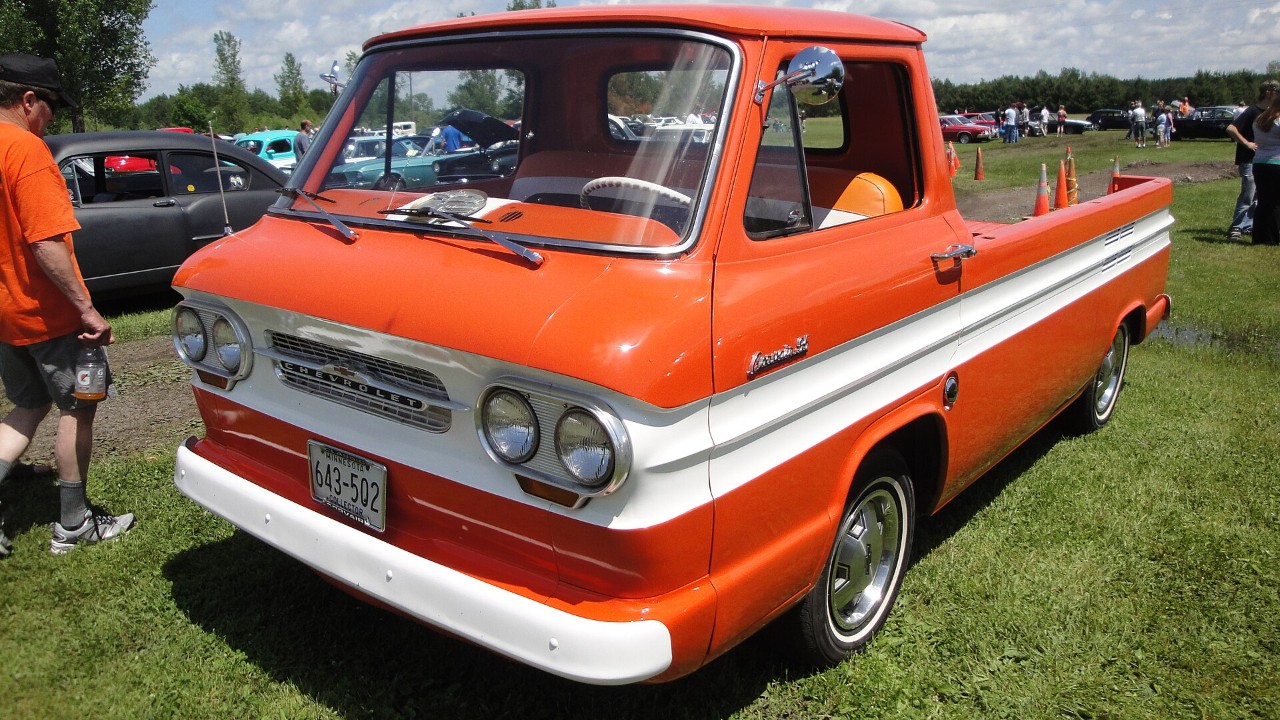
According to Old Cars Weekly’s Brian Earnest, the Corvair 95 line ran from 1961 to 1964. It included the Corvan panel van, the Greenbrier passenger van, the Loadside pickup and the Rampside. The 95 stood for the wheelbase in inches, which Earnest notes was 13 inches shorter than a Corvair sedan’s.
Power came from the rear, just as in the Corvair car. Old Cars Weekly lists a 144.8-cubic-inch air-cooled opposed six with two carburetors. A three-speed manual was standard, and a four-speed cost $71.10 extra. Mac’s Motor City Garage also describes the engine as a 145-cubic-inch air-cooled flat six.
Later, the engine grew for the last year. Wikipedia’s Corvair 95 entry, which cites Krause’s Standard Catalog of American Cars, puts the 1964 engine at 164 cubic inches. Silodrome likewise lists both a 2.4-liter and a 2.7-liter six for the series.
How the ramp worked
First, the ramp was a door in the right side of the bed. Old Cars Weekly describes it as hinged at the bottom, so it dropped down to form a ramp. A rubber shield covered its top edge to protect it once it was lowered.
In fact, the gate was built for weight. Mac’s Motor City Garage says it was double-walled, used a full-width hinge and was rated at 1,000 pounds. When opened, it swung down to the ground at a 22-degree angle. American Car Historian adds that the ramp was four feet wide and gave a loading height of just 14 inches.
Businesses noticed, too. Silodrome reports that Bell Telephone used Rampsides to handle cable drums. Meanwhile, a December 1961 Billboard Music Week story pitched the truck as ideal for a jukebox rental business, according to American Car Historian.
Otherwise, the truck was compact. Old Cars Weekly gives a 105-inch-long bed that measured 43 7/8 inches wide. The truck weighed 2,665 pounds, carried a 1,500-pound payload rating and had a 4,700-pound gross vehicle weight limit.
The Corvair Rampside production numbers
The first year was the big one. Old Cars Weekly and Sports Car Market both put 1961 Rampside production at 10,787. By comparison, Chevrolet built 15,806 Corvans and 2,475 Loadsides that year, Old Cars Weekly says.
Then demand dropped fast. Sports Car Market’s B. Mitchell Carlson writes that only 4,102 Rampsides were built for 1962. Silodrome gives the same 1962 figure. The Loadside fared worse, with 369 built for 1962, after which Chevrolet dropped it from the line.
The sources read for this story give no separate 1963 total. For 1964, though, Old Cars Weekly and Sports Car Market agree on 851 Rampsides. Old Cars Weekly also counts 8,147 Corvans for 1964. Across all four years, Sports Car Market puts Rampside production at 18,342.
Why buyers moved on
The rear engine was both the selling point and the problem. Because the drivetrain sat under the back of the bed, the cargo floor could not be flat. Mac’s Motor City Garage says a tall kickup over the rear axle cut cargo space and made loading from the back harder. It also calls the flat six busy and noisy next to a conventional Chevrolet pickup of the day.
Cost mattered too. Silodrome notes that the Corvair 95 cost more to buy and to run than the Volkswagen Type 2. Sports Car Market adds that GM built its six to compete with VW’s air-cooled four. Meanwhile, Silodrome says the vans proved more popular than the pickups.
In the end, Old Cars Weekly says, dwindling sales prompted GM to give up on the line. American Car Historian confirms the trucks were not produced after 1964. Chevrolet instead turned to a conventional forward-control Chevy Van for 1964, according to Wikipedia’s entry on the Corvair 95.
What a Corvair Rampside brings today
Even so, survivors do turn up for sale. Sports Car Market covered a restored 1962 Corvair Rampside offered as Lot 175 at Barrett-Jackson’s Scottsdale, Arizona, sale. On January 15, 2019, it sold for $77,000, including buyer’s premium.
More from Fast Lane Only
- Unboxing the WWII Jeep in a Crate
- 15 rare Chevys collectors are quietly buying
- 10 underrated V8s still worth hunting down
- Police notice this before you even roll window down
This article was created with the help of AI and was reviewed and edited by Fast Lane Only editors before publication.