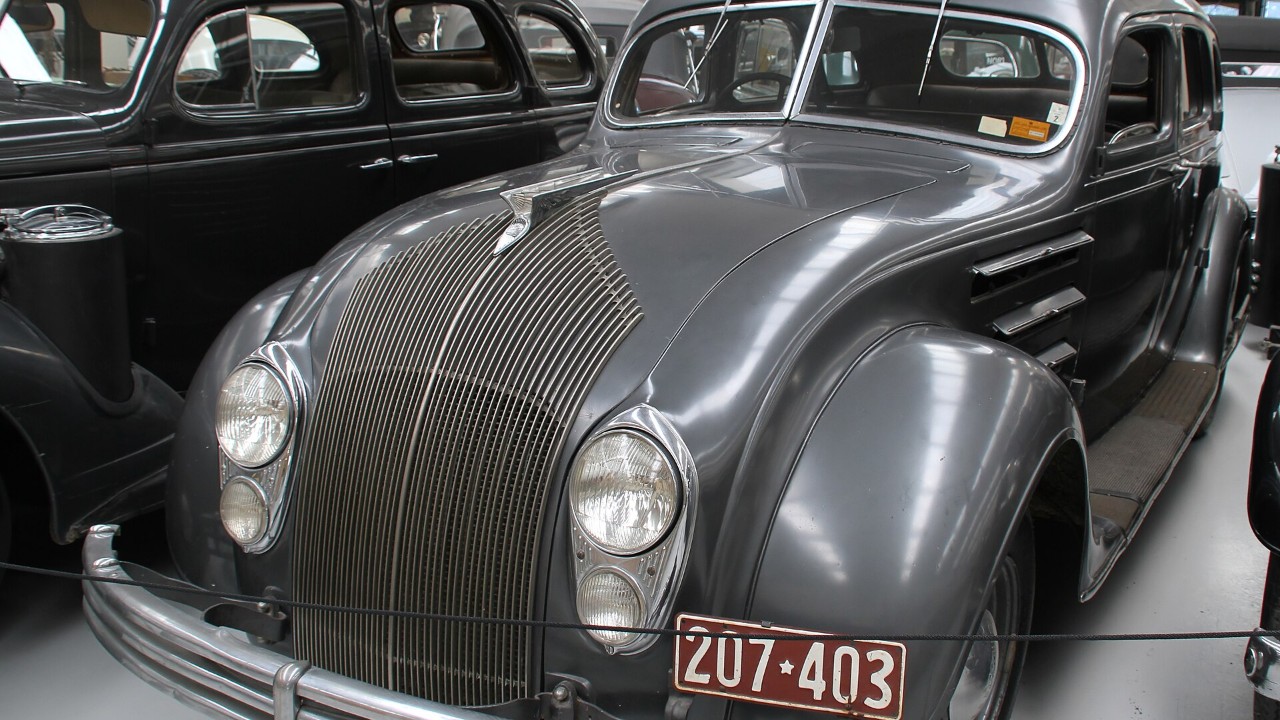
The 1934 Chrysler Airflow is best known for its rounded, wind-tunnel shape. However, its bigger idea sat under the skin. Chrysler moved the engine forward until it rode over the front axle, then slid every seat forward so the rear passengers sat between the axles instead of on top of the rear one.
That layout changed how the car rode, how it carried its weight and how much room it had inside. Most cars of the mid-1930s shared the same boxy two-box shape. The Airflow broke from it, and the buying public was not ready.
Here is what Chrysler’s engineers rearranged, why they did it and how the market answered.
Wind tunnels, scale models and Orville Wright
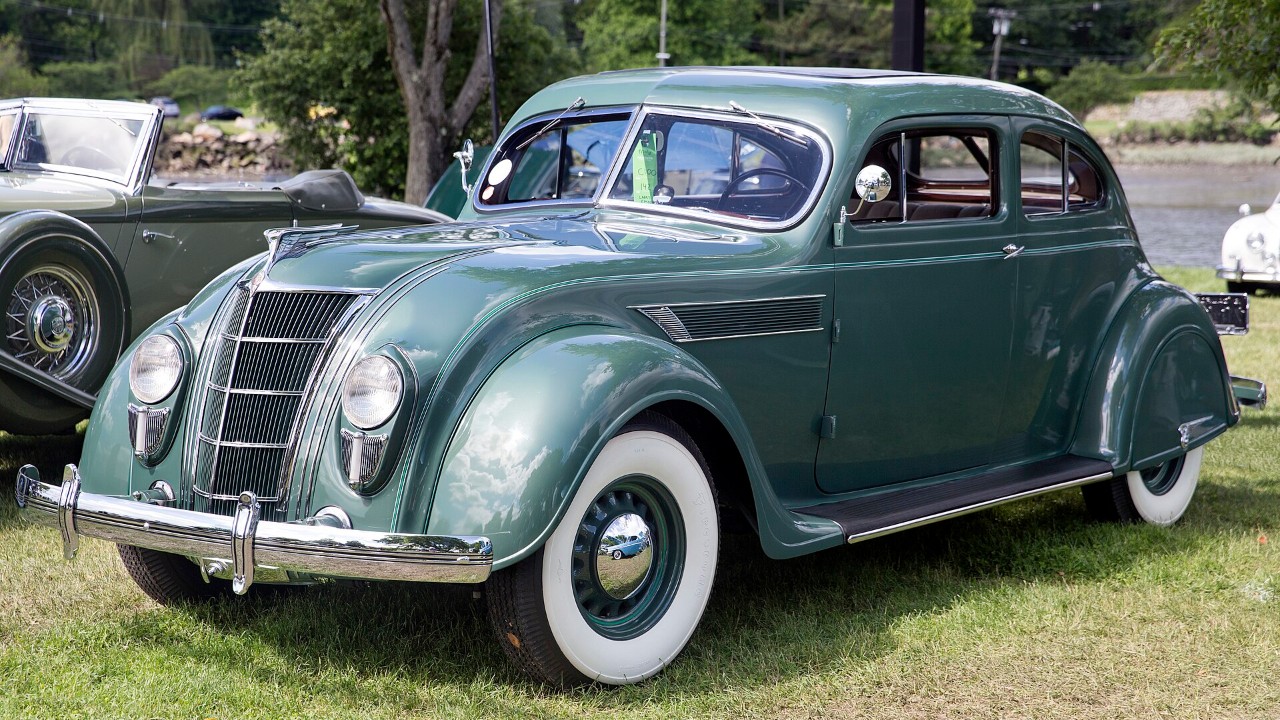
The project grew out of aerodynamics. According to PE Magazine from the National Society of Professional Engineers, Carl Breer of Chrysler Engineering proposed a streamlined car. He then ran wind-tunnel tests at Chrysler’s Highland Park site with Fred Zeder and Owen Skelton. By April 1930, the team had tested 50 scale models, with help from Orville Wright.
At first, the results surprised them. The Revs Institute says engineer William Earnshaw found ordinary cars so inefficient that, in theory, they could reach a higher top speed in reverse. As a result, a teardrop became the starting shape. Chrysler, in turn, needed a new layout to fill that teardrop with people.
Why the Chrysler Airflow moved its engine forward
The first working prototype did not even put the engine up front. Revs says it was rear-engined and rear-drive, and engineers dropped it because it was too complex and looked awkward. So the production car went back to a front engine driving the rear wheels.
The difference was where that engine sat. Over the course of development, Chrysler moved it 18 inches forward from the original design, according to Revs, until it sat directly above the front axle. The Audrain Automobile Museum describes the same move: the engine went forward over the front wheels to improve balance.
Moving the engine freed space behind it. Revs notes that the change let designers lower the passenger compartment by several inches. That, in turn, helped the center of gravity, the handling and getting in and out.
Passengers inside the wheelbase
Next, Chrysler moved the people. The Audrain museum explains that every seating position shifted forward. As a result, rear passengers sat between the axles, not on top of the rear axle.
That mattered because a passenger over an axle feels every bump the wheel hits. By contrast, a passenger closer to the middle of the car rides through less of the motion. Revs says seating occupants within the wheelbase improved ride quality and comfort. For that reason, Chrysler called it the “floating ride.”
The new layout also opened up the cabin. According to Revs, the Airflow could seat three adults side by side in both the front and the back. Other features, Revs adds, included automatic overdrive and raked safety-glass windows.
The weight numbers
Weight distribution tells the rest of the story. The Audrain museum says a typical two-box car of the time carried about 65% of its weight over the rear wheels, and passengers made that worse. In contrast, the Airflow’s layout put 54% of its weight on the front and 46% on the rear. With passengers aboard, the museum says, the balance evened out to about 50-50.
Beyond the seating, the structure changed as well. Revs describes a unitized cage around the passenger compartment, bolted to a cross-membered steel frame. Revs credits that hybrid design with roughly four times the torsional rigidity of rival cars. PE Magazine adds that the car was wood-free and built around a steel cage, unlike other cars of the 1930s.
Proving it, and selling it
Chrysler worked hard to prove the car’s toughness. In August 1934, Harry Hartz drove a stock Airflow to 72 production-car records, according to Revs. Those included a flying mile at 95.7 mph and a 2,000-mile run averaging 74.7 mph. A newsreel also showed an Airflow surviving a push off a 110-foot cliff.
Buyers stayed away anyway. Revs says Chrysler rushed production a year early and had to re-engineer its lines for the new body and frame. Early cars had problems, too: PE Magazine reports that faulty manufacturing let some engines come loose from their mounts at 80 mph. Meanwhile, General Motors ran advertising that cast the Airflow as unsafe.
The sales figures were blunt. Chrysler expected 35,000 cars a year, but Revs says sales peaked in the first year at under 12,000. PE Magazine reports that Chrysler’s traditional models outsold the Airflow 2.5 to 1. By 1937, Revs says, Airflow sales had fallen to just over 4,500, and Chrysler dropped the model.
Where to see one
The engineering outlived the car. Time magazine called the Airflow a commercial flop, PE Magazine notes, but it also called Chrysler’s wind-tunnel work visionary. The Audrain museum adds that Volvo and Toyota both built early cars that borrowed from the Airflow’s design.
Today, two museums show the layout up close. The Audrain displays a 1935 Airflow Imperial C-2 Coupe, which it says is one of 10 known survivors of about 200 built. Finally, the Revs Institute shows a 1934 Chrysler Airflow Imperial CV Coupe, one of 212 built that year and the first car Revs ever bought for its collection.
More from Fast Lane Only
- Unboxing the WWII Jeep in a Crate
- 15 rare Chevys collectors are quietly buying
- 10 underrated V8s still worth hunting down
- Police notice this before you even roll window down
This article was created with the help of AI and was reviewed and edited by Fast Lane Only editors before publication.