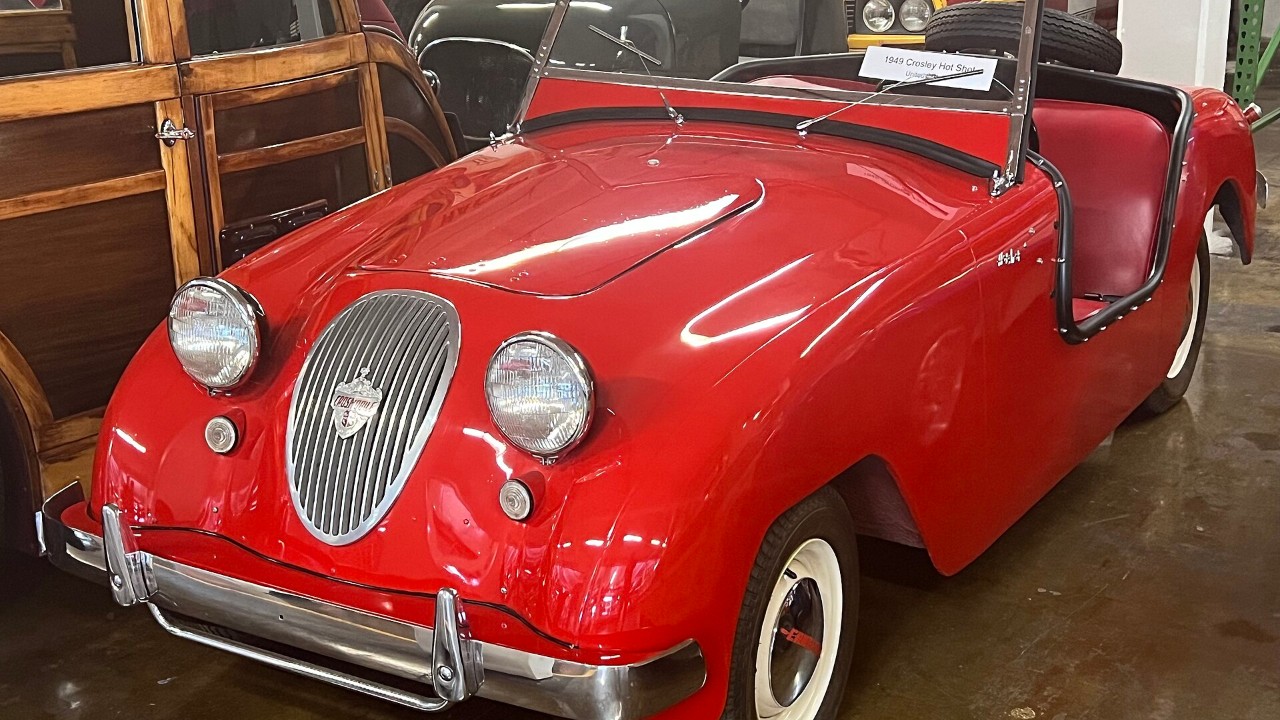
In 1949, a tiny Crosley sports car rolled out with disc brakes at all four wheels. A year later, those Crosley Hotshot disc brakes were gone. Road salt had attacked the calipers, and Crosley went back to drums.
It is a short story with a long tail. Disc brakes later became normal on almost every car.
Crosley got there early, then learned the hard way what winter roads do to exposed hardware.
A small car with a big idea
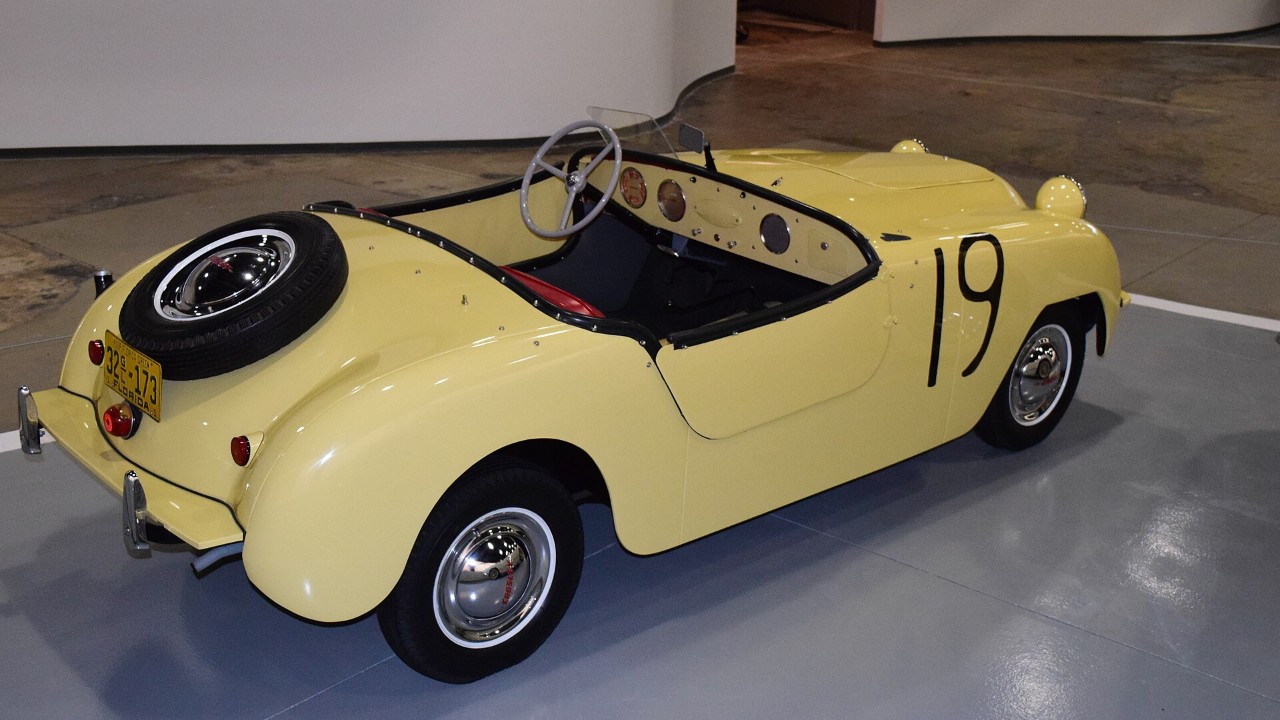
The Hotshot arrived in July 1949, according to Curbside Classic. It shipped at under 1,200 pounds. Meanwhile, the Lane Motor Museum says it rode on an 85-inch wheelbase and started at $849.
Power came from a 44-cubic-inch four. The Lane museum rates its cast-iron CIBA engine at 26.5 horsepower. That engine replaced the copper-brazed COBRA four that Crosley had used since 1946. Export cars, the Lane museum adds, wore Crosmobile badges to avoid a clash with England’s Crossley Motors.
The brakes were the real surprise, though. Curbside Classic says the “Hydradisc” setup became standard on every Crosley from May 15, 1949. In other words, the discs went on sale about six weeks before the Hotshot itself.
How the Crosley Hotshot disc brakes worked
Curbside Classic credits the design to Jesse G. Hawley of the Hawley Brake Corporation in Corning, New York. Each wheel used a 7.5-inch cast-iron rotor. A single-piston floating caliper squeezed two 1.25-inch pads against it.
The system replaced small mechanical drums of just 6 inches, per the same source. In addition, each piston could work hydraulically or mechanically. As a result, the handbrake applied all four brakes, not just the rear pair.
Adjustment was simple. Curbside says owners tightened a single screw until the wheel locked and then backed it off four clicks. Crosley claimed that job was needed only once a year in normal driving.
The origin story depends on who tells it. The Lane museum describes the brakes as an adaptation of Goodyear-Hawley aircraft brakes. Curbside Classic, by contrast, calls the repurposed-aircraft story untrue. It notes Hawley had licensed his disc designs to Goodyear for landing gear, which may explain the mix-up.
A name, a patent and every model
Even the name has a paper trail. Curbside Classic says “Hydradisc” came from copywriter Mary Ann Kelly at the Ralph H. Jones Co., Crosley’s ad agency. Hawley, meanwhile, had been working on car discs since at least 1943 and tried a prototype on his own 1941 Ford coupe.
His patent came later. According to Curbside, it was issued on October 21, 1952, and assigned to the Hawley Brake Corporation, not to Goodyear.
The discs also were not a Hotshot exclusive. Curbside says every Crosley model got them for about a year, including the Farm-O-Road utility vehicle. By comparison, MG roadsters of the day still used drums, the site notes.
What road salt did to them
On dry roads, the brakes worked. The Lane museum says they had strong stopping power. However, on salted northern roads in winter, “the alloy parts corroded and locked up,” the museum explains.
Curbside Classic traces the weakness to the caliper. There was a dust cover at the back but no splash shield over it. Because of that gap, salty water could reach the moving parts and corrosion could seize them.
Crosley had argued otherwise. According to Curbside, the company claimed spinning rotors and pad friction would keep water, snow and mud away. Salt, though, was a different matter. A Crosley distributor, Ed Herzog, later said rubber shields would have prevented most of the trouble. Still, Powel Crosley chose not to revise the design, Curbside reports.
Drums return in 1950
The experiment ended within about a year. Curbside Classic says Crosley dropped the Hydradisc after May 1950 and fitted conventional 9-inch Bendix drums. Likewise, the Lane museum dates the switch to 9-inch Bendix hydraulic brakes to mid-1950.
Curbside estimates that about 7,400 Crosleys left the factory with the discs. It also says 9,250 complete sets went unused. Hawley then sued Crosley for breach of contract, and the case settled out of court in 1951.
Crosley was not alone in trying discs that year. Chrysler’s 1949 Crown Imperial also had four-wheel discs, Curbside notes, though of a very different type.
The Hotshot kept winning anyway
The brake change did not end the Hotshot’s racing story. On December 31, 1950, a Hotshot driven by Frits Koster and Ralph Deshon won the first race at Sebring, Florida, according to the Crosley Automobile Club. That six-hour event used an Index of Performance, which gave smaller cars a shorter distance to cover.
The Lane museum also records the win at the inaugural Sam Collier Memorial race. In fact, the museum says Hotshots dominated 750cc H-modified racing and won 10 of 12 SCCA West Coast races.
The car’s run was brief. Powel Crosley sold Crosley Motors to General Tire and Rubber in 1952, and car production ended, Curbside says. By then, the Lane Motor Museum counts 2,498 Hotshot, Super Hotshot and Super Sports models built from 1949 to 1952.
More from Fast Lane Only
- Unboxing the WWII Jeep in a Crate
- 15 rare Chevys collectors are quietly buying
- 10 underrated V8s still worth hunting down
- Police notice this before you even roll window down
This article was created with the help of AI and was reviewed and edited by Fast Lane Only editors before publication.