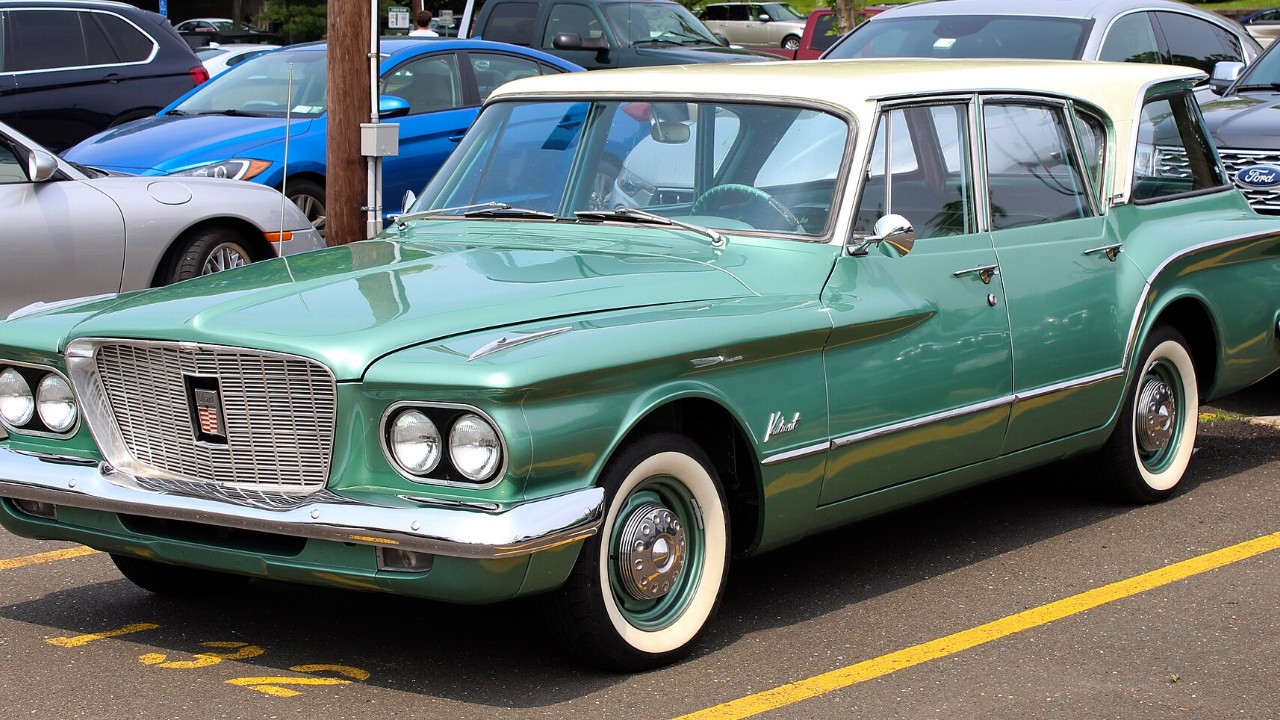
The Chrysler slant six arrived for 1960 with its cylinders tipped 30 degrees off vertical. That lean looks odd the first time you open the hood of a Valiant, and it was no styling gimmick. Chrysler’s engineers tilted the block to solve real packaging problems in a new compact car.
The company needed a new six in the late 1950s. Its old inline six was an L-head design, with the valves in the block instead of the head. By then that layout was heavy, bulky and short on power. A compact car could not carry it well.
So Chrysler started fresh. The result was an overhead-valve inline six that leaned over on its side, and it went on to power Chrysler Corporation cars and trucks for decades.
Why Chrysler needed a new six for the Valiant

According to Mac’s Motor City Garage, Chrysler’s existing sixes were “antique L-head designs that dated back to well before World War II.” The site calls the old engine “overweight, bulky, and inefficient” and “totally unsuited for the all-new Valiant.” In other words, the new compact needed a new engine to match.
The history at Motales makes the same point. It says the aging flathead six suffered from “low power and mileage” by the mid-1950s. That account also gives the timeline. Management approved the project on April 16, 1958, and the first engine ran on the dyno in the final days of November 1958.
The schedule was tight, too. Motales says the goal was production by August 1959, which left less than two years to develop the engine fully. As a result, the engine reached buyers in the 1960 models.
Who designed the Chrysler slant six
Credit for the engine is shared, and the two main sources frame it a little differently. Mac’s names Willem Weertman, then Chrysler’s manager of engine design, as lead engineer on the project. By contrast, Motales says Robert S. Rarey was the natural choice to lead the six-cylinder project, working with Weertman.
Motales credits the tilt itself to two other men. Fred Rose was the lead designer, and Ray Latham was the design supervisor. Their idea was to move the water pump from the front of the engine to its side and tip the engine over by 30 degrees.
The engine also carried more than one name early on. Mac’s says Plymouth first branded it the 30-D, a reference to the cylinder bank angle. Meanwhile, Motales says the engine was coded G internally, with an LG (low stroke) and an RG (raised stroke) version.
The four reasons for the 30-degree lean
The clearest list of reasons comes from Robert Sinclair, the Valiant program chief, as quoted by Motales. First, moving the water pump to the side cut the engine’s length, and therefore the car’s length. Second, the lean made room for a more efficient long-branch intake manifold.
Third, the hood could sit lower. Finally, the center of gravity could come down. Each of those benefits mattered in a small car that Chrysler wanted to look low and modern.
Mac’s puts numbers and context on two of them. With the cylinders laid over 30 degrees, the water pump could sit alongside the block instead of in front. That shortened the engine’s footprint by “a good four inches,” the site says. It adds that the lean allowed “a significantly lower cowl and hood height, a key element in the Valiant’s distinctive styling.”
Another engineer saw service benefits, too. Motales quotes Ed Guyer, who believed the tilt would provide more space for the suspension and alternator. He also thought it would make the distributor easier to reach.
Long intake runners and the “bunch of bananas”
The intake side was where the lean paid off for performance. Mac’s says the canted block made room for long, straight intake runners for better fuel and air distribution. That distribution, it notes, was “a traditional trouble spot in inline-six layouts.”
The manifold that used this space got a nickname. Motales says John Hurst developed the “bunch of bananas” intake, which John Platner and Don Moore later refined. Because the intake and exhaust ports sat on the same side of the head, exhaust heat warmed the intake floor. That made warm-up faster.
The basic layout lasted, too. Motales cites Daniel Stern, who noted that the exhaust manifolds stayed interchangeable from 1960 to 1986, despite later strengthening changes.
Chrysler slant six displacements and power
Two sizes launched the engine in 1960. Mac’s lists the 170-cubic-inch version, with a 3.40-inch bore and 3.125-inch stroke, at 101 horsepower at 4,400 rpm. The larger 225 used a 4.125-inch stroke and made 145 horsepower at 4,000 rpm in 1960, the site says.
There was also a hotter option in the first year. According to Motales, the dealer-installed 1960 Hyper-Pak added a four-barrel carburetor and a hot cam. It rated the 225 at 196 brake horsepower and the 170 at 148 brake horsepower.
Chrysler also tried a lighter block early on. Mac’s says that between 1961 and 1963, Chrysler produced more than 50,000 slant six engines with a die-cast aluminum block. However, Motales notes the company kept the iron block as a backup plan. In the end, iron won because it was faster and cheaper to make.
How long the slant six stayed in production
The engine outlived the car it was designed for by a long way. According to Mac’s, the slant six stayed in Chrysler passenger cars until 1983. It kept going in trucks until 1987.
Industrial versions lasted longer still. Mac’s records that Chrysler discontinued the industrial slant six in 1991, 31 years after the 30-degree engine first appeared in the 1960 Valiant.
More from Fast Lane Only
- Unboxing the WWII Jeep in a Crate
- 15 rare Chevys collectors are quietly buying
- 10 underrated V8s still worth hunting down
- Police notice this before you even roll window down
This article was created with the help of AI and was reviewed and edited by Fast Lane Only editors before publication.