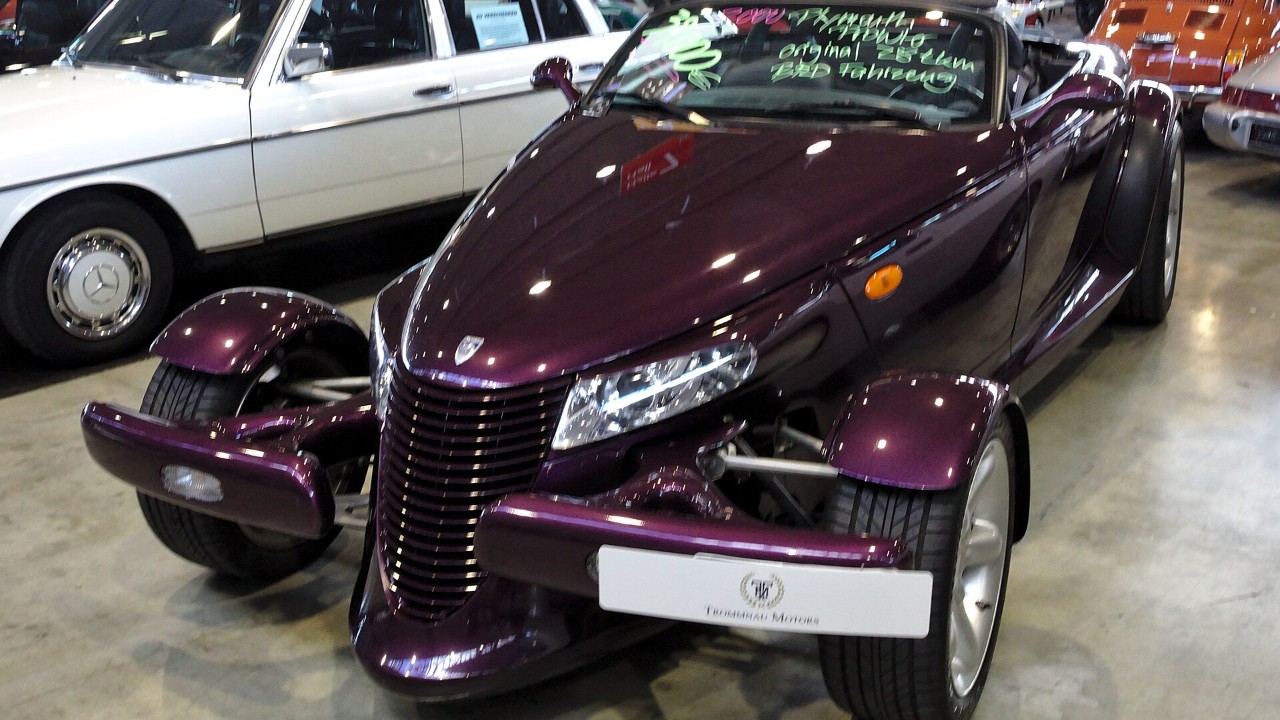
The Plymouth Prowler started as a purple show car at the Detroit auto show in January 1993. Chrysler then did something few carmakers do with a hot rod sketch. It built one for sale, with an aluminum frame, and kept building it through 2002.
In the end, 11,702 Prowlers left a small Detroit plant. That makes it a rare case of a factory hot rod that buyers could order from a dealer. It also served as a test bed for a material Chrysler barely knew how to use at the time.
Here is how a studio brainstorm became a production car, what it had under that long nose, and why the last ones wore a different badge.
How the Plymouth Prowler started at Pacifica
The idea came out of Chrysler’s Pacifica design studio in Carlsbad, California, around 1990 and 1991. According to Hagerty’s history of the car, an intern named Emile Bouret suggested a hot rod during a brainstorming session. Designer Kevin Verduyn had already pinned hot rod sketches to his studio wall. “We had hundreds of ideas, all kinds of crazy stuff,” Verduyn told Hagerty.
Then the executives walked through. Design chief Tom Gale, president Bob Lutz and engineering chief François Castaing all liked what they saw, Hagerty reports. Gale, in fact, was sketching a hot rod of his own at the time. The clay model took about a year, and the team debated how close the shape should sit to the 1932 Ford.
Credit for the look has more than one name attached. The Shively Motors Mopar Museum says the design drew on Chip Foose’s thesis work, which featured 1930s-style hot rods. Hagerty, by contrast, tells the story through Verduyn and the Pacifica studio.
From show car to showroom
A show car is cheap to build once. A production car is not, so the business case mattered. Hagerty says engineering vice president Craig Love led the team that turned the concept into something Chrysler could build. Lutz, meanwhile, kept the budget small by insisting on parts Chrysler already made.
Chief executive Bob Eaton gave the final go-ahead. He also drove the production car onto the stage at the 1996 Detroit show, according to Hagerty. Sales began with the 1997 model year at a price of $38,300.
The paint was part of the story too. At launch, the Prowler came only in metallic purple. Hagerty reports that the shade was first developed for Gale’s personal hot rod, though he never used it on that car. Later model years added more colors.
Why the Prowler went aluminum
Underneath, the Prowler was a research project as much as a hot rod. “We really didn’t have much experience with forming and stamping aluminum,” Gale told Hagerty. As a result, Chrysler decided to make the car “a research project for creating a new kind of aluminum car.”
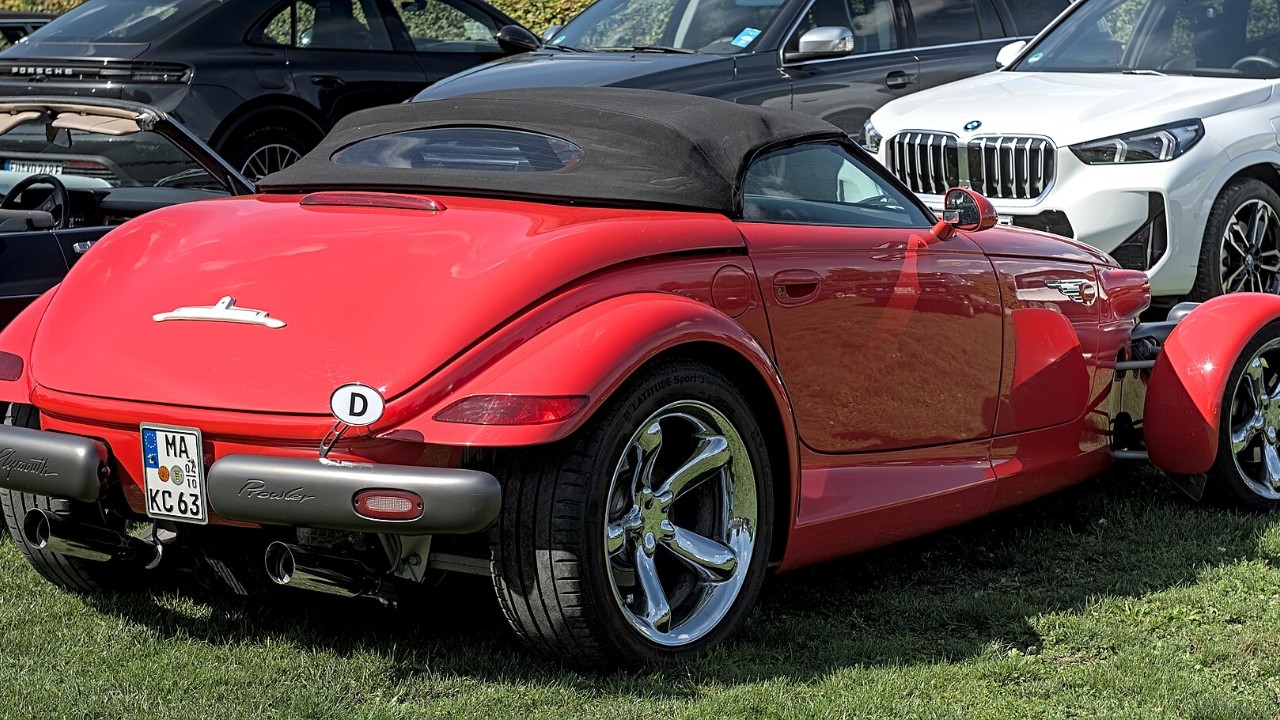
The frame used a complex series of aluminum extrusions, and the body used aluminum parts as well. That is why it is fair to call the Prowler aluminum-framed. Calling it all-aluminum, however, goes further than the sources do. Hagerty puts the weight at 2,800 pounds, and TFL Car gives the same figure.
The chassis also carried fully independent front and rear suspension, TFL notes. Hagerty describes it as an “Indy-car suspension.” Either way, the exposed front wheels showed it off.
The Plymouth Prowler V6 and its numbers
There was no V8. Instead, the Prowler borrowed a 3.5-liter, 24-valve overhead-cam V6 from Chrysler’s LH sedans, Hagerty says. In 1997 it made 214 horsepower and 221 pound-feet of torque. A four-speed automatic sent that power to the rear wheels.
That gearbox sat at the back of the car. TFL describes it as a rear-mounted automatic with a manual-shift mode, and both TFL and the Shively museum say no manual was offered. Hagerty lists a 0-to-60 mph time of seven seconds and a top speed of 117 mph.
Then came a gap. TFL reports that Plymouth skipped the 1998 model year entirely. When the car returned for 1999, it had an all-aluminum V6 rated at 253 horsepower, along with a small weight cut. TFL says that rating held through 2002, and the Shively museum also lists 253 horsepower for its 2001 car.
Practicality was another matter. Hagerty notes a 12-gallon fuel tank and about 25 mpg. The Shively museum adds that the car had no trunk at all. For that reason, Chrysler offered a matching trailer, and the museum puts its price at $5,000. TFL counts 1,367 factory trailers.
Built in Detroit, finished as a Chrysler
Every Prowler came out of the Conner Avenue assembly plant in Detroit. The Shively museum notes that the same plant built the Dodge Viper. Hagerty adds that Verduyn and Love drove the first production car off the line.
The badge changed before the car did. Chrysler dropped the Plymouth brand in 2001, and the Prowler became a Chrysler model, according to Hagerty. The Shively museum identifies the 2001 model year as the switch from Plymouth to Chrysler branding.
Production ended in 2002. By then, Chrysler had built 11,702 Prowlers, a total Hagerty, TFL and the Shively museum all report. TFL also counts 457 cars for the first 1997 season.
Where to see a Plymouth Prowler today
Values follow the odometer. Back in 2012, TFL found that cars with around 50,000 miles sat in the $25,000 range. At the same time, low-mileage examples brought around $40,000. TFL’s rarest colors were High Voltage Blue, Woodward, Black Tie and Chrysler Orange.
One low-mileage car now sits in a museum. The Shively Motors Mopar Museum in Shippensburg, Pennsylvania, displays a 2001 Plymouth Prowler with only 7,000 miles. Its owner traded it to Shively Motors on a new Jeep in 2023, and the museum calls it one of the final Plymouth-badged cars built.
More from Fast Lane Only
- Unboxing the WWII Jeep in a Crate
- 15 rare Chevys collectors are quietly buying
- 10 underrated V8s still worth hunting down
- Police notice this before you even roll window down
This article was created with the help of AI and was reviewed and edited by Fast Lane Only editors before publication.