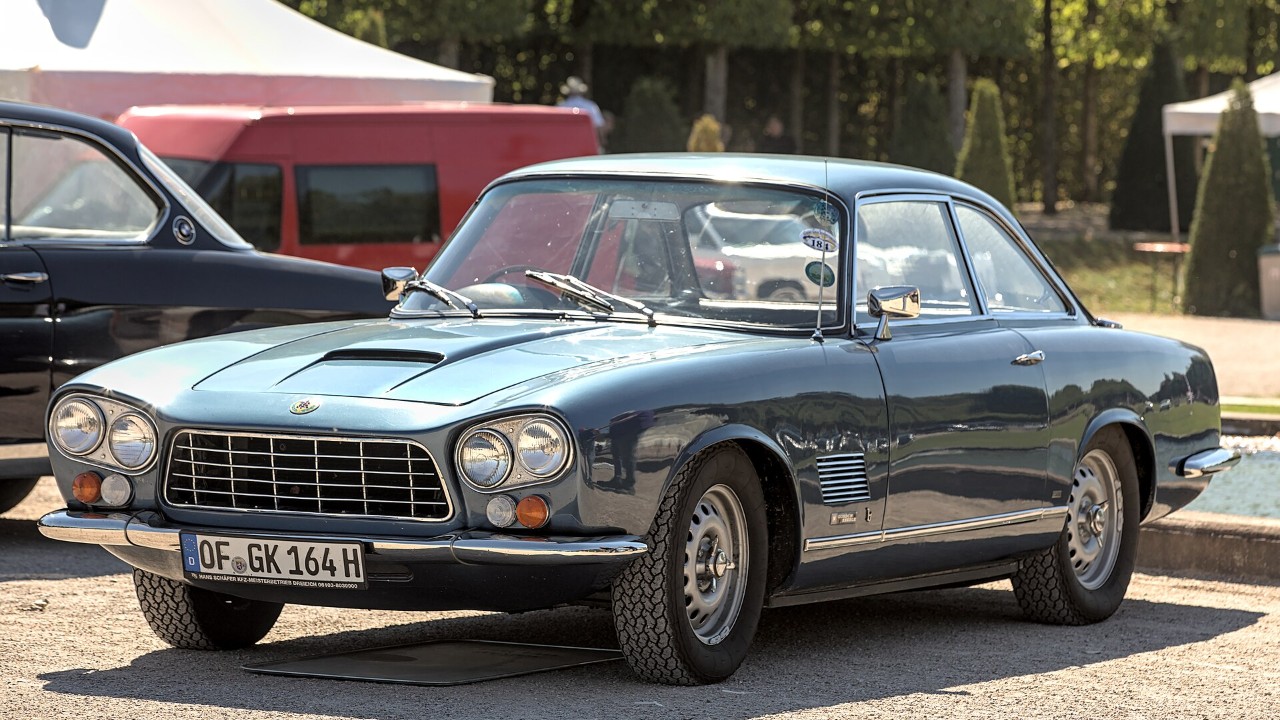
The Gordon-Keeble GK1 was a British grand tourer with an Italian-designed body and an American heart. Its makers built 99 of them in the mid-1960s, each powered by a 300-horsepower Chevrolet V8. Later, a 100th car came together from leftover parts.
That small number hides a busy story. Two company failures, a famous Spitfire hangar and a tortoise badge all belong to it.
It also corrects a common shortcut. The production cars carried a Chevrolet 327, not a Corvette engine, although a Corvette V8 did power the prototype.
Where the Gordon-Keeble GK1 began
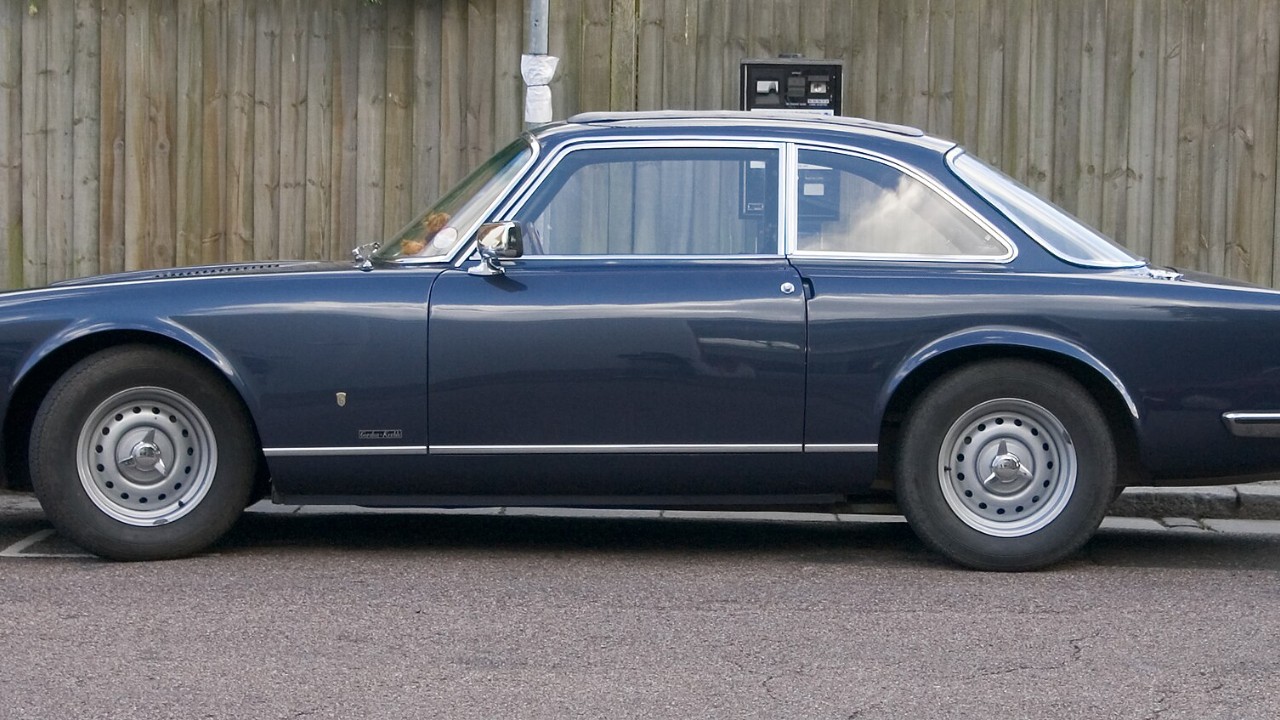
John Gordon and racing driver Jim Keeble met in 1959 and formed a company to build the car, according to Hagerty’s history of the Gordon-Keeble. Their Gordon GT appeared at the 1960 Geneva Motor Show. Hagerty notes that Giorgetto Giugiaro designed it at 21, in his first job at Bertone.
That 1960 prototype used a 283-cubic-inch Chevrolet Corvette V8, Hagerty says. However, the production cars switched to a larger engine, and that difference matters for anyone describing the GK1 today.
The 300-hp Chevrolet V8
Hagerty lists the production engine as a 327-cubic-inch Chevrolet V8 rated at 300 horsepower. Wikipedia’s Gordon-Keeble entry gives the same 327 and 300 hp. Meanwhile, the Gordon-Keeble Owners’ Club history describes a Chevrolet V8 with 300 bhp and 360 lb-ft of torque.
The club says a Warner T-10 four-speed manual gearbox sat behind it. Hagerty adds Dunlop disc brakes and handmade square-tube frames. As for pace, Hagerty reports 0–60 mph in under six seconds and a top speed near 140 mph, and the club also gives 140 mph.
Hagerty also gives a 15.6-second quarter mile and fuel economy of 16 to 20 mpg.
Glass fibre and a Spitfire hangar
Production Gordon-Keeble GK1 bodies were glass fibre rather than steel. According to the owners’ club, that choice avoided the high cost of press tooling. Hagerty and Wikipedia both name Williams & Pritchard as the first body supplier, and Wikipedia says the work later moved in-house. Underneath, Hagerty says, the handmade frames were insulated with injected foam rubber.
The club also records where it happened. Production began at Eastleigh aerodrome, now Southampton Airport, in the same building where the first Supermarine Spitfire was prepared for its 1936 maiden flight.
Then there is the badge. The club says a tortoise was placed where the badge would sit during an early photo shoot. Similarly, Wikipedia says a tortoise wandered into the frame, and the company adopted it because of the irony of its slowness. Hagerty describes the finished emblem as a tortoise surrounded by laurel leaves.
Two failures and 99 cars
The business side went badly. Wikipedia lists a price of £2,798 and calls it unrealistically low. Hagerty says the company failed in 1965 because of supplier strikes and those low prices.
The owners’ club puts the first liquidation in May 1965, after about 82 cars. A London-based concessionaire then refinanced the firm, but it failed again in less than 12 months, the club says. Before that, it finished 11 part-built cars and built six more from scratch, bringing the club’s total to 99.
Wikipedia names the buyers as Harold Smith and Geoffrey West, who ran it as Keeble Cars Ltd. By then, John Gordon had left the company, and the club says he took the rights to the Gordon GT stag’s-head badge with him. Hagerty likewise counts 99 GK1s from a 1964–1967 production run.
The 100th car and the survivors
The story did not end at 99. According to the owners’ club, a North London garage later assembled car number 100 from leftover parts. Hagerty and Wikipedia also describe a final car built from spares, although the sources give different dates for it.
The cars have held up well. The owners’ club, founded in 1970 by Ernie Knott, says all but 10 cars survive today. By comparison, Wikipedia cites the club’s claim that over 90 remain, while Hagerty says 95 of the 100 are known to the club.
Owners also gather them in numbers. For example, Hagerty reports that the 2004 40th-anniversary event drew 40 surviving cars.
So about 90 of the 100 Gordon-Keeble GK1 cars survive. The owners’ club says at least 70 of them are still in use, and 27 of those live overseas.
More from Fast Lane Only
- Unboxing the WWII Jeep in a Crate
- 15 rare Chevys collectors are quietly buying
- 10 underrated V8s still worth hunting down
- Police notice this before you even roll window down
This article was created with the help of AI and was reviewed and edited by Fast Lane Only editors before publication.