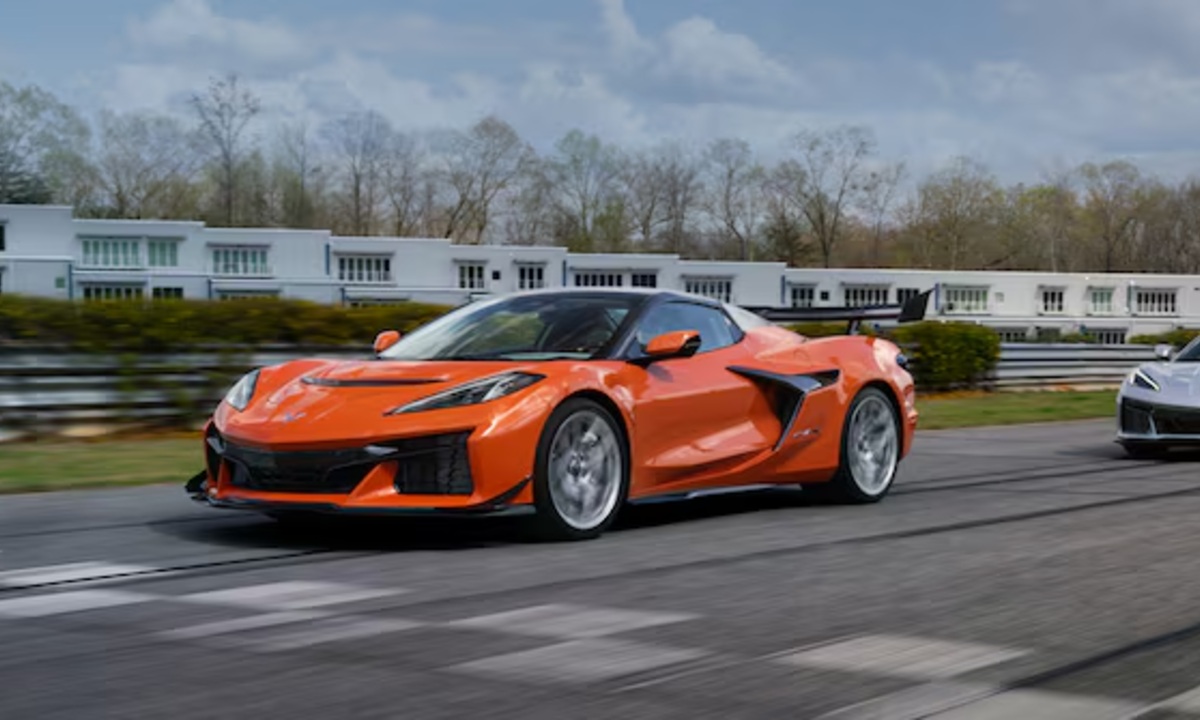
The Corvette ZR1X has not only rewritten the American performance playbook, it has forced a global rethink of what a quarter‑mile record looks like for a road‑legal car. With an officially recorded 8.675‑Second ¼‑Mile and a sub 2 Second 0‑60, the factory‑backed Chevrolet hypercar has entered territory once reserved for multimillion‑dollar exotics, while carrying a price tag that keeps it within sight of dedicated enthusiasts.
Although the headline spectacle has been framed as the ZR1X “smoking” the Koenigsegg Jesko in a drag‑strip showdown, that specific comparison is unverified based on available sources. What is documented is that the Corvette’s 8.675‑Second pass and near‑instant launch capability place it directly in the conversation with the quickest production cars in the world, including the Jesko, whose own quarter‑mile and 0‑400‑0 km/h benchmarks have set the standard for modern hypercars.
A quarter‑mile that resets expectations
The core of the ZR1X story is simple: a production Corvette has run the quarter‑mile in 8.675‑Second, with Chevrolet describinImage credit: Chevrolet g it as America’s Quickest Production Car and confirming that the run was achieved on a prepped drag‑strip surface with electrified all‑wheel drive putting power to the ground. That elapsed time, paired with a sub 2 Second 0‑60, moves the car into a realm that, until now, belonged to boutique manufacturers and heavily modified builds rather than something that rolls out of a major automaker’s factory with a warranty. The official specification sheet also lists an Avail. 0 to 60 time of 1.89 seconds and an Avail. quarter‑mile of 8.99 seconds, underscoring that the headline 8.675‑Second pass represents the sharp edge of what the platform can deliver in ideal conditions.
Context makes that number even more striking. Over decades, the Corvette’s own quarter‑mile progression has been incremental, with each generation shaving tenths rather than entire seconds, yet What General Motors captured at US 131 M Motorsports Park in Michigan has been described as a Moment That Redefines Corvette Speed. The ZR1X did not simply edge past its predecessors, it vaulted into a performance class where 1.75G of acceleration force and a launch that feels closer to a top‑fuel car than a traditional sports coupe are now part of the production‑car experience. That leap is why the car is being framed as America’s Quickest Production Car and why its 8.675‑Second Mile run is already being treated as a reference point for future benchmarks.
How Chevrolet engineered an American hypercar
Numbers on a timing slip are only part of the story, because the ZR1X represents a deliberate attempt by Chevrolet to build an American hypercar rather than a traditional front‑engine grand tourer. Earlier announcements described Chevrolet introducing an all‑wheel drive Corvette worthy of the hypercar label, with an electrified system that routes power to all four wheels and a trap speed over 150 mph in quarter‑mile testing. The production specification confirms that the Corvette ZR1X delivers 1,250 Combined horsepower, pairing a twin‑turbo V8 with an electric drive system, and that it is Starting at $209,700, a figure that undercuts many European exotics that cannot match its straight‑line pace.
Technical breakdowns of the car’s Performance and Engine Specs highlight an LT7 Twin‑Turbo V8 that generates four‑figure output on its own, supported by an electrified front axle that sharpens response and traction. Chevrolet has previously used hybrid assistance in the E‑Ray, but the ZR1X scales that concept into a system designed for maximum acceleration, with software that coordinates combustion and electric torque to deliver the 1.89 seconds Avail. 0 to 60 time on a prepped surface. Additional reporting notes that the car used Michelin PS4S tires for its record attempts and that Chevy acknowledged the drag strip was prepared for the speed runs, while also asserting that the car’s performance envelope remains extraordinary on unprepped pavement, which reinforces that this is not a fragile, one‑run special but a repeatable package.
Jesko benchmarks and the limits of comparison
Any discussion of ultimate acceleration now inevitably runs into the Koenigsegg Jesko, particularly the Jesko Absolut, which has been promoted as one of the fastest accelerating production cars in the world. Official communication from Koenigsegg on social media celebrated a New record with a 0‑400‑0 km/h run in 25.21 seconds and a 1/4 mile time of 8.77 at 298.84 km/h, along with a 1/2 mile in 13.05 at 370.75 km/h. Separate video coverage of the Koexagco Absolute in a drag race setting has reinforced its reputation as a technical tour de force, with a 5 L twin turbo V8 and a focus on extreme high‑speed stability rather than daily usability.
On paper, the proximity between the Jesko’s 8.77‑second quarter‑mile and the Corvette’s 8.675‑Second pass invites direct comparison, and it is tempting to declare a clear winner in a hypothetical heads‑up race. However, the available sources do not document any sanctioned or independently verified run where a ZR1X and a Jesko lined up on the same strip under identical conditions. Surface preparation, weather, tire choice and launch strategy all play decisive roles at this level, and without a shared test environment, any claim that the Corvette has definitively “smoked” the Jesko in a real‑world showdown is unverified based on available sources. What can be said with confidence is that a factory Corvette now operates in the same performance neighborhood as one of the most advanced hypercars ever built, which is a remarkable development on its own.
From Corvette heritage to hypercar disruptor
The ZR1X’s achievement carries extra weight because it sits atop a lineage that began as an affordable American sports car rather than a clean‑sheet hypercar project. Historical retrospectives on the Corvette’s quarter‑mile evolution emphasize how each generation nudged the car closer to supercar territory, but the latest run at US 131 M Motorsports Park in Michigan is framed as a Moment That Redefines Corvette Speed precisely because it breaks that gradualist pattern. Earlier high‑performance variants like the Z06 and ZR1 pushed into the 10‑second and low‑11‑second range, yet the ZR1X’s 8.675‑Second Mile pass represents a step change that effectively moves the Corvette nameplate into a new category.
Chevrolet has leaned into that repositioning. Corporate messaging has described the 2026 ZR1X as the most powerful, most advanced Corvette ever created, noting that it takes the 1,064‑hor output of earlier experimental setups and elevates it into a fully realized production package. The car is repeatedly characterized as a true American hypercar, with Chevrolet and Corvette branding used to signal that this is not a limited‑run halo car detached from the rest of the lineup, but rather the new flagship of an established performance family. That continuity matters, because it means the same brand that once defined itself by front‑engine V8 coupes now fields a mid‑engine, electrified, all‑wheel‑drive machine that can credibly share a timing sheet with the likes of the Jesko.
Value, accessibility, and the new performance hierarchy
Perhaps the most disruptive aspect of the ZR1X is not its raw speed but its economic positioning. With a Starting price of $209,700, the Corvette undercuts hypercars that cost several times as much while delivering acceleration that is quicker down the quarter than some of the most vaunted exotics on sale. Analysis of its competitive set notes that it holds its own against machines like the Bugatti Tourbillon and Pininfa, cars that sit in the multimillion‑dollar bracket and have traditionally defined the upper limit of road‑legal performance. Even compared to exotic competition, the ZR1X holds its own, which is why some commentators have argued that a $209K Chevy makes $5 million hypercars look like questionable value for buyers who prioritize straight‑line speed.
More from Fast Lane Only