

Before the Ford Model T got cheap, cyclecars were the budget way onto four wheels. Most used a motorcycle engine, belt drive and a body of plywood or even wicker. Cycle World’s 1969 history counted more than 80 makers in North America at the 1914 peak, and the European craze lasted until about 1923.
Light, cheap and frugal transport sounds a lot like the small city cars people want now. That’s why we think these early oddballs deserve a fresh look. These are our picks of the seven that feel the most relevant today.
1. G.N. cyclecar

Two young engineers, H.R. Godfrey and Archibald Frazer-Nash, started G.N. in 1910 with two foot lathes, a drill and £50 in cash, Motor Sport’s 1949 history says. Their 1,087 cc air-cooled V-twin drove the rear wheels through chains, dog clutches and belts. In 1912 the Sporting two-seater cost 95 guineas and weighed about 400 lb. Better yet, a G.N. returned 91 and 94 mpg in 1921 fuel tests. That kind of efficiency is exactly why the cyclecar idea feels current. The partners later went on to Frazer Nash and HRG.
2. 1912 Bedelia BD-2

Robert Bourbeau and Henri Devaux were both 18 when they designed the Bedelia in 1907. Their Paris firm then built it from 1910 to 1925. The layout is pure lateral thinking. The passenger sat up front, while the driver sat behind and steered by cable and bobbin. To change speed, the driver moved the drive belt between pulleys. During World War I, the French military even proposed versions as stretcher carriers. In our view, a narrow tandem two-seater makes as much sense in a crowded city today as it did then.
3. 1919 AV Monocar

The AV Monocar was a one-person cyclecar, built for the commuter who never carries anyone else. Ward and Avey bought the design from John Carden and built it in Teddington from 1919 to 1924, according to Motor Sport. An air-cooled JAP V-twin of up to 988 cc sat in the tail. Meanwhile, the body could be plywood, compressed paper or mahogany. Prices started at £146 5s, and several hundred were built. A single-seat runabout for the daily commute? Designers keep chasing that idea.
4. 1920 Briggs & Stratton Flyer

The Flyer is about as simple as a car can get. The Louwman Museum lists a 200 cc single-cylinder engine making 2 hp. That engine drove a fifth wheel at the back directly. Instead of springs, the frame of six flexible ash spars did the job of suspension. In 1920 the Flyer cost just $125, and Briggs & Stratton sold the rights in 1924. It is basically a grown-up go-kart. For that reason, we think it says more about cheap, joyful transport than many modern cars do.
5. 1921 Amilcar CC

Amilcar took its name from its backers, Joseph Lamy and Emil Akar. Edmond Moyet designed the engine for its first model, the CC. That meant a 903 cc side-valve four, a three-speed gearbox and no differential, good for about 50 mph. French law let cyclecars under 770 lb pay a tiny annual tax. However, buyers wanted comfort, so Amilcars often ran over the limit. The firm built more than 15,000 side-valve cars in France. We think that lesson holds up, because tax rules keep shaping small cars.
6. Salmson cyclecar

Salmson built aero engines in World War I, then turned to small cars. In June 1919 it signed a three-year licence to build the G.N. in France, according to Unique Cars and Parts. Soon, Emile Petit designed Salmson’s own 1,086 cc four. The AL that used it stayed light enough to count as a cyclecar for tax. On 16 September 1921, Lombard won the Grand Prix des Cyclecars at Le Mans at an average of 54.6 mph. In our view, Salmson proved early that a small, light car could also be a serious racer.
7. 1934 Morgan Super Sports three-wheeler
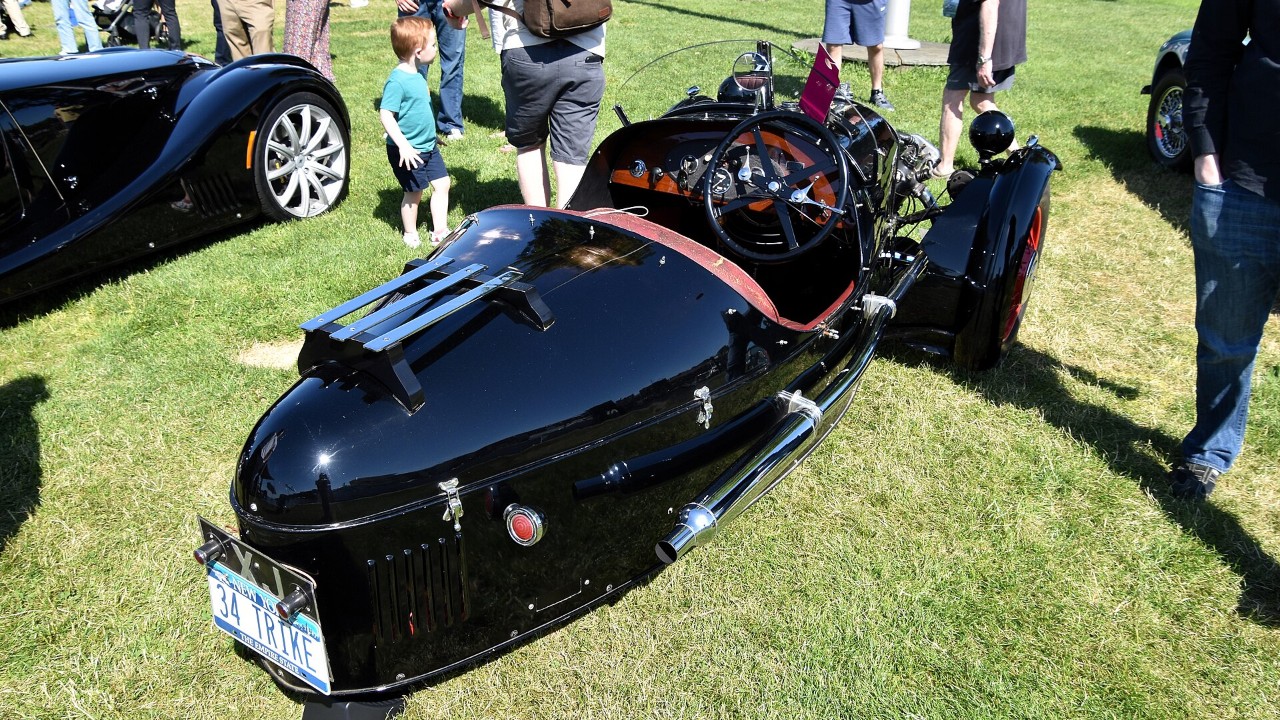
H.F.S. Morgan had his three-wheeler designed by 1909, and the Morgan Motor Company followed in 1910. By 1934 the Super Sports rode on the M-type chassis introduced in 1928, Silodrome notes. Like the earlier Morgans, it carried its V-twin out front. Morgan kept building V-twin three-wheelers until 1939. Our tour of Morgans from the three-wheeled Runabout to the 2019 Plus Six follows the rest of the story. Other makers tried the formula too, as our list of three-wheeled cars that made it to production shows. The clearest proof of relevance came in 2011, when Morgan revived the Three-Wheeler with an 82 bhp, 1,983 cc S&S V-twin.
Sources: Cycle World (1969), Motor Sport (A history of the G.N.), Grace’s Guide (G.N.), Cybermotorcycle (Bedelia), Motor Marques (Bedelia), Motor Sport (The A.V.), Louwman Museum, Unique Cars and Parts (Amilcar), Unique Cars and Parts (Salmson), Silodrome (Morgan).
More from Fast Lane Only


