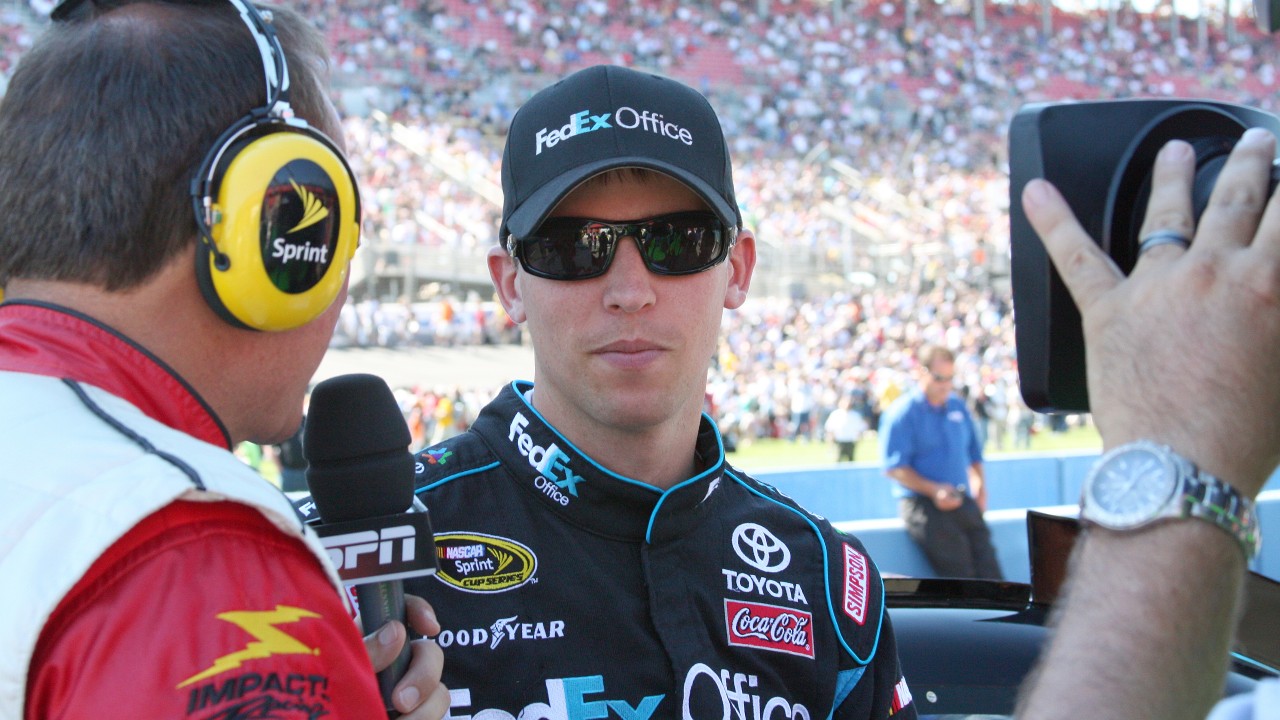
Denny Hamlin has turned a long-simmering garage gripe into a full-scale debate, arguing that NASCAR’s caution lengths are being stretched for television and are actively hurting the quality of races. His frustration boiled over during the Martinsville weekend, where he said the yellow-flag pace felt endless and the product on track suffered as a result.
His comments have struck a nerve with drivers, fans, and broadcasters alike because they cut to the heart of a modern tension in stock-car racing: how to balance an entertainment-driven TV show with the integrity and rhythm of a live competition.
Hamlin’s Martinsville breaking point
By the time the Martinsville NASCAR weekend wrapped, Hamlin’s patience with caution procedures had clearly run out. He described being in disbelief at how long it took to cycle through simple yellow-flag sequences and argued that the delays were no longer about safety or pit-road order, but about fitting in extra commercial breaks. In his view, what should be a brief reset had turned into a drawn-out intermission that drained energy from the race.
Reporting on his reaction from that Martinsville NASCAR event captured Hamlin’s core complaint: he felt the caution stretches were so excessive that they distorted the natural flow of the competition and undercut the intensity that short tracks are supposed to deliver. In his comments, he pushed for a rethinking of how many laps NASCAR spends under yellow and how quickly the field is turned loose again after pit stops.
Hamlin did not limit his criticism to the Cup Series. He pointed out that he noticed similarly long caution sequences during the O’Reilly Auto Parts Series race on Saturday, which reinforced his belief that this was not a one-off officiating quirk but a systemic pattern across the Martinsville weekend. The repetition of the same issue in different races convinced him that the problem was baked into current procedures rather than the product of a single unusual incident.
A veteran voice raising the volume
Hamlin is not a fringe figure taking potshots from the sidelines. He is one of the most accomplished and visible drivers in the garage, and his words carry weight. His stature in the sport is reflected in the way fans and media track his every move, from his results on track to his outspoken commentary, as seen in profiles of Denny Hamlin that emphasize his prominence.
When a driver at his level says he “couldn’t believe” how long cautions were at Martinsville and connects that frustration to the broader viewing experience, it resonates beyond a single race recap. Hamlin has built a reputation as someone willing to critique NASCAR’s decisions in public, from rules interpretations to schedule choices. That history frames his latest comments not as a random outburst but as part of a consistent push for what he sees as a better product.
His status also means that his criticism quickly escapes the driver-radio bubble and lands in front of a national audience. Social media posts and fan pages highlighted how Hamlin called out long caution periods and said races are being stretched out, with one widely shared graphic summarizing his claim that TV-driven delays are compromising the action for both competitors and spectators, as reflected in a fan report of his remarks.
“Hurting the watching experience”
Hamlin’s sharpest line from his Martinsville debrief was aimed not at officiating minutiae but at the core value proposition of NASCAR as a televised sport. He argued that by dragging out cautions, NASCAR is “hurting the watching experience.” That phrase has since become a shorthand for his broader critique.
From his perspective, every extra lap under yellow chips away at the intensity that keeps viewers locked in. He suggested that what might make sense on a TV rundown sheet, such as guaranteeing a certain number of commercial slots under caution, can be disastrous for the live product when it turns a 400-lap short-track sprint into a stop-and-go slog. His comments framed the issue as a trade-off: more controlled TV windows on one side, and a more compelling, organic race on the other.
Hamlin also connected his frustration to the fan experience at the track. Long caution stretches mean spectators sit through extended slow laps instead of seeing drivers battle at full speed. That disconnect, he argued, risks alienating the very people NASCAR is trying to attract and retain, especially at historic venues like Martinsville where fans expect relentless action.
The Martinsville numbers and fan reaction
Fans did not rely solely on impressions to gauge how the Martinsville race felt. They quickly started pulling statistics to quantify just how much time the field spent under yellow. A detailed post in The Day After the Races discussion on Reddit noted that the event’s Elapsed Time was listed as “2:47:18 for 400 laps (210.4 mi / 338.61 km)” and that there were “Cautions: 5 cautions for 54” laps, with those figures presented in that exact format as part of the recap in Day After the.
Those numbers helped frame Hamlin’s frustration. Five cautions for 54 laps at a track where green-flag runs are the main attraction can feel disproportionate, especially when several of those yellow periods are driven by stage breaks and TV windows rather than by lengthy cleanups. Fans in that discussion thread echoed Hamlin’s sense that the event felt choppy and that the pauses were long enough to pull them out of the moment.
On social media, complaints about stage cautions and television breaks intensified, particularly after Chase Elliott’s late-race involvement in the Martinsville story line sharpened attention on how restarts and caution timing can swing outcomes. One widely shared post described how a major debate emerged in NASCAR following the Martinsville race regarding stage cautions and noted that this flare-up came right after Chase Elliott’s run, as recounted in a fan debate that captured the mood.
TV windows, stage breaks and the caution clock
Behind Hamlin’s comments sits a structural reality: NASCAR’s modern race format is deeply intertwined with television. Stage breaks, guaranteed commercial windows and built-in yellow-flag opportunities are all part of how the sport is packaged for broadcast partners. Hamlin’s complaint is that this packaging has started to dictate the on-track rhythm more than the racing itself.
In his Martinsville critique, he questioned why it takes so many laps to cycle through a standard caution. He suggested that if the goal is to provide time for pit stops and a few commercials, that can be accomplished in fewer laps with more efficient procedures. He floated ideas such as tightening the pit-road timeline, accelerating lineup confirmation and being more aggressive about going back green once the track is ready.
Hamlin also highlighted the cumulative effect of stage cautions layered on top of natural yellows. On a day with multiple incidents, every scheduled stage break adds more slow laps, which can push the total caution count into territory that feels excessive for fans and drivers. His argument is not necessarily against the concept of stages, but against the way their associated cautions are managed in concert with TV needs.
Support from Dale Earnhardt Jr. and other voices
Hamlin’s critique did not land in a vacuum. Dale Earnhardt Jr. publicly agreed with his assessment that NASCAR is stretching cautions too far and that the current approach is bad for the show. A detailed report on their comments described how Denny Hamlin and Dale Earnhardt Jr. have sharply criticized NASCAR over lengthy caution rules, presenting a united front from two of the sport’s most influential voices, as highlighted in coverage of how Hamlin, Earnhardt Jr blasted the rules.
Earnhardt Jr. responded specifically to Hamlin’s claim that NASCAR is “hurting the watching experience,” saying he agreed with the core point and that fan complaints from Martinsville backed it up. His perspective carries added weight because he straddles multiple roles as a former driver, team owner and broadcaster. When he says the caution lengths are out of step with what viewers want, he is speaking from both inside and outside the car.
Other commentary from the Martinsville weekend echoed the same theme. Analysts and fans pointed out that when drivers of Hamlin’s and Earnhardt Jr.’s stature align on an issue, NASCAR typically has to at least review its policies, even if it does not make immediate changes. Their shared criticism has turned caution length from a background grumble into a front-burner topic.
Hamlin’s specific call for change
Hamlin has not limited himself to venting. He has explicitly called on NASCAR to change the length of cautions, arguing that the sport needs a more efficient approach that respects both safety and entertainment. In detailed reporting on his stance, he urged NASCAR to shorten the time spent under yellow and to reconsider how stage breaks and TV windows are structured, as laid out in coverage of how Denny Hamlin called for change.
He framed his proposal in practical terms. In his view, NASCAR can still give broadcasters the commercial inventory they need without forcing fans and drivers to sit through so many slow laps. That might mean adjusting when breaks are taken, using picture-in-picture side-by-side more aggressively or tightening the caution procedures themselves.
Hamlin also suggested that NASCAR should study data from recent events to see how caution lengths have trended compared with earlier eras. If the numbers show a clear upward shift, he argued, that would support his contention that TV considerations have gradually lengthened yellow-flag periods beyond what is necessary.
How TV partners fit into the debate
Although Hamlin’s criticism is directed at NASCAR’s rules and procedures, the underlying tension involves television partners that pay heavily for broadcast rights. Those partners want predictable windows for commercials and storytelling, which stage breaks and extended cautions can provide. The challenge is finding a balance where those windows do not feel intrusive to viewers.
Hamlin’s comments implicitly call on both NASCAR and its broadcasters to rethink how they structure race coverage. He is effectively arguing that a tighter, more intense race will be better television in the long run, even if it means fewer long caution periods and more reliance on in-race graphics or split-screen ads. His stance suggests that the sport risks short-term commercial gains if the viewing experience degrades and audiences tune out.
Some of the reporting on his call for change has emphasized that NASCAR’s current TV agreements are complex and involve multiple partners, which can make rapid adjustments difficult. Still, Hamlin’s argument is that the Martinsville weekend showed the current balance is off, and that the sanctioning body should not wait for a new contract cycle to start addressing it, as summarized in coverage that described how Denny Ha wanted NASCAR to act.
Stage cautions under renewed scrutiny
The Martinsville debate has also revived long-running arguments about stage cautions themselves. When NASCAR introduced stages, it did so to create natural breaks for strategy and guaranteed restarts that could bunch up the field. Over time, however, critics have argued that the mandatory cautions at the end of each stage distort strategy and inflate the number of yellow laps.
More from Fast Lane Only