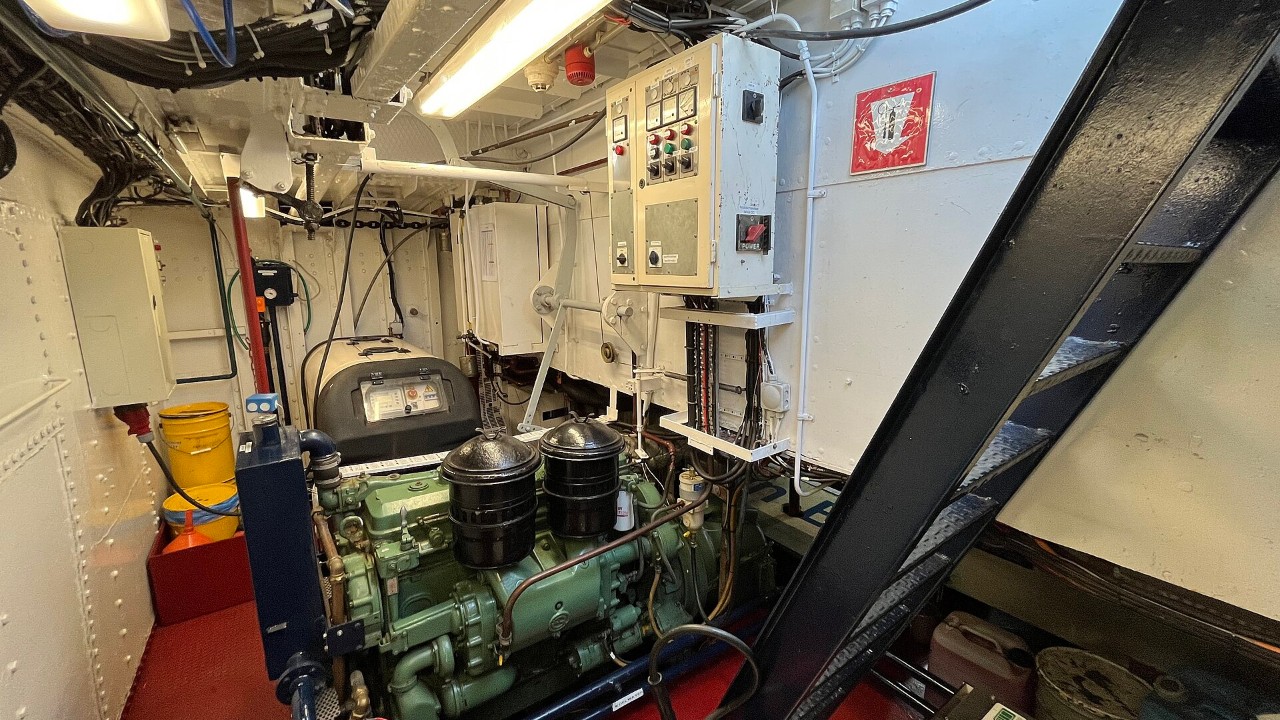
The Detroit Diesel 6-71 could not run without the blower bolted to its side. As a two-stroke, it had no way to pull in its own air. Instead, a gear-driven pump did the breathing for it. After World War II, hot rodders bought those surplus pumps cheaply and turned them into a drag-racing staple.
The story runs from a 1938 city bus to the Top Fuel dragster. Along the way, the same basic part changed jobs completely. On the diesel it was an air pump, but on a gasoline V8 it became real boost.
What 6-71 means
General Motors named the engine with simple arithmetic. The first number counts the cylinders, and the second gives the displacement of each one in cubic inches. Therefore a 6-71 is a six-cylinder engine of about 426 cubic inches.
The “71” is rounded, however. The Series 71 entry puts each cylinder at 70.93 cubic inches. GM introduced the inline six in 1938 as the first flagship product of its Detroit Diesel Engine Division. According to Mac’s Motor City Garage, 71 cubic inches per cylinder works out to 426 for the six.
Why the Detroit Diesel 6-71 needed a blower
A four-stroke engine sucks in air on its own intake stroke. A two-stroke fires on every revolution instead, so it has no separate stroke for breathing. The Series 71 also lacked crankcase aspiration. As a result, it could not naturally draw in combustion air.
That is where the Roots blower came in. A gear-driven blower forced fresh air through passages in the block and ports in the cylinder walls. The exhaust then left through poppet valves in the cylinder head. In other words, air flowed one way, from the ports in the walls to the valves in the head.
Paul Niedermeyer of Curbside Classic stresses that the blower only created the draft needed to scavenge the cylinder. It did not supercharge the engine in the sense of raising pressure above atmospheric. Mac’s Motor City Garage agrees, calling it “simply an air pump” on the diesel.
From a 1938 bus to GMC trucks
Development of the 71 family began in 1934 and was ready by 1937, according to Curbside Classic. It followed long work on two-stroke diesels at GM’s research laboratory under Charles Kettering. Each cylinder also got its own unit injector at the top. As the Series 71 entry notes, that left no high-pressure fuel lines outside the injector body.
At first, the big customer was a bus. GM built some 400 units in 1938, Curbside says, and the GM/Yellow Coach Model 719 took most of them. Its rear-mounted 6-71 made 165 horsepower.
Soon after, trucks followed. In 1939, GMC offered the diesels, nicknamed Jimmys, across trucks rated from 3.5 to 8 tons. Buyers got three- and four-cylinder versions. The 6-71 began as a special-order option, and then it became standard on the 900-series trucks in 1940. Curbside adds that the two-stroke sound and the blower whine earned the engine the nickname “Screaming Jimmy.”
A wartime workhorse
World War II turned the 6-71 into a mass-produced engine. Detroit Diesel built an estimated 193,000 engines during the war, according to American Automobile Industry in World War Two. That site says it supplied 52,525 6-71s for 33,549 landing craft, fitted as singles and quads.
Tanks also used them. The site’s table lists 10,968 M4A2 Shermans, each with a 6046 unit. That was two 6-71 engines working together. Similarly, the Series 71 entry puts the Sherman total at 22,000 engines in double packs.
That huge wartime output mattered later. After the war, surplus military equipment went on sale for pennies on the dollar, as Fuel Curve puts it.
How hot rodders took it
Barney Navarro got there early. In 1948 he picked up a surplus GMC 3-71 blower for next to nothing, Fuel Curve reports. Then he fitted it to a Ford flathead V8. Mac’s Motor City Garage tells the same story and adds that he raced the roadster on the California dry lakes.
Soon, the results showed up on the timing slips. Navarro’s de-stroked 176-cubic-inch 1941 block ran a 3-71 driven by four V-belts, according to the American Hot Rod Foundation. At the SCTA El Mirage meet on September 25-26, 1948, he went 139.75 mph in Class C Roadster. That was up from 121.29 mph in July.
Others soon followed, and on gasoline engines the blower now made real boost. The foundation also describes Beatty’s belly tank lakester. Its 295-cubic-inch 1948 Mercury engine carried a 4-71 making 10 pounds of boost. At the 1951 Bonneville Nationals, Beatty set a Class D Lakester record at 185.80 mph. Mac’s names the Gilmer toothed belt as the most popular drive setup. Meanwhile, Fuel Curve says racers used the GMC blower almost exclusively in dry lakes and drag racing for about 25 years.
From 6-71 to 14-71
The numbers on a blower follow the engine it came from. Most GMC cases share a 7.5-inch height, but rotor length varies, Fuel Curve explains. A 4-71 has rotors about 10 inches long, while a 6-71’s are just about 15 inches. The GMC design has traditionally used three-lobe rotors.
Racers eventually wanted more air than a 6-71 could move. As a result, today’s racing blowers use extrapolated sizes set by the rules. On a 14-71, the rotors run a full 19 inches long, according to Mac’s.
The Detroit Diesel 6-71 itself also had a long run. Sales of the Series 71 ended in the summer of 1995, when a four-stroke Detroit Diesel replaced it. Curbside Classic notes that MTU still builds a limited number of new two-cycle engines for military use. On the drag strip, NHRA Top Fuel and Funny Car racers run blowers of 14-71 dimensions. Even so, Mac’s says the design remains based on the original GMC two-stroke blower.
More from Fast Lane Only
- Unboxing the WWII Jeep in a Crate
- 15 rare Chevys collectors are quietly buying
- 10 underrated V8s still worth hunting down
- Police notice this before you even roll window down
This article was created with the help of AI and was reviewed and edited by Fast Lane Only editors before publication.