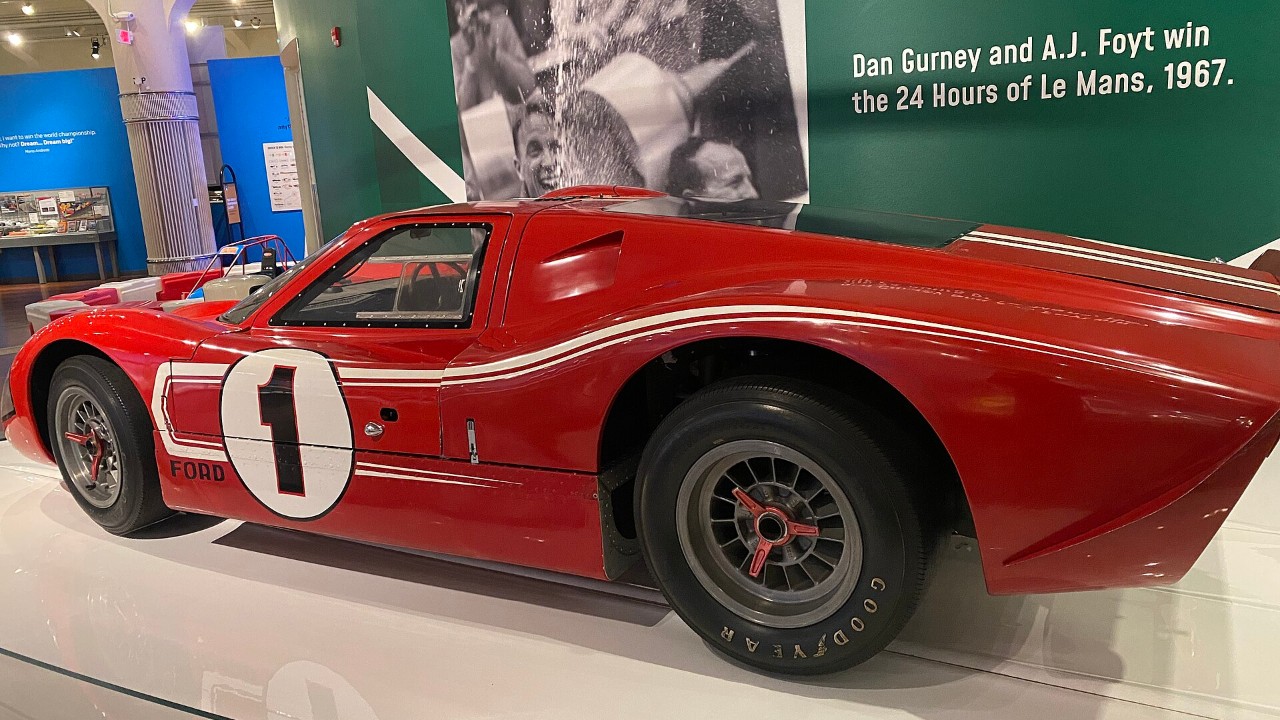
The Ford Mark IV that won the 1967 24 Hours of Le Mans has a bump in its roof above the driver’s seat. It isn’t there for airflow. Instead, it made room for Dan Gurney, who stood 6-foot-4, according to The Henry Ford museum in Dearborn, Michigan.
Gurney shared the red-and-white No. 1 car with A.J. Foyt, and the pair beat Ferrari’s best in France. Then Gurney started a podium habit that racers still follow today.
Today the car survives with its race scars intact. Here is how the bubble came about, what the Mark IV was and where you can see the car now.
Why the Ford Mark IV got a bubble roof
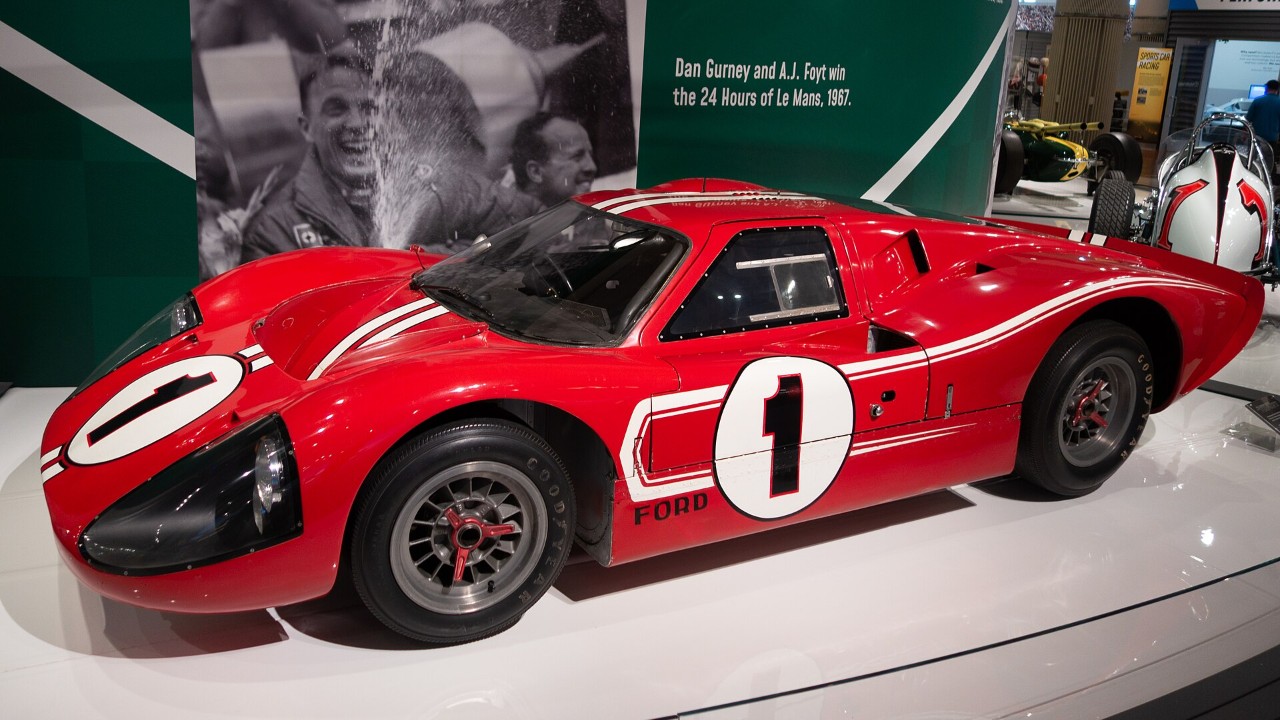
Gurney was tall and lanky, and the Mark IV’s cockpit was tight. As a result, he had to tilt his head to fit in the cockpit. The Henry Ford’s Ford at Le Mans in 1967 collection says the bump in the roof accommodated his height.
Accounts differ on who shaped it. The Truth About Cars credits fabricators at Kar Kraft, Ford’s prototype shop in Dearborn. Meanwhile, the race’s reference entry says Shelby American fabricated it. Either way, the bulge sits on the right, because the car has right-hand drive even though it was built in the U.S.
In addition, the same article stresses that the “Gurney bubble” is not an aerodynamic device. It blends into contours on the roof panel, the door and the engine cowl. That’s why the shape carries Gurney’s name.
What the Mark IV was
The Mark IV grew out of Ford’s J-car program. Ford shelved that project after Ken Miles was killed in an accident in August 1966, according to the 1967 Le Mans race record. Later, the revived car got an all-new, American-designed chassis and a 7-liter V8.
The museum’s catalog entry for the car lists a 427-cubic-inch overhead-valve Ford V8 rated at 500 hp at 5,000 rpm. That engine drove through a four-speed manual. Ford Motor Company built it in Dearborn, with design help from Shelby American. The body and structure used aluminum, while the windows were Plexiglas.
By comparison, Ferrari’s 330 P4 ran a 244-cubic-inch V12 rated at about 450 hp, according to The Henry Ford. The Ferrari was 490 pounds lighter and used fuel injection. The Ford, on the other hand, breathed through twin four-barrel carburetors.
As it turned out, the design proved itself quickly. In April 1967, Bruce McLaren and Mario Andretti won the 12 Hours of Sebring in the Mark IV’s first race, the museum says.
The 1967 Le Mans win
Ford entered four Mark IVs at Le Mans on June 10 and 11, 1967. Shelby American ran two, and Holman & Moody ran the other two. In the end, the winning No. 1 car was one of the Shelby American entries.
Trouble started before the green flag. A manufacturing defect cracked all four windshields in practice. However, Dow Corning made replacements and rushed them to France within two days, according to The Henry Ford.
Gurney had raced at Le Mans every year since 1958, while Foyt was a rookie there. Still, the pairing worked. The race record lists 388 laps and 3,251.57 miles, a distance record, at an average of 135.48 mph.
In fact, the museum’s catalog page calls that a record average speed. It also puts the Mark IV 32 miles ahead of the second-place Ferrari 330 P4 of Ludovico Scarfiotti and Mike Parkes. At the end, Foyt drove across the line and Gurney rode the hood to the podium.
Gurney’s champagne
On the podium, Gurney shook his bottle of champagne and sprayed everyone nearby. “It was like a fire hose,” he later said, as The Henry Ford quotes him. The museum credits that moment with starting a victory tradition.
The Truth About Cars notes that Henry Ford II stood among the dignitaries who got soaked. That article also points out that North American sports teams had celebrated with champagne before. Even so, Gurney is widely credited with bringing the spray to motorsport.
Meanwhile, the bottle has its own story. Gurney signed it and gave it to Life photographer Flip Schulke, who used it as a lamp for about 30 years. Later, Gurney got it back, and it now sits in the boardroom of his All American Racers shop, according to the race record.
Where the Le Mans Mark IV is now
The Henry Ford lists the car as object 71.83.1. It shows Le Mans as the car’s only race appearance. Today the Ford Mark IV is on display in the Driven to Win: Racing in America exhibit at Henry Ford Museum.
However, the car did make one trip away. It was damaged while in the U.K. for Goodwood events, according to The Truth About Cars in 2014. The museum reported a crunched left sill panel and broken engine mounts. Afterward, the car went to Gurney’s All American Racers shop in California for repair and conservation.
Retired Ford Le Mans engineer Mose Newland consulted on the work. He identified color-coded original engine parts, which showed the engine was original. The team also left the race damage alone on purpose, including panel cracks and the cracked windshield.
The car then returned to Dearborn in time for a gala honoring Gurney with the Edison-Ford medal. It remains there in the Driven to Win exhibit, bubble roof and all.
More from Fast Lane Only
- Unboxing the WWII Jeep in a Crate
- 15 rare Chevys collectors are quietly buying
- 10 underrated V8s still worth hunting down
- Police notice this before you even roll window down
This article was created with the help of AI and was reviewed and edited by Fast Lane Only editors before publication.