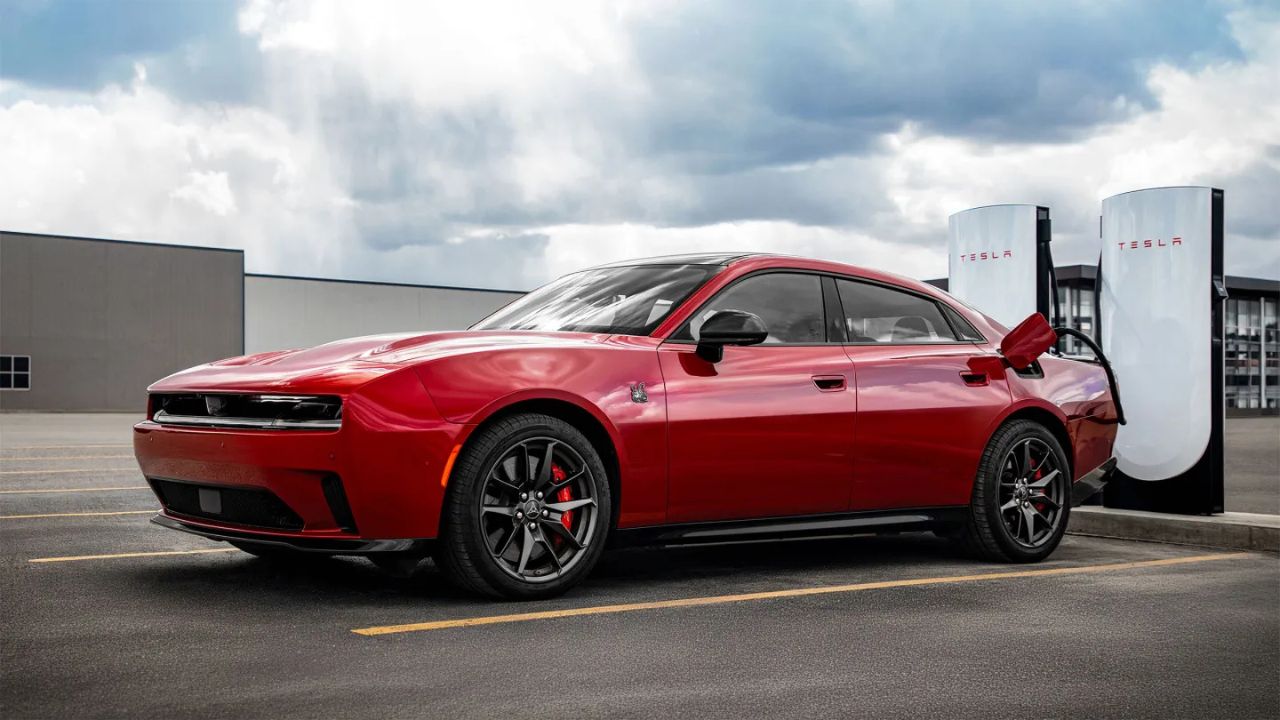
Dodge has quietly raised the starting price of the all-electric Charger Daytona, lifting the manufacturer’s suggested retail price to $72,495, according to recent reporting. The move reshapes where the new battery-powered muscle car sits in the market and raises fresh questions about how aggressively Dodge intends to chase volume versus profit with its first modern EV performance flagship.
The adjustment comes just as early adopters weigh deposits, dealer markups, and tax-credit eligibility, turning the Charger Daytona’s sticker into a test case for how much enthusiasts are willing to pay to go electric without giving up traditional muscle-car attitude.
What changed in Dodge raises Charger Daytona EV MSRP to $72,495, report says
The key development is straightforward: Dodge has increased the base MSRP for the Charger Daytona EV to $72,495, according to a report on the electric Dodge Charger. That figure places the Daytona well above mainstream electric sedans and crossovers and squarely in premium performance territory.
The price hike affects the initial all-electric Charger Daytona trims that Dodge has been using to introduce the model as a spiritual successor to the gasoline Charger. This car pairs a large battery pack with all-wheel drive and performance tuning that targets traditional V8 benchmarks, while also layering in EV-specific features such as selectable sound profiles and software-defined performance modes. The higher MSRP applies before destination charges, options, or dealer-installed extras, meaning real-world transaction prices are likely to climb even higher once popular packages and appearance upgrades are added.
For buyers who had been tracking early guidance, the new sticker changes the math. Many shoppers plan EV purchases around total cost of ownership, weighing fuel savings and lower maintenance against higher upfront cost. A move to $72,495 stretches the initial outlay and can push monthly payments into territory that overlaps with established luxury EVs. It also narrows the gap between the Daytona and high-output internal-combustion performance cars from other brands, which may still appeal to drivers who are not ready to switch to electric power.
The adjustment also reshapes how the Charger Daytona lines up within Dodge’s own catalog. The company has used aggressive pricing in the past to draw buyers into its muscle cars, then relied on options and special editions to drive profit. With the EV, Dodge appears to be starting from a higher baseline, hinting that the brand sees the Daytona less as a volume play and more as a halo product intended to showcase technology and keep die-hard fans in the fold as regulations tighten around combustion engines.
Why Dodge raises Charger Daytona EV MSRP to $72,495, report says matters now
The timing of the higher MSRP matters because the broader EV market is in flux. Several automakers have been cutting prices or rolling out lower-cost trims to spur demand after a surge of early interest cooled. Against that backdrop, Dodge choosing to lift the Charger Daytona’s sticker to $72,495 signals a different strategy, one that leans on brand loyalty and performance credentials rather than chasing the lowest payment.
For performance-focused EV shoppers, the Charger Daytona enters a crowded field that includes versions of the Tesla Model 3 Performance, Tesla Model S, Ford Mustang Mach-E GT, and various dual-motor offerings from Hyundai, Kia, and others. Many of those rivals undercut the Daytona on base price, which raises the bar for what Dodge must deliver in acceleration, handling, technology, and perceived quality. The higher MSRP effectively tells buyers that the company believes its first electric muscle car can command a premium because of its design, character, and connection to the Charger legacy.
The change also has implications for federal and state incentives. In the United States, EV tax credits often hinge on price caps tied to vehicle type and MSRP. A sticker of $72,495 risks placing certain Charger Daytona configurations above thresholds that would otherwise help soften the blow of a high-performance EV purchase. If a buyer loses access to a credit worth several thousand dollars because the car sits above a cap, the effective cost jump is even larger than the MSRP change alone suggests.
Dealer behavior is another wild card. High-interest halo models often attract markups, especially in the first months of availability. If dealers add premiums on top of a $72,495 base price, some customers who had been ready to move from a gasoline Charger or Challenger into an EV may decide to wait, cross-shop other brands, or hold on to their existing cars longer. That dynamic could slow Dodge’s ability to build early momentum for the Daytona and to prove that its EV strategy can keep pace with rivals that already have several electric models on the road.
At the same time, the higher MSRP can be read as a reflection of real costs. Performance EVs require large battery packs, powerful motors, sophisticated cooling systems, and extensive software development. Those elements are expensive, particularly in the early years of a new platform. By setting the Charger Daytona’s price where it has, Dodge may be signaling that it is not willing to subsidize the car heavily in order to buy market share, at least not yet. Instead, the company appears to be betting that a smaller group of committed buyers will pay for a distinctive product that blends muscle-car cues with electric torque.
The move also lands in a period when some automakers are rethinking the pace of their EV rollouts and shifting more attention to plug-in hybrids. By raising the price of its showcase EV, Dodge is effectively doubling down on a strategy that keeps the Charger Daytona as a statement piece. The car becomes less a mass-market alternative and more a signpost for where the brand sees its performance identity heading as regulations and consumer tastes evolve.
What comes next for Dodge raises Charger Daytona EV MSRP to $72,495, report says
With the new MSRP set, the next chapter for the Charger Daytona EV will hinge on how shoppers respond once cars reach showrooms in larger numbers. Early order banks and reservation lists will provide the first clues. Strong demand at the higher price would validate Dodge’s decision and could encourage the brand to maintain a premium stance for future trims. Slower take-up, or heavy discounting at the dealer level, would suggest that the market is less willing to pay a luxury-level sticker for an electric muscle car, no matter how quick it is.
Dodge also has room to adjust the strategy through additional variants. The company could introduce lower-output versions with smaller battery packs, fewer standard features, or simpler interiors that carry a more accessible price while preserving the core Charger look. Such trims would help broaden the car’s appeal beyond the early adopters who are comfortable spending over $70,000 on a performance EV. On the other end of the spectrum, even more powerful or track-focused editions could push pricing higher still, reinforcing the Daytona’s role as a halo product and giving Dodge a ladder of performance that mirrors the old Hellcat and special-edition hierarchy.
Software and subscription features are another lever. If Dodge chooses to gate certain performance modes, sound profiles, or driver-assistance functions behind over-the-air upgrades, the company could keep the base MSRP where it is while creating new revenue streams over the life of the vehicle. That approach would align with broader industry trends and might allow the brand to eventually offer a slightly lower starting price while counting on software sales to make up the difference. For now, however, the headline number that shoppers see is $72,495, and that is the figure shaping initial perceptions.
Longer term, the Charger Daytona’s pricing will influence how Dodge positions future EVs and hybrids. If the car succeeds at its higher MSRP, it will strengthen the argument inside the company that performance-focused electrified models can sustain premium pricing, even without the sound and drama of a big gasoline engine. If it struggles, Dodge may pivot toward more value-oriented electrified offerings, using the lessons from the Daytona to refine battery sizes, feature sets, and performance targets that better match what buyers are willing to pay.
More from Fast Lane Only
- Unboxing the WWII Jeep in a Crate
- 15 rare Chevys collectors are quietly buying
- 10 underrated V8s still worth hunting down
- Police notice this before you even roll window down
*Research for this article included AI assistance, with all final content reviewed by human editors.