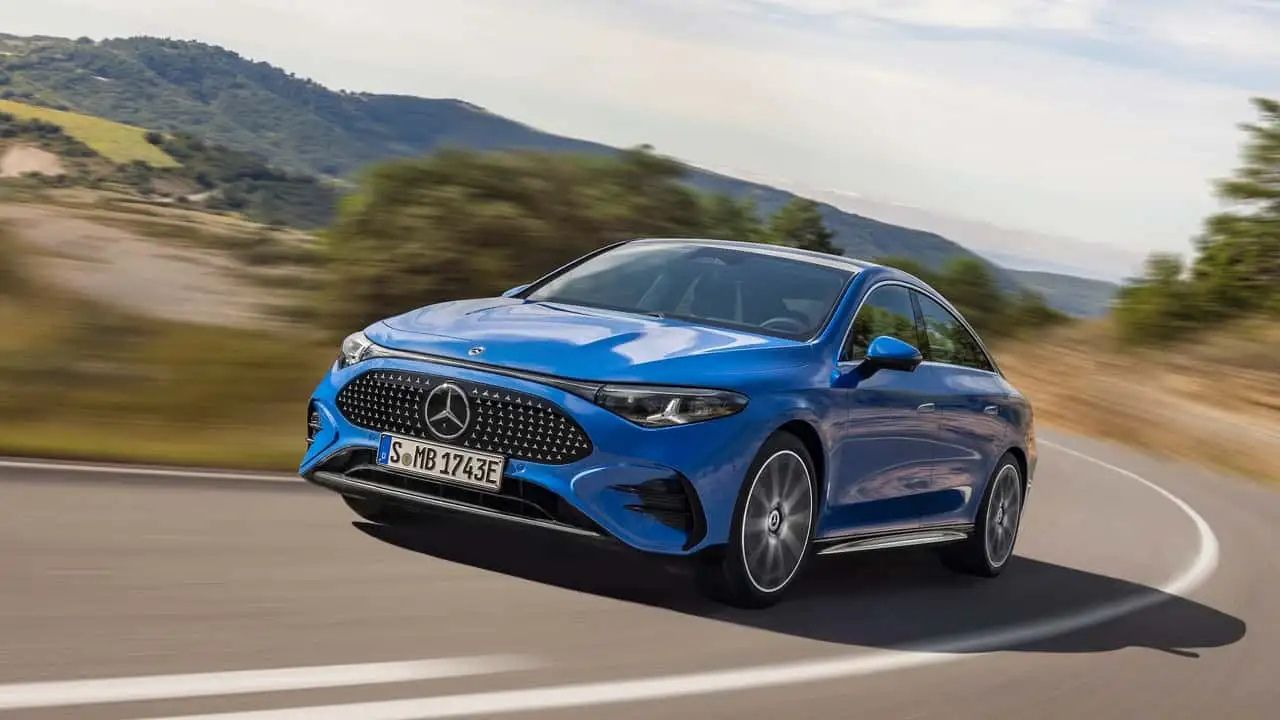
The pre-production Mercedes CLA 350 EV has quietly reset expectations for compact electric sedans. In Edmunds’ independent real-world range test, the sleek four-door nearly touched the 400-mile mark on a single charge, dramatically outperforming its official estimate and underscoring how quickly efficiency is advancing. For shoppers comparing EVs on range anxiety alone, this result changes the conversation around what an everyday electric car can deliver.
How Edmunds pushed the Mercedes CLA EV to the edge of 400 miles
Edmunds runs a consistent real-world range loop that has become a reference point for EV shoppers. The protocol uses mixed-speed driving on public roads, with climate control set to typical comfort levels and the vehicle driven until the battery is effectively depleted. Against that backdrop, the CLA 350 EV prototype logged a result that stunned even seasoned testers, coming within a whisker of 400 miles before needing to plug in.
The key detail is how far the car exceeded its projected figure. According to independent coverage of the test, the compact Mercedes traveled significantly beyond its official rating, with the gap measured in dozens of miles rather than a modest buffer. That performance put the CLA 350 EV in the same conversation as larger, more expensive long-range EVs, even though it occupies a smaller, more efficiency-focused segment. The result suggests that Mercedes has tuned both hardware and software to squeeze every usable mile from its battery pack.
Efficiency sits at the center of this story. The CLA uses a new-generation electric architecture that focuses on low aerodynamic drag, reduced rolling resistance and a highly optimized powertrain. Reports on the test highlight that the sedan’s drag coefficient is among the best in its class, which helps explain how it can nearly touch 400 miles without resorting to an enormous battery. In practice, that means the car can carry a relatively modest pack, keep weight down and still deliver the kind of highway range that eases long-distance anxiety.
Independent analysis of the test from electric-vehicle specialists emphasizes that the CLA 350 EV not only beat its own estimate but also outperformed several current long-range benchmarks that have built their reputations on big numbers. That context matters because Edmunds’ loop has historically been tougher on some models that look impressive on paper. When a car shines on this test, it tends to translate into real-world confidence for owners.
The test car itself was a pre-production example, which raises the natural question of how closely the final showroom version will match this performance. Automakers sometimes tweak software, tire choices or gearing before launch. Yet the magnitude of the overperformance leaves little doubt that even a slightly detuned production CLA EV would still land in rarefied range territory for its size and price bracket. For Mercedes, the test provides an early proof point that its next wave of compact EVs can compete on more than just badge appeal.
Why a nearly 400-mile compact EV matters for buyers and charging habits
For many would-be EV owners, the decision to switch from gasoline still hinges on two questions: how far the car can go and how often it needs to plug in. A compact sedan that can almost reach 400 miles on a charge reshapes both calculations. Daily commuters who cover 30 to 50 miles can realistically drive several days, or even a full workweek, before thinking about a charger. That flexibility makes it easier to live with slower home charging and reduces dependence on public fast-charging networks.
Edmunds has documented how charging behavior often matters as much as headline range. Its guidance on electric-car charging stresses that most drivers rely primarily on Level 2 home charging, topping up overnight rather than arriving at public stations with an empty battery. In that context, a car with nearly 400 miles of usable range can turn charging into a background chore instead of a constant planning exercise. Owners can plug in every few nights, or simply when convenient, and still keep a healthy buffer.
The CLA’s result also has implications for road trips. Long-distance travel has been one of the last strongholds for gasoline vehicles, in part because drivers dread long charging stops every 150 or 200 miles. A compact EV that can realistically cover close to 400 miles on the highway before needing a fast charger cuts the number of stops on a full day’s drive and gives drivers more freedom to choose high-speed, reliable stations. It also means that even if a station is busy or partially offline, the driver has enough reserve to continue to the next location.
Range parity with gasoline is another psychological milestone. Many compact gas sedans offer total tank ranges in the 400-mile neighborhood, though they require a few minutes at a pump to refill. When an EV like the CLA approaches that figure, the debate shifts from “is the range enough” to “how fast and convenient is the charging.” That is a more favorable battleground for electric cars, since home charging offers a convenience advantage that gas vehicles cannot match.
The test result matters for the broader EV market as well. It signals that long-range capability is no longer limited to large crossovers or luxury flagships with oversized batteries. If a compact Mercedes can nearly reach 400 miles through efficiency gains, rival brands will face pressure to match or exceed that benchmark in their own next-generation compact EVs. Shoppers who might have dismissed smaller electric sedans as “city cars” now have evidence that they can also be credible long-distance machines.
For charging networks and policymakers, a fleet of more efficient, long-range EVs could ease some infrastructure strain. Cars that need fewer fast-charging sessions, and can comfortably skip crowded stations, reduce peak demand on individual sites. That does not remove the need for more chargers, but it does suggest that smart vehicle engineering can complement investment in public infrastructure and help smooth the transition for first-time EV drivers.
How the CLA EV test shapes expectations for future models and standards
The CLA 350 EV’s performance will likely ripple through both engineering roadmaps and consumer expectations. For Mercedes, it validates its focus on efficiency-focused architectures for smaller vehicles, rather than chasing ever-larger battery packs. Future variants of the CLA family, including potential performance or all-wheel-drive versions, will be judged against this early benchmark. Buyers will expect that even sportier trims retain meaningful range, not just quick acceleration.
Competing automakers will also take note. Many current compact EVs cluster around shorter official ranges, which can look less appealing next to a rival that has nearly 400 real-world miles in its pocket. The test result may accelerate plans to introduce new platforms with lower drag, more efficient motors and smarter thermal management. It may also encourage brands to publish more realistic range estimates, since outperforming those numbers in independent tests can generate positive headlines and build trust.
Regulators and testing agencies are watching too. The gap between official estimates and real-world results has been a recurring frustration for EV owners. When a car so dramatically exceeds its rated figure in an independent loop, it raises questions about how conservative or aggressive various test cycles are. Over time, strong real-world performers like the CLA could support efforts to refine rating methods so that window-sticker numbers better reflect what drivers actually experience on the road.
For consumers, the Edmunds result sets a new reference point for what a compact EV can reasonably deliver. Shoppers who once felt compelled to step up to a larger SUV for range alone may reconsider, especially if compact sedans and hatchbacks continue to improve. As more models target similar efficiency gains, the market could see a renewed interest in smaller, lighter EVs that are easier to park, cheaper to run and still capable of serious road-trip duty.
More from Fast Lane Only
- Unboxing the WWII Jeep in a Crate
- 15 rare Chevys collectors are quietly buying
- 10 underrated V8s still worth hunting down
- Police notice this before you even roll window down
*Research for this article included AI assistance, with all final content reviewed by human editors