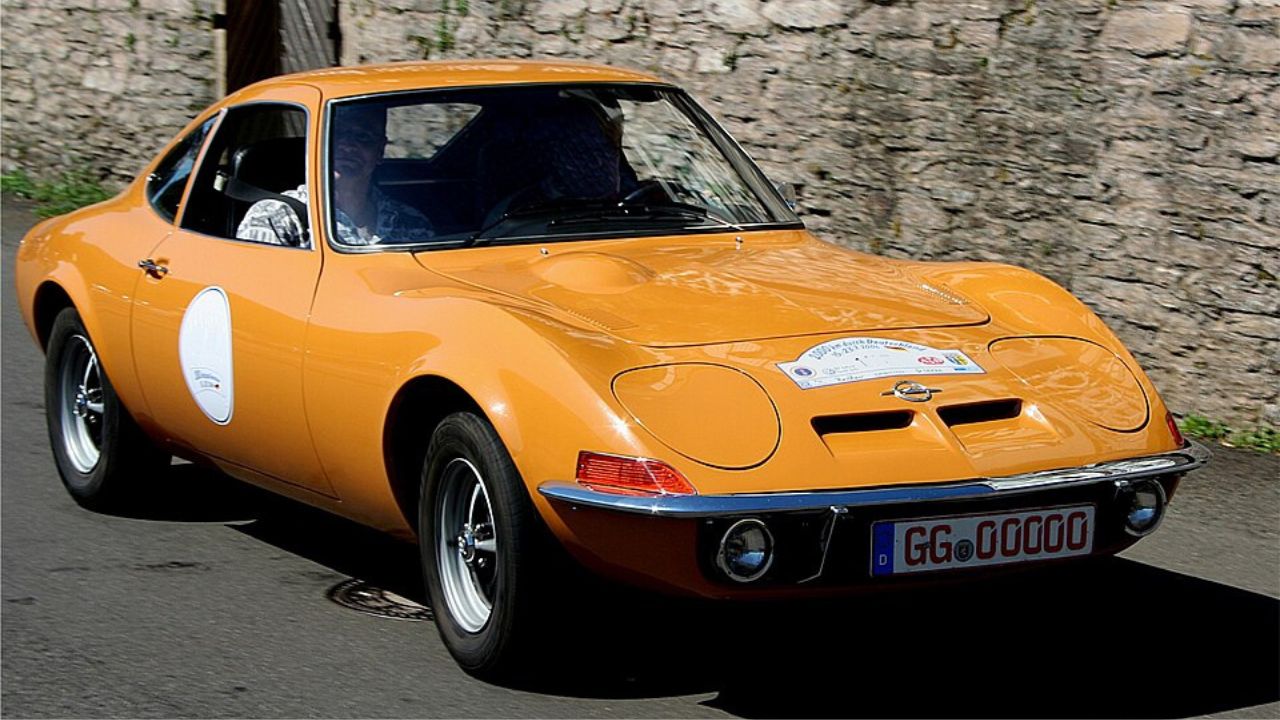
The 1968 Opel GT arrived as a compact German sports car that looked far more exotic than its badge or price suggested. Even detractors who criticized its performance and practicality often conceded that the styling delivered far more drama than anyone expected from Opel and its parent, General Motors. The car that some owners now describe as “almost amazing” still turns heads decades later, even as many surviving examples sit neglected and left to rust.
Viewed in profile or from the rear, the Opel GT’s curves, long hood and tucked tail created an image closer to a mini Italian coupe or a scaled-down Corvette than a modest European commuter. That contrast between appearance and reality sits at the heart of the GT story and helps explain why the car remains a cult favorite despite its flaws.
From Frankfurt showpiece to American curiosity
Opel made its first big splash with the GT as a styling exercise at the Frankfurt and Paris auto shows, where the sleek prototype previewed a new direction for the German brand. The company, which built the car under the umbrella of General Motors, later turned that show car into a production model sold both in Europe and in the United States. Enthusiasts now look back at that early display as the moment when the modest manufacturer signaled that it wanted a piece of the sports car market and presented the world with what one account calls German Sports Car.
The Opel GT was a German car made under General Motors by Opel, and it carried a mix of European design and American corporate backing that was unusual at the time. One detailed review describes the Opel GT as an unusual and misunderstood little sports car and stresses that it was a German product with partial American influence, a point that reinforces how the car straddled markets and expectations. That same review notes that the Opel GT is and built by Opel as part of General Motors, a combination that helped it reach export markets, especially the United States.
In period, the GT arrived in American showrooms as a stylish alternative to domestic pony cars and British roadsters. It was small, light and visually dramatic, yet it came from a brand that many U.S. buyers associated with practical sedans rather than swoopy coupes. That disconnect made the car intriguing, but it also set up expectations that the mechanical package could not always match.
Erhard Schnell’s “Symphony in Steel and Speed”
The design of the 1968 Opel GT 1900 is closely tied to stylist Erhard Schnell, whose work on the car has been celebrated as a kind of sculptural composition. One retrospective even refers to the 1968 Opel GT 1900 as Erhard Schnell’s Symphony in Steel, a phrase that captures how the body’s flowing lines and tight proportions created a sense of motion even at rest.
The GT’s long hood, short rear deck and sharply tapered tail gave it classic front-engine, rear-drive sports car proportions. Pop-up headlamps that rotated sideways rather than flipping up added visual theater. The cabin sat low between pronounced fenders, and the rear glass wrapped around in a fastback curve that looked more exotic than anything else in Opel’s lineup. Even among small European coupes of the period, the GT’s form stood out as particularly dramatic.
That visual drama is a key reason why critics who found fault with the car’s dynamics still praised its appearance. The styling projected speed and sophistication that rivaled much more expensive machinery, and that reputation has only grown over time as the GT’s shape has become a familiar sight in classic car circles and online communities.
The “Baby Corvette” connection
From the start, observers noticed how much the Opel GT resembled a shrunken Chevrolet Corvette. The comparison grew stronger when the third generation Corvette, known as the C3, reached the market with its own sweeping fenders and coke-bottle curves. The Opel GT is often referred to as the baby Corvette due to its visual similarity to the third generation Corvette the C3, and some enthusiasts point out that both cars shared design input from the same broader General Motors styling network. A detailed video on the subject notes that the Opel GT is called the baby Corvette and that the resemblance to Corvette the C3 is no accident.
Other commentators describe the car as a small Corvette or “Baby Corvette” designed by the same design team that worked on the C2 Corvette, positioning the Opel GT as the European baby brother of the classic American sports car. That narrative has become part of the model’s identity, especially among U.S. collectors who enjoy the idea of a European coupe that looks like a scaled-down version of their favorite domestic icon.
Styling comparisons extend beyond enthusiasts. Coverage of the GT’s history notes that its styling has been likened to the 1968 Chevrolet Corvette, and that the resemblance became especially clear once the 1968 Chevrolet Corvette went on sale. Shared cues such as the pointed nose and muscular rear haunches helped the Opel GT punch above its weight in showroom appeal.
Manufactured in Germany, marketed to the world
The Opel GT was manufactured by the German automaker Opel, a subsidiary of General Motors, and it remained in production from 1968 to 1973. A detailed retrospective explains that the GT was built in that five-year span and that its design came out of Opel’s own styling studio, which had already shown the concept at earlier motor shows. The same account notes that the car was manufactured by the German automaker Opel, that Opel was part of General Motors, and that its design was a key selling point during its production run.
Another overview of the car’s history reinforces that the Opel GT is a German car made under General Motors by Opel, and that the car was partially built using components from existing Opel models. This strategy allowed the company to control costs while offering a stylish halo car that could draw buyers into showrooms. The GT’s mechanical package, including its engine and many chassis parts, came from Opel’s mainstream models, which helped with serviceability but also limited ultimate performance.
Despite those constraints, the GT’s lightweight body and relatively powerful engine gave it a genuinely sporty character. Enthusiast discussions emphasize that the car’s modest weight and available 1.9 liter engine allowed it to offer a lively driving experience, even if it was not as fast as some contemporary sports cars. One summary notes that the car’s lightweight body and relatively powerful engine allowed it to offer a sporty driving experience, though it was not as fast as some rivals, a description that neatly captures its middle-ground position in the market.
When style outpaced substance
Period road tests reveal that the Opel GT’s chassis did not fully live up to its dramatic appearance. One detailed account of those early reviews explains that testers found the Opel’s handling only mediocre, with strong understeering tendencies that limited its agility in tight corners. The same report notes that they considered the 165×13 tires too small for the car’s potential and criticized the overall balance. Those impressions show how the GT’s visual promise sometimes exceeded its dynamic reality.
The mismatch between looks and performance is echoed by modern enthusiasts who describe the car as stylish but underwhelming. In one enthusiast group, owners recall that many small European sports cars were fun to drive because they handled well and offered lively responses, yet they argue that the Opel GT did not always deliver the same level of excitement. That discussion, which points out that many small European sports cars were more rewarding to drive, reflects a long-running critique of the GT.
Still, even those critics tend to concede that the car looked fantastic. The balance of opinion often runs along the lines of “great to look at, less great to drive,” which has become part of the GT’s mystique. The car’s styling set expectations that its modest tire size, suspension tuning and shared-component drivetrain could not always meet, yet that same styling is what keeps people talking about the model decades later.
Pop culture, TV screens and lasting images
The Opel GT’s visual appeal helped it cross over into popular culture. One enthusiast account notes that the car was so cool that it was featured in the sitcom Get Smart, where its compact size and futuristic shape fit neatly into the show’s playful take on espionage and gadgetry. That appearance cemented the GT’s image as a stylish, slightly quirky sports car and exposed it to viewers who might never have seen one in person.
Its presence in television and advertising reinforced the idea that this was a car for drivers who wanted to stand out. The coupe’s distinctive nose, fastback roofline and pop-up headlamps made it instantly recognizable on screen. Even viewers who could not name the model often remembered the shape, which only added to its reputation as a design-forward product from a brand better known for practical sedans.
“Almost amazing” and the pull of nostalgia
Modern coverage often describes the Opel GT as an “almost amazing” sports car, a phrase that captures both affection and frustration. One recent video series that revisits classic models introduces the GT with the line “today we are talking about” a car that came close to greatness but fell short in some areas. The host greets viewers with “what’s up petrol heads” and explains that the show, titled Lost, digs into the stories behind the metal, including the story of the Lost in Opel and its near-miss status among sports cars.
Another enthusiast channel invites viewers with “welcome to the channel” and sets the stage by saying that it is time to step into the world of automotive classics and take a closer look at a truly iconic model. That same presentation calls the GT a mini Corvette with big character and treats it as a true classic, highlighting how nostalgia has softened some of the earlier criticism. The host positions the Opel GT as a car whose personality and design outweigh its shortcomings, and the video on this mini Corvette with big character is one of several that have helped reframe the GT for new audiences. In that context, the phrase “welcome to the channel” becomes a gateway into a deeper appreciation of the mini Corvette with.
These modern reappraisals often acknowledge the car’s flaws while celebrating its strengths. Commentators describe the GT as a car that looks like a concept brought to life, with details that still feel fresh. They also point out that the car’s compact size, simple mechanics and shared parts make it approachable for hobbyists, even if sourcing some body panels and trim pieces can be challenging.
More from Fast Lane Only