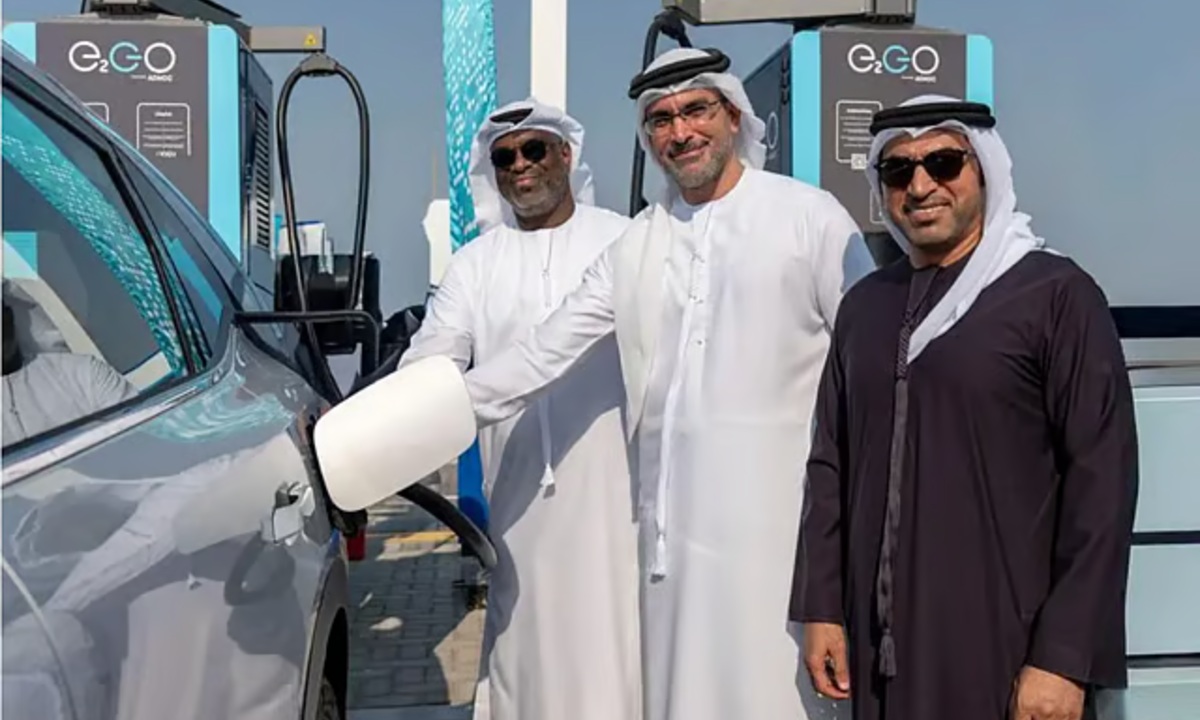
In a country built on oil wealth, a sprawling new electric vehicle charging hub on the desert highway between Abu Dhabi and Dubai signals a calculated shift. The United Arab Emirates is not abandoning hydrocarbons, but it is investing heavily in the infrastructure that will determine whether battery powered transport can scale in one of the world’s most car dependent regions. The 60 stall fast charging site is both a practical asset for drivers and a strategic message that even a leading producer of crude expects electric mobility to grow.
A mega charger in the middle of oil country
The new hub sits at Saih Shuaib on the E11, the main artery linking Abu Dhabi and Dubai, and it has been designed on a scale that would stand out in any market. The Site between Abu Dhabi and Dubai is described as featuring 60 charging points, a figure that puts it among the largest single location fast charging facilities globally and turns a once sparse stretch of highway into a critical node for long distance EV travel. By clustering so many high speed chargers in one place, the operator is betting that drivers will treat the stop as a reliable refuelling point rather than a last resort.
Adnoc Distributi, the fuel retail arm of the national oil company, is behind the project and has framed it as the region’s “largest superfast” station, with chargers that can take compatible vehicles from 0 to 80% in about 20 minutes. That performance aligns with the latest generation of DC fast charging hardware and is intended to make a highway stop feel closer to a conventional fuel visit in both timing and convenience. The UAE has already highlighted that it has inaugurated one of the world’s largest ultra fast electric vehicle charging hubs, and ADNOC Distribution has been presented as having launched one of the world’s largest superfast EV charging hubs on the E11 highway between Abu Dhabi and Dub, reinforcing the sense that this is not a modest pilot but a flagship installation.
Strategic placement on a vital corridor
The choice of Saih Shuaib is as important as the hardware itself. Strategically located at Saih Shuaib on the E11 highway between Abu Dhabi and Dubai, the new EV Mega hub sits on one of the country’s most heavily used routes, where commuters, freight operators and tourists all converge. Placing a 60 stall site on this corridor ensures that a large share of the UAE’s early EV adopters will encounter fast charging as part of their normal travel patterns rather than having to detour into city centers or industrial zones.
Reports describing the project emphasize that the E11 link between Abu Dhabi and Dubai is one of the country’s most vital corridors, which makes it a natural test bed for high volume charging. By anchoring the hub at a familiar highway service area, Adnoc Distribution and related entities are also leveraging existing patterns of fuel retail, food service and rest stops, effectively folding EV charging into the same roadside ecosystem that has long served combustion vehicles. That approach mirrors the way the UAE gas station chain has opened a 60 stall EV fast charging hub on the Abu Dhabi Dubai highway, positioning the Mega site as a template for how traditional fuel retailers can adapt their networks to an electrified future.
Oil majors reposition as EV infrastructure players
The decision by ADNOC and its retail arm to build one of the world’s largest superfast hubs is part of a broader repositioning by oil producers that see charging infrastructure as both a hedge and a new line of business. Built by local convenience store chain ADNOC Distribution and situated on a key stretch of highway connecting the United Arab Emir, the hub shows how a company rooted in gasoline and diesel sales can use its real estate, customer relationships and capital to move into electricity. For drivers, the continuity of brand and location may ease the psychological shift from filling a tank to plugging in.
Commentary on the project has noted that Middle Eastern petrostates are not usually associated with betting against an ever increasing demand for oil, yet the UAE has cultivated a reputation for planning ahead in energy markets. The fact that the UAE has inaugurated one of the world’s largest ultra fast hubs, and that ADNOC Distribution has launched one of the world’s largest superfast EV charging hubs on the E11 highway between Abu Dhabi and Dub, suggests that the leadership sees value in being early rather than reactive. In practice, that means using the same state backed entities that dominate the fossil fuel sector to build out the backbone of the EV era, rather than leaving it entirely to new entrants.
EV demand in the GCC is small but rising
Critics sometimes argue that such large charging projects are premature in a region where electric vehicles still account for a small share of sales, but recent data indicates that demand is moving in the right direction. Electrification shows positive signs of growth across the Gulf, with the average EV sales penetration rate across the GCC countries surveyed in the Ind described as placing the region among the more dynamic emerging markets. The survey based research behind that assessment underscores that while absolute numbers remain modest compared with Europe or China, the trajectory is upward and policymakers are watching it closely.
Within that context, the UAE’s decision to back a 60 stall highway hub looks less like a vanity project and more like an attempt to stay ahead of the curve. The GCC is often grouped as a single bloc, but the UAE has been particularly active in positioning itself as a test bed for clean technologies, and the new hub fits that pattern. By combining survey insights on Electrification in the GCC with on the ground investments such as the Saih Shuaib Mega site, officials are effectively trying to solve the classic chicken and egg problem of EV adoption, ensuring that infrastructure is visible and robust before mass market buyers arrive in force.
Symbolism and practical impact beyond the UAE
The optics of a vast fast charging complex in the heart of oil country carry weight far beyond the number of stalls or kilowatts delivered. For policymakers and investors watching the energy transition, the UAE’s move signals that even producers with deep stakes in hydrocarbons are preparing for a more diversified transport landscape. Middle Eastern petrostates have historically built their economic models around an assumption of steady or rising oil demand, yet the UAE is now hosting one of the world’s largest ultra fast hubs and promoting ADNOC Distribution as a central player in that build out, a combination that would have seemed unlikely only a few years ago.
On a practical level, the hub between Abu Dhabi and Dubai will make it easier for owners of long range models from global brands to treat the E11 as a routine commute or weekend route rather than a range anxiety test. The Site between Abu Dhabi and Dubai with 60 charging points that can get EVs from 0 to 80% in about 20 minutes, the Strategically located Saih Shuaib Mega hub with 60 high speed chargers, and the broader framing of the UAE as having inaugurated one of the world’s largest ultra fast hubs all point to a deliberate attempt to normalise electric driving in a region synonymous with oil. Unverified based on available sources whether similar hubs are already planned on other GCC corridors, but the scale and visibility of this project will likely shape those decisions.
More from Fast Lane Only