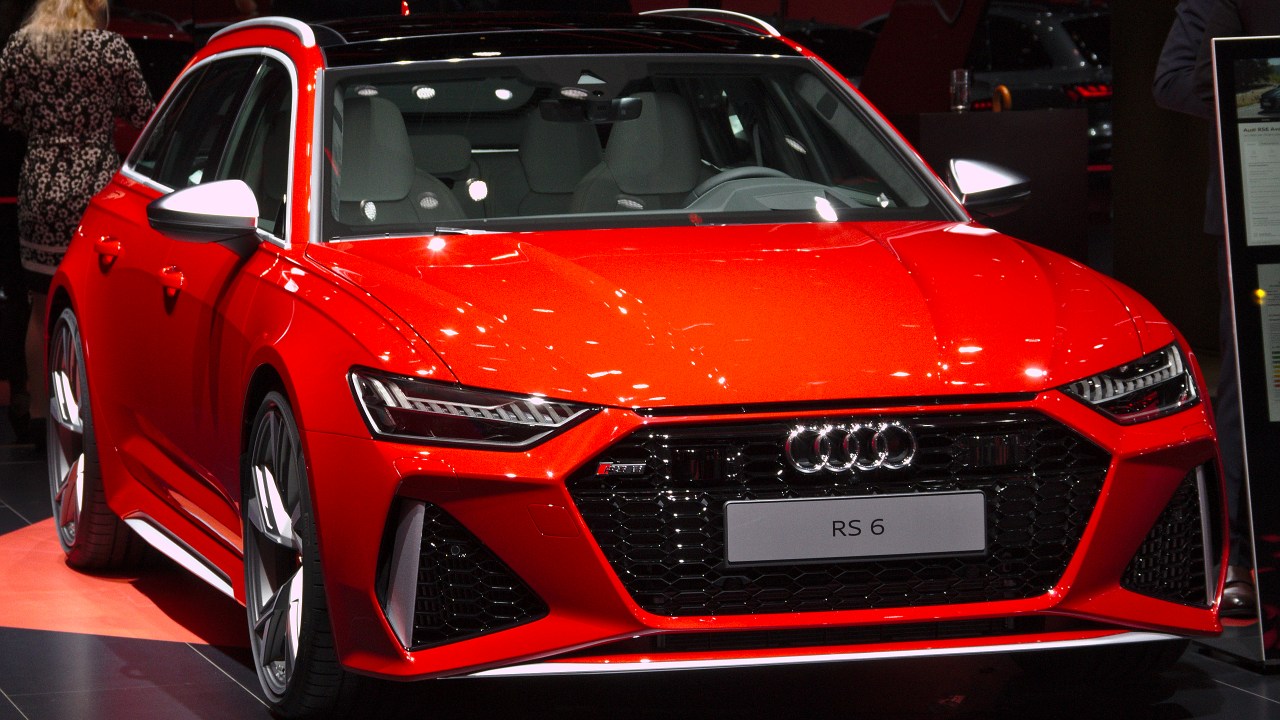
The idea of a family wagon embarrassing low-slung exotics at the drag strip sounds like internet folklore, yet the twin-turbo V10 Audi RS6 has turned that fantasy into repeatable reality. With four doors, a vast cargo area and understated styling, it looks like a commuter car, but in tuned form it has been running quarter-mile times that put it in the same conversation as dedicated supercars and track specials. The spectacle of a long-roof Audi surging past machines wearing Ferrari and McLaren badges has become one of the most compelling storylines in modern performance culture.
The wagon that started as an overachiever
Long before tuners pushed it into supercar territory, the C6-generation Audi RS6 Avant arrived as an overpowered outlier in the executive car park. It combined a twin-turbo, 5.0‑litre V10 with quattro all-wheel drive and a practical wagon body, a package that delivered some 580 hp and a 0–62 mph sprint that rivalled contemporary two-door sports cars. Contemporary testing noted that prototypes were capable of running well past 200 mph, underscoring how much headroom Audi had engineered into the drivetrain and cooling systems.
That foundation matters because it explains why the RS6 V10 responds so aggressively to modification. The same basic architecture that allowed Audi to sign off a 580 hp production car has supported builds ranging from a 700 hp Biturbo Avant focused on brutal accelerations to a 900 hp example lapping the Nürburgring with the driver remarking that he had never seen the oil temperature reach 106 in that car before. Another owner has taken the concept further still with a 1,250 hp Audi RS6 V10 Sedan that competes in the Rolling50 Deutsche Meisterschaft, a setting that demands sustained high-speed stability as well as raw thrust.
From 580 hp to four-figure quarter-mile assassin
The leap from brisk factory wagon to quarter-mile assassin is most obvious in the growing crop of four-figure RS6 builds. A Stage 3 Audi RS6 Avant with more than 1,000 hp has been recorded running 10‑second passes over the 1/4 mile, a benchmark that traditionally belonged to purpose-built drag machinery or the most extreme hypercars. Drivers who are accustomed to fast machinery describe getting goosebumps simply from the anticipation of piloting such a car, a reaction that speaks to how violently a tuned RS6 can deploy its power through all four wheels.
Even below that four-figure threshold, the numbers are startling. A 700 hp Audi RS6 V10 Biturbo Avant has been filmed delivering what onlookers describe as brutal accelerations, its long roof and estate proportions at odds with the way it surges through the gears. The 900 hp Nürburgring car, still based on the same twin-turbo V10, shows that these builds are not limited to straight-line party tricks but can withstand the sustained load and heat of a demanding circuit, again highlighted by that 106 degree oil temperature moment that caught its driver’s attention.
Humiliating exotics in real-world runs
The RS6’s most viral moments have come when it lines up against cars that, on paper, should walk away from a wagon. One of the clearest examples is the 1,250 hp Audi RS6 V10 Sedan facing a 610 hp Audi R8 V10 at a Rolling50 Deutsche Meisterschaft event. The R8, with its lighter body and mid‑engine layout, launches ahead, yet the RS6 reels it in over the measured distance and manages to catch up in just a few heartbeats, a visual demonstration of how sheer power and traction can overturn traditional hierarchies between supercar and sedan.
Similar dynamics play out when the RS6 is pitted against other high-output machinery. A family-car-versus-supercar battle featuring an 850 bhp Audi RS6 against a 770 bhp rival shows the wagon using its extra power and all-wheel-drive traction to decisive effect once speeds rise. In another comparison, a tuned RS6 Avant is timed in the 1/4 mile and its performance is set against the broader drag-race landscape, where a Model listed as McLaren Senna holds a 10.7 second benchmark in a leaderboard that spans everything from hypercars to an R/C car. The fact that a long-roof Audi can edge into that timing territory, even in modified form, is precisely what gives these races their sense of upset.
Context: how close the wagon runs to elite benchmarks
To understand why enthusiasts talk about the RS6 “humiliating” exotics, it helps to place its tuned quarter-mile times alongside established reference points. The McLaren Senna, a track-focused special built in tiny numbers, appears in that drag-race leaderboard with a 1/4‑mile time of 10.7 seconds and is indexed as entry 115 in the table. When a 1,000+ hp RS6 Avant is consistently running 10‑second passes, it is operating in the same performance band as that Model, despite carrying a full interior, a wagon body and the ability to haul luggage or family members.
Other exotics provide similar context. The McLaren Senna and Ferrari 812 GTS are designed from the outset as halo cars, with stripped weight, aggressive aerodynamics and price tags that reflect their exclusivity. By contrast, the RS6 Avant began life as a high-performance derivative of a mainstream platform, yet in tuned V10 form it can match or outstrip such machines over 400 metres. When a 1,250 hp RS6 V10 Sedan is filmed hunting down a race‑worthy Audi R8 V10, or when an 850 bhp wagon walks away from a 770 bhp supercar, the message is clear: in the real world of imperfect surfaces and rolling starts, the right wagon can make some very serious machinery look ordinary.
Why the twin-turbo V10 wagon captivates enthusiasts
Part of the RS6 V10’s appeal lies in how completely it scrambles expectations of what a wagon should be. The Audi RS6 Avant was already celebrated for combining supercar speed in a wagon body, with a twin-turbo engine, quattro all-wheel drive and the ability to sprint from 0–60 mph in around 3 seconds in later V8 form. The V10 generation adds a more exotic soundtrack and a sense of mechanical excess that tuners have been eager to exploit, turning a fast family car into a machine that can run door to door with a McLaren Senna over the quarter mile when sufficiently modified.
That duality of practicality and power is central to its cult status. Enthusiasts point to the Avant’s spacious interior, ample cargo room and comfortable seating as reasons it can handle grocery runs, road trips or track days with equal ease, while its wide fenders and aggressive stance give it a head‑turning presence without the ostentation of a mid‑engine supercar. The Audi RS6 Avant Performance is often cited as proof that practicality and brutal power are not mutually exclusive, and the V10 cars extend that philosophy to an almost absurd degree. In a world where exclusivity and badge prestige often dominate the conversation, the sight of a long-roof Audi quietly queuing at the staging lights and then charging past exotica in 10‑second bursts is precisely what keeps the RS6 twin-turbo V10 wagon lodged in the enthusiast imagination.
More from Fast Lane Only