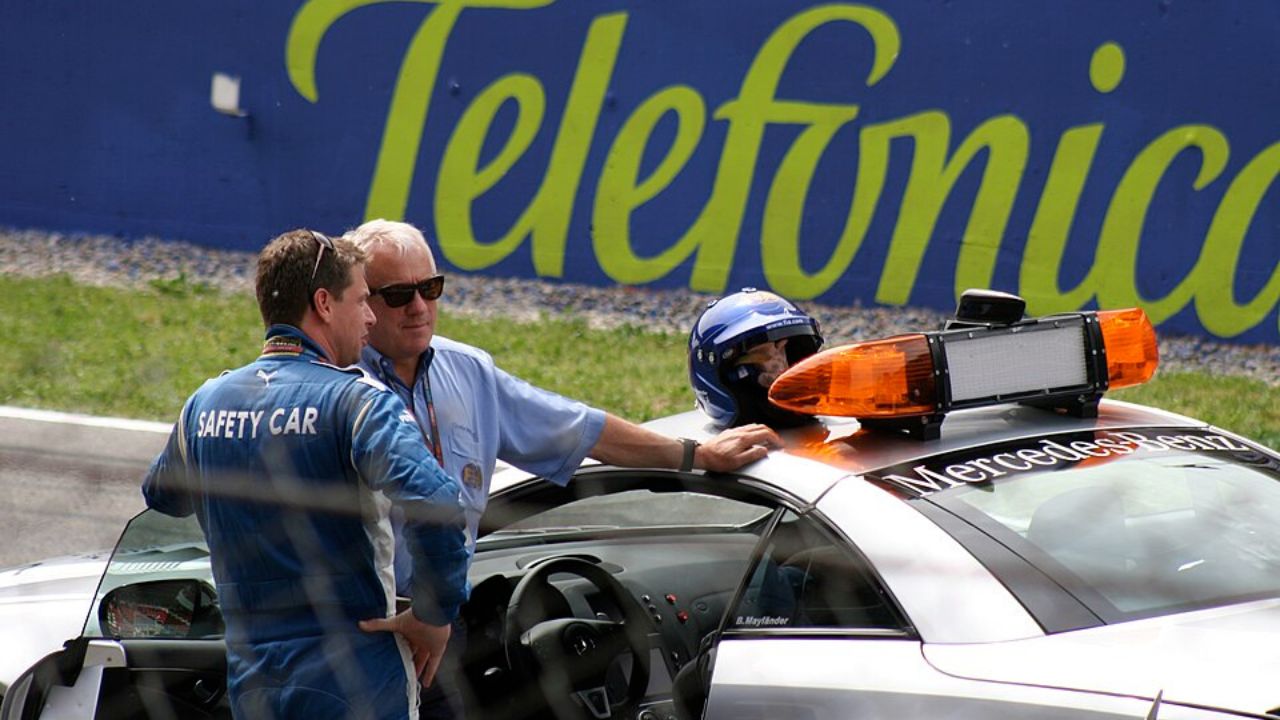
For most Formula 1 fans, the spotlight falls on the drivers, the cars and the championship fight. Yet every grand prix also depends on one man who is not racing at all, but who still feels the same knot in his stomach every time the lights go out. After reaching 500 race weekends in the paddock, long-time safety car driver Bernd Mayländer says the pressure has not eased with experience. If anything, the responsibility of leading a field of 1,000 horsepower cars at reduced speed has only grown heavier.
His milestone underlines that modern F1 safety is not just about carbon fibre and crash structures. It is also about the split-second judgment of the person at the front of the queue when chaos breaks out, and about a job that only becomes more complex as the sport evolves.
What happened
Bernd Mayländer, the official Formula 1 safety car driver, marked his 500th race weekend in the paddock earlier this season. The German, who has been part of the world championship for more than two decades, described how the nerves he felt in his early years have never truly gone away. In an interview, he explained that the weight of responsibility that comes with controlling the pace of the field during incidents still hits him every time he climbs into the cockpit of the safety car, even after reaching the landmark of 500 races.
From the outside, Mayländer’s role appears deceptively simple. When race control calls for the safety car after an accident, poor weather or debris on track, he leads the pack of F1 cars at a controlled speed until conditions are safe again. In reality, that job demands constant communication with race control, close coordination with the medical car, and a fine feel for grip and temperature so the race drivers behind can keep their tyres and brakes alive without taking unnecessary risks.
Across his 500 events, Mayländer has driven a series of high-performance road cars adapted for circuit duty, most recently the Mercedes-AMG GT models that have become a familiar sight at the front of the queue. He has guided the field through torrential rain, multi-car crashes and late-race neutralisations that have swung championships. Each deployment is different, yet he describes the same surge of adrenaline whenever the call comes to leave the pit lane and pick up the leader.
The veteran has also seen his working environment change. The safety car now operates within a more complex framework of race control procedures, virtual safety cars and red flag rules than existed when he first took the job. Onboard systems feed him more data, while live communication with the race director and his own co-driver has become more structured. Even so, the core of the job remains the same: react quickly, drive at the limit of what is safe for the conditions, and hand the race back in the cleanest possible shape.
Reaching 500 race weekends is not just a personal achievement for Mayländer. It is a sign of how central the safety car has become to modern Formula 1. There are seasons where it appears in almost every grand prix, often at moments of maximum tension. The driver at the wheel needs to be ready for that intensity from the first practice session to the final lap of the year, which helps explain why the nerves never quite disappear.
Why it matters
For all the focus on lap times and overtakes, safety is the foundation that allows Formula 1 to push performance so far. The safety car is one of the sport’s most visible safety tools, and its driver carries responsibility that can shape both outcomes and reputations. When Mayländer talks about lingering nerves after 500 weekends, he is describing the mental load that comes with knowing a single misjudgment could have consequences for 20 drivers and hundreds of team members.
Every safety car period compresses the field and resets strategy. Teams gamble on pit stops, tyre choices and track position, and a poorly timed restart can hand an advantage to one driver while trapping another in traffic. The safety car driver sits at the center of that storm. He must choose a pace that keeps tyre temperatures high enough for those behind to avoid dangerous cold-brake moments, while not running so fast that marshals and recovery vehicles are exposed to risk. In wet conditions or low visibility, that balance becomes even more delicate.
Mayländer’s experience helps him judge that balance, but it does not remove the pressure. He has to interpret feedback from the track surface, feel aquaplaning before it becomes a problem, and sense how much the F1 cars behind can tolerate. When he says the nerves have not faded, he is acknowledging that the situation never becomes routine. Each circuit has its own hazards, from blind crests to tight walls, and each incident demands a fresh assessment of how quickly the pack can safely circulate.
The safety car’s influence on championship narratives adds another layer. History is full of title-deciding races where a late safety car scrambled the order, extended a tyre stint or offered a rival a free pit stop. Fans remember the arguments about whether a race should have been restarted or finished behind the safety car, and teams scrutinise every decision from race control. Mayländer’s driving sits inside that scrutiny, because his pace and timing affect how quickly lapped cars can unlap themselves and how much time teams have to react.
His longevity also highlights how specialised the role has become. There is no pool of substitute safety car drivers rotating through the calendar. Instead, one individual builds up knowledge of every track, every pit entry and exit, and the way different generations of F1 cars behave behind him. That continuity is valuable for race directors, who can rely on a known quantity when they send the safety car out into an unfolding incident.
From a safety culture perspective, Mayländer’s comments about enduring nerves cut against any assumption that routine breeds complacency. The fact that someone with 500 race weekends still feels tension before each deployment suggests that the system encourages vigilance rather than comfort. In a sport where the margin between a controlled incident and a serious accident can be a few seconds of miscommunication, that mindset matters.
There is also a human angle. F1 drivers often speak about the pressure of carrying a team’s hopes and the expectations of sponsors and fans. The safety car driver carries a different kind of pressure, grounded in duty of care rather than points. Mayländer’s job is not to win, but to prevent situations where others could lose far more than a race. That responsibility, repeated hundreds of times, explains why experience has not dulled his sense of risk.
On the technical side, his role intersects with the ongoing evolution of safety procedures. The introduction of the virtual safety car, for example, has reduced the number of full safety car deployments in some scenarios, but has not eliminated the need for a physical car and driver. Heavy crashes, poor visibility and track blockages still require a lead vehicle that drivers can follow through a compromised section of circuit. As cars become faster and more sensitive to tyre temperature, the demands on the safety car driver increase rather than shrink.
For teams and drivers, having a consistent and trusted safety car driver is part of their own risk calculations. They know how Mayländer tends to manage restarts, where he likes to accelerate away, and how he responds to changing grip. That predictability is not about giving anyone an advantage, but about reducing surprises at moments when concentration is already stretched. His continued presence after 500 weekends gives the paddock a familiar reference point in a sport that changes regulations, cars and even race formats regularly.
From the fan perspective, the safety car has become a character in its own right. Social media debates erupt whenever it appears, with arguments about whether race control deployed it too early or too late, or whether the restart procedure was fair. Behind those debates sits a real person making real-time decisions at high speed. Mayländer’s reflection that the pressure never fades helps explain why those decisions can be so contentious. They are made in imperfect conditions, often with limited information, and they carry consequences that are dissected in slow motion later.
What to watch next
As Formula 1 continues to expand its calendar and experiment with formats, the demands on the safety car operation will only grow. More races mean more travel, more variables and more potential incidents. For Mayländer, that translates into more weekends where he must be ready to react from the first lap of practice to the final lap of the grand prix. His milestone of 500 race weekends is unlikely to be the endpoint of his involvement, but it does invite questions about succession planning and how the sport prepares the next person who might eventually take the wheel.
Training a future safety car driver will not be as simple as handing over a set of keys. Whoever follows will need deep circuit knowledge, comfort with high-performance machinery and the ability to manage pressure that does not ease with experience. They will also need to integrate into a race control environment that is increasingly data-rich, with live telemetry, GPS positioning and weather feeds informing decisions. Observing how Mayländer works alongside race directors and stewards today offers a template for how that handover might one day unfold.
Procedurally, the sport is likely to keep refining how and when it uses the safety car. Debates about finishing races behind the safety car, how quickly lapped cars should be released, and when a red flag is preferable to a neutralised race will continue. Each high-profile incident tends to trigger a review of the rules, and the safety car driver’s experience is part of those debriefs. Mayländer’s sense of persistent pressure can feed into those conversations, especially when he explains how conditions felt from the front of the queue compared with what cameras showed on television.
Technology will also shape the future of his role. The safety car already uses advanced communication and monitoring systems, but there is scope for even more integration. Real-time grip estimation, more precise weather radar and better visibility tools could all help the driver judge pace in marginal conditions. At the same time, the sport will need to guard against overloading the cockpit with information that distracts from the simple task of driving safely at the limit for the conditions.
There are broader questions too. As Formula 1 leans into sustainability messaging and experiments with alternative fuels and hybrid systems, the choice of safety car and how it is used will attract attention. The current generation of safety cars already reflects that shift with hybrid powertrains and efficiency features, yet they must still be capable of running at speeds that keep F1 tyres alive. Watching how the series balances environmental goals with performance requirements will be part of the safety car story in the next few years.
More from Fast Lane Only