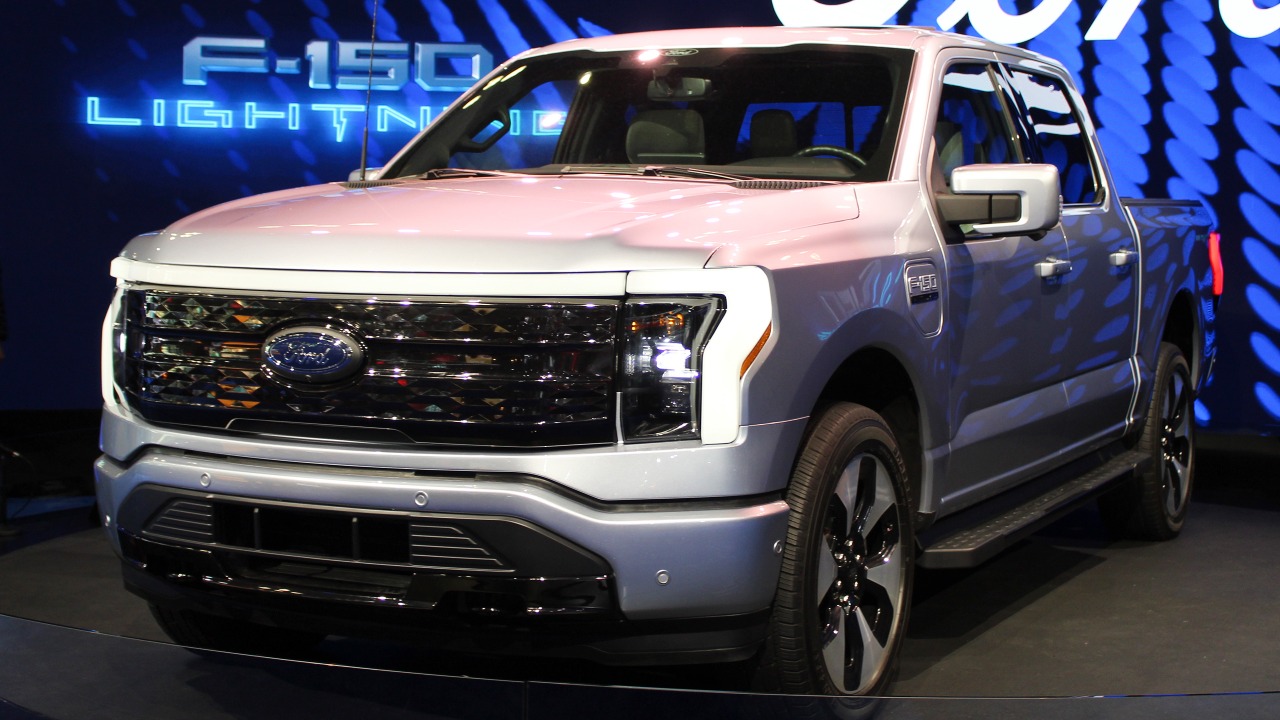
Ford is not only walking away from its next big electric pickup, it is doing so in a way tailored to the current occupant of the Oval Office. In a conversation with President Donald Trump, chief executive Jim Farley confirmed that a planned full size battery truck is being shelved in favor of a new, affordable gasoline powered model that will be built in the United States. The move crystallizes how quickly the political and market winds have shifted around electric vehicles and how aggressively Ford is repositioning its truck strategy.
A quiet burial for Ford’s next full size EV truck
Ford had been working on a new full size electric pickup that was meant to follow the F 150 Lightning and anchor its next generation EV lineup. That project is now effectively dead, replaced by a lower cost internal combustion truck that Farley described to President Trump as something he would appreciate. Reporting from Jan indicates that the company has confirmed a new gas powered pickup for its Tennessee operations, explicitly framed as a substitute for the previously planned electric model that was supposed to sit below the Lightning in price and size.
Farley’s message to the president fits a broader reset. Earlier plans called for a sub $30,000 electric pickup that Farley once likened to an “Apollo” level effort inside Ford, a reference he tied to the Apollo and Gemini programs in the United States space race. That affordable EV, which internal teams had treated as a moonshot, is now being displaced by a conventional truck that can be engineered and produced with far less risk. In private briefings, Farley has acknowledged that the new ICE product will take the place of the promised budget EV pickup that had been slated for the Tennessee Truck Plant, a decision that underscores how far the company has moved from its earlier rhetoric about a mass market electric work truck.
From Lightning to hybrids and range extenders
The cancellation of the next big EV truck does not stand alone, it follows Ford’s decision to end production of the all electric F 150 Lightning and pivot toward hybrid and extended range gasoline platforms. Ford Motor Co has already said it will cease building the Lightning by the end of 2025, less than four years after launch, and will instead develop a pickup that uses a gasoline range extender powertrain. Separate reporting describes how Ford has stopped production of the all electric F 150 Lightning and is turning to hybrids, with executives saying they are “following the customer” as they reconfigure the truck lineup.
Financially, the retreat is significant. In Dec, Ford acknowledged that it is canceling the F 150 Lightning fully electric pickup and taking a $19.5 billion charge as it moves away from its earlier EV truck strategy. Analysts have noted that the company has effectively pulled the plug on the Lightning, with no direct all battery replacement planned and a new emphasis on an EREV concept described in internal documents as Ford Cancels Electric F 150 Lightning, Plans EREV Instead. The repeated use of the number 150 in these reports is a reminder that this is not a niche product but the electric offshoot of the country’s best selling truck, which makes the reversal all the more consequential.
Why Ford is betting on gasoline again
Ford’s shift back toward gasoline and hybrid trucks is rooted in a mix of policy changes, cost pressures, and consumer hesitation. Executives have cited slower than expected EV demand, particularly in the full size pickup segment, where buyers remain sensitive to towing range, charging infrastructure, and upfront price. High battery costs, persistent supply chain volatility, and uncertainty about long term incentives have all contributed to what one internal assessment described as mounting pressure on legacy carmakers, a pressure that has pushed Ford to scrap some of its EV dreams in favor of gas generator hybrids and more traditional powertrains.
Regulatory signals have also changed. Farley has privately acknowledged that the new ICE truck strategy is easier to justify in a world of lowered EPA fuel economy standards, a shift that aligns with the Trump administration’s approach to environmental regulation. In that context, a USA built affordable ICE truck becomes not only a market play but a political statement, one that can be presented to the president as proof that Ford is investing in domestic manufacturing and conventional engines rather than chasing mandates. The company’s decision to replace a sub $30,000 electric pickup with a combustion model reflects a calculation that, under current rules, it can meet compliance targets while still giving truck buyers the familiar refueling experience they prefer.
Trump, Farley, and the politics of a “truck he’ll love”
When Farley told President Trump that Ford was scrapping its next big EV truck in favor of a gasoline pickup he would like, he was doing more than offering a sound bite. The exchange, described in Jan reporting, took place during a factory visit where Farley touted a new USA built “affordable” ICE powered truck and confirmed that it would replace the previously promised budget EV. By framing the decision in terms of what the president would appreciate, Farley signaled that Ford sees political capital in aligning its truck portfolio with Trump’s skepticism toward aggressive electrification targets.
The symbolism matters. Trump has repeatedly championed traditional energy and has been critical of policies that he argues force consumers into electric vehicles before the market is ready. Farley’s decision to highlight a new gas powered pickup, built in Tennessee and pitched as a value oriented work truck, fits neatly into that narrative. It allows Ford to present itself as listening to both “the customer” and the current administration, while quietly shelving an EV program that had become financially and technically challenging. In that sense, the “truck he’ll love” line is less a throwaway remark and more a concise summary of Ford’s recalibrated political and commercial strategy.
Localization, labor, and the new truck map
Ford’s truck rethink is unfolding alongside a broader industry pivot away from globalized supply chains and toward more localized production footprints. Industry leaders have described how automakers are reversing decades of globalization and investing in regional manufacturing hubs, a trend that has been especially pronounced in North America. One trade group representative captured the mood by noting that, At the same time, though, we also know that there are still many unknowns, and followed that with a reminder from Our members that “Never say never” when it comes to future technology shifts. For now, however, the momentum is clearly behind building more vehicles, including trucks, closer to their end markets.
Ford’s decision to anchor its new affordable ICE pickup in Tennessee fits squarely within this localization wave. By committing to USA built trucks, the company can appeal to Trump’s emphasis on domestic manufacturing, reassure unions and local officials about job security, and reduce exposure to cross border trade friction. Earlier hints from Jan coverage of Farley’s remarks pointed to the Tennessee Truck Plant as a focal point for this strategy, with the new gasoline model taking the production slot once reserved for the sub $30,000 EV. In practice, that means workers who might have been assembling battery packs and electric drivetrains will instead be building conventional engines and transmissions, at least for the next product cycle.
More from Fast Lane Only