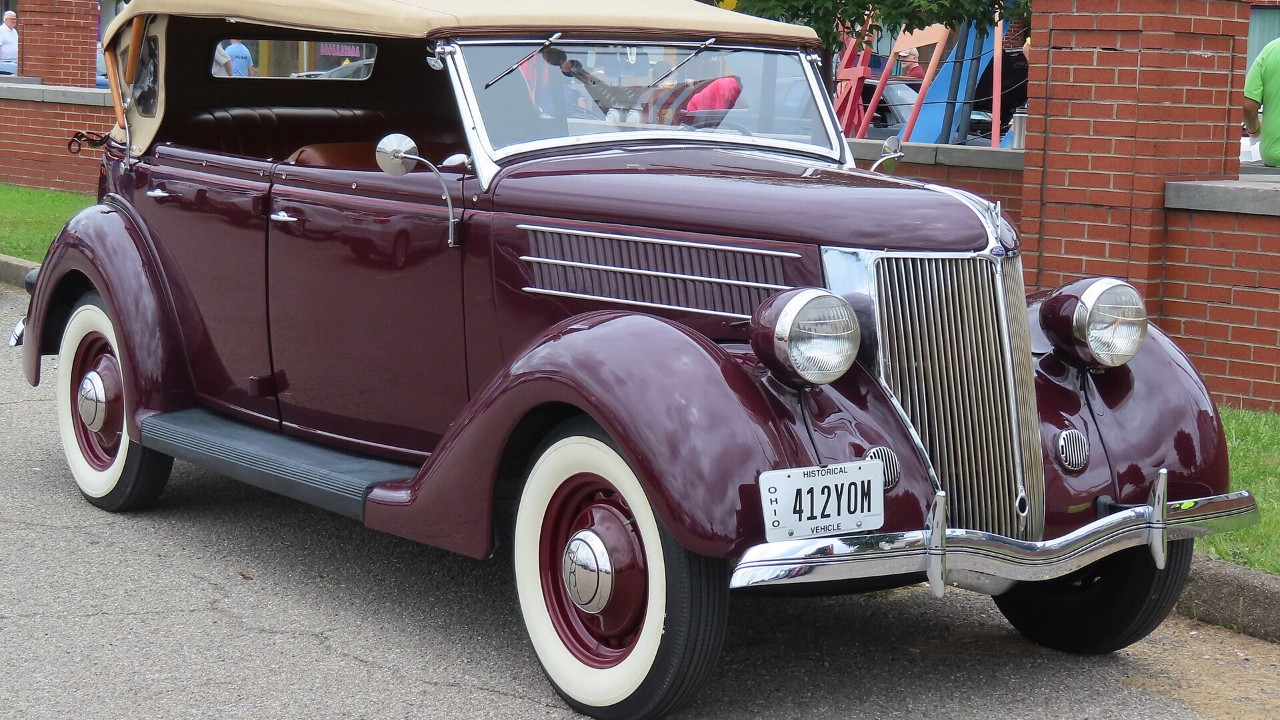
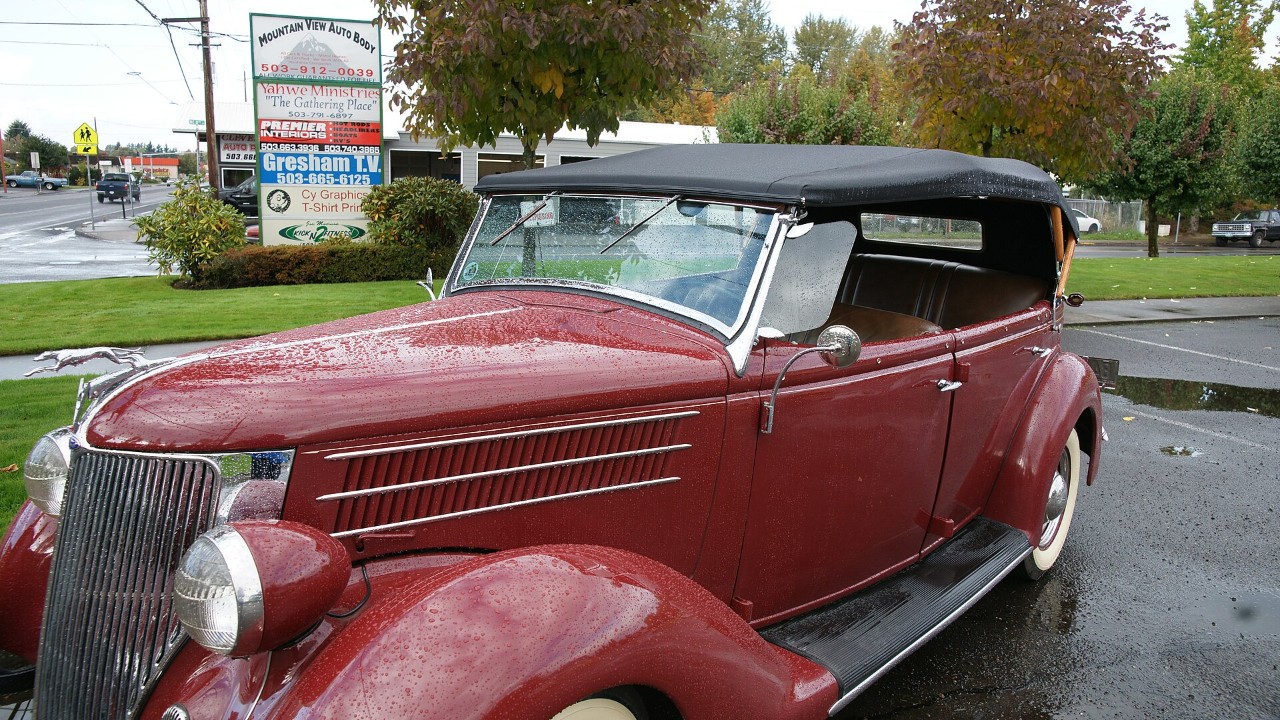
Franklin D. Roosevelt could not use his legs to drive, yet he drove himself around Hyde Park in a 1936 Ford Phaeton fitted with hand controls. That FDR Ford Phaeton covered 19,143 miles. After his death, Eleanor Roosevelt kept driving it, then gave it to his presidential library, where it is on display today.
The car itself is an ordinary open Ford, not a limousine. What makes it worth a look is the hardware a local mechanic added. Thanks to that work, a president who had lost the use of his legs could take the wheel himself.
Every detail below comes from the National Park Service, the FDR Library, the White House Historical Association, an RM Sotheby’s catalog and a classic car dealer. Where only one outlet describes something, the text says so.
Why Roosevelt needed hand controls
Roosevelt contracted polio in 1921, at the age of 39, and lost almost all use of his legs. That is how historian Lina Mann describes it in the White House Historical Association’s history of Roosevelt’s presidential cars. As a result, he had his private automobiles outfitted with special hand controls.
Those private cars were separate from the official fleet. According to Mann, he owned a 1938 Ford Convertible Coupe and a 1936 Ford Phaeton for personal use at his home in Hyde Park, New York. He also used them when he visited the “Little White House” in Warm Springs, Georgia. By contrast, the Secret Service primarily used the Cadillacs in the fleet. Roosevelt, she writes, loved to drive on back country roads with the top down.
How FDR’s Ford Phaeton hand controls worked
The National Park Service credits the controls to Fred Relyea, a mechanic in Poughkeepsie, New York, who designed and installed them. Because of them, the NPS says, Roosevelt could drive despite his disability. He enjoyed driving the car whenever he was at Hyde Park.
A January 2026 article on We Are The Mighty describes how the system worked. First, Relyea turned the throttle and choke into dashboard knobs. Then a single lever replaced both the clutch and the brake. Moved in calibrated stages, it released the clutch, reengaged it and finally applied the brakes.
That setup demanded coordination. To steer, the same article says, Roosevelt braced his torso against the wheel and used his upper-body strength. At the same time, he worked several hand controls at once.
What Ford built in 1936
Ford introduced its 1936 models on October 19, 1935, according to Heacock Classic. The lineup offered 10 body styles, and Ford sold more than a million cars that year. Heacock describes the phaeton as a four-passenger open car with a three-speed manual transmission and four-wheel drum brakes.
For a closer look, RM Sotheby’s catalog for a 1936 Model 68 DeLuxe Phaeton describes an open car with no roll-up door glass and only a minimal top. That example carries the 221-cubic-inch flathead V8, rated at 85 horsepower. RM also calls it one of 5,555 built for 1936.
However, none of the sources say which trim level Roosevelt’s car was. Those figures describe the model, not his particular car. Still, RM notes that Ford sold nearly 20,000 open cars in 1936, even as other makers dropped open models.
From Eleanor Roosevelt to the FDR Library
After the president’s death, Eleanor Roosevelt kept using the Phaeton until 1946, the NPS says. She then gave it to the Franklin D. Roosevelt Presidential Library and Museum in Hyde Park. By then the car had covered 19,143 miles.
The library treats it as a centerpiece. In a 2012 renovation update, the FDR Library called the Phaeton the largest object in its museum collection. At that point, the car had been on display on the library’s lower level for over 65 years.
That size became a problem during the renovation. Because of it, the car could not leave the lower level while demolition and construction went on there. So conservators built a special crate to protect it and move it around the floor as work progressed. The library planned to return it to public view in the summer of 2013, when its new permanent exhibits opened.
Seeing the car today
Today the Phaeton remains on exhibit at the library, according to the NPS. A souvenir postcard from around 1970, held by the Chester Historical Society, shows it as a deep blue convertible on the library’s lower level. The back of the card also mentions its special manual controls.
Visitors can also see the custom levers, knobs and mechanisms Relyea added, We Are The Mighty notes. By the NPS count, the car Roosevelt drove himself, and Eleanor after him, covered 19,143 miles before it went on display.
More from Fast Lane Only
- Unboxing the WWII Jeep in a Crate
- 15 rare Chevys collectors are quietly buying
- 10 underrated V8s still worth hunting down
- Police notice this before you even roll window down
This article was created with the help of AI and was reviewed and edited by Fast Lane Only editors before publication.