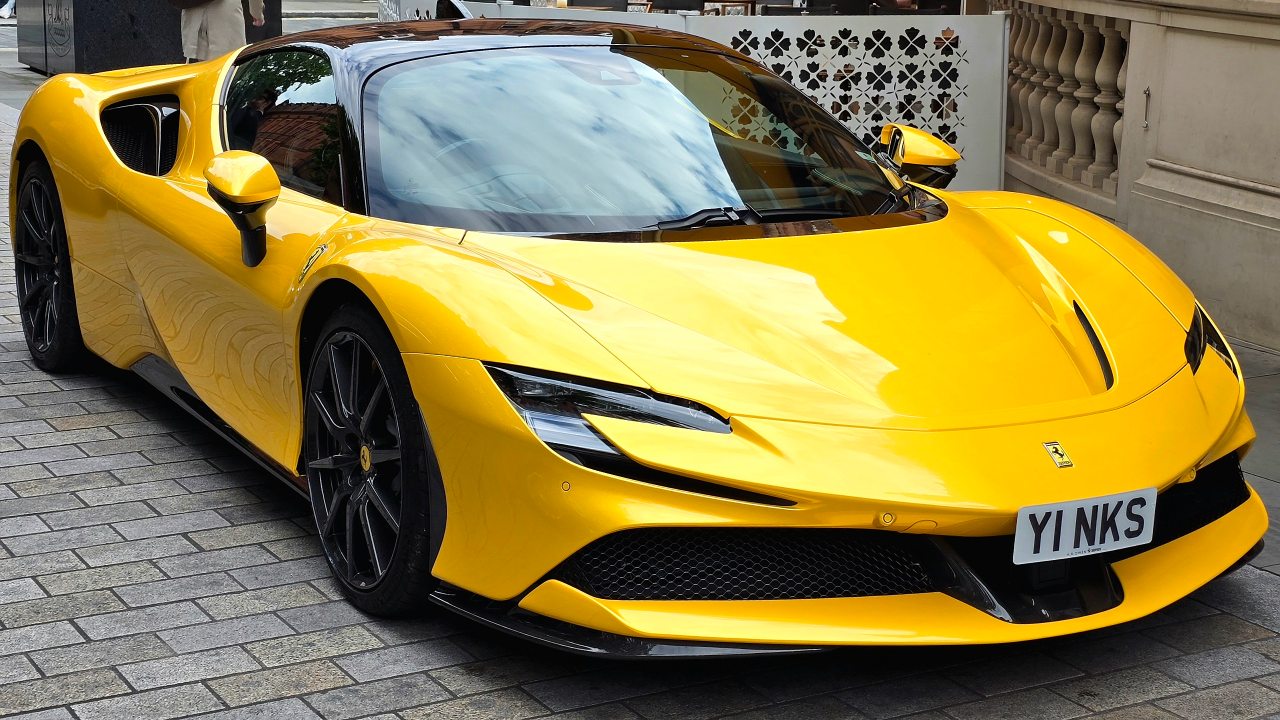
Ferrari has quietly confirmed what many in the industry suspected: a large share of its plug-in hybrid supercar owners rarely, if ever, connect their cars to a charger. Instead of treating the battery as a primary power source, customers are leaning on the combustion engine and letting the electric hardware play a supporting role. The admission raises uncomfortable questions about how electrification works when the vehicles in question are six‑figure toys rather than daily transport.
Behind the headline is a deeper story about how ultra‑wealthy drivers actually use high performance hybrids, and how a brand built on noise and drama is trying to reconcile that heritage with tightening emissions rules. Ferrari’s own internal data suggests that the plug is often an afterthought, even as the company prepares to roll out more electrified models.
Ferrari’s data shows hybrids are treated like traditional supercars
Ferrari has disclosed that owners of its plug‑in hybrid models, notably the SF90 Stradale and the 296 GTB, are seldom charging their cars. Internal Analysis of five years of Ferrari ownership data indicates that pure electric driving modes are “almost never” selected and that the cars are typically operated with the combustion engine running, while the hybrid system simply blends in electric power when needed. In practice, that means the 986 horsepower SF90 Stradale and the 819-horsepower 296 GTB are being driven much like earlier petrol‑only Ferraris, despite the presence of sizeable batteries and charging ports.
The company’s review of usage patterns also shows that many cars spend long stretches parked without being plugged in, even though the high voltage battery is designed to be maintained on charge when the vehicle is in storage. Ferrari Says 296, SF90 Owners Aren, Really Plugging In Their Hybrid Sports Cars, and that Hybrid Ferrari Owners Aren, Plugging In Much, a pattern that aligns with what The Prancing Horse has now publicly acknowledged. For a brand that introduced the SF90 Stradale as its first series production plug‑in hybrid and followed it with the 296 GTB to keep pace with emissions regulations, the revelation underscores a gap between regulatory intent and real‑world behavior.
Owners prize performance and sound over electric range
The usage data reflects a simple reality: Ferrari buyers are prioritizing performance, sound, and emotional engagement over electric range or fuel savings. Owners of the current plug‑in models appear to treat the battery as a performance enhancer rather than a standalone power source, relying on the electric motors for extra torque and sharper response while allowing the petrol engine to do most of the work. Reports on why Ferrari owners are not charging their plug‑in hybrid supercars note that the first driving mode, which is a pure‑electric setting, and the second, which automatically switches between power sources, are seldom if ever used, with customers instead favoring modes that keep the engine active.
That preference is consistent with the way these cars are marketed and experienced. The SF90 Stradale was introduced as the most powerful road Ferrari to date, with 986 hp, and the 296 GTB as an 819-horsepower plug‑in hybrid that mates a smaller engine with a battery to maintain Ferrari NV performance standards. For many buyers, the appeal lies in the combination of a high revving combustion engine and instant electric shove, not in silently gliding through city centers. As a result, the plug‑in capability becomes a technical feature that satisfies regulators and spec sheets, while the day‑to‑day driving experience remains firmly anchored in traditional supercar theatrics.
The 849 Testarossa launch pulled back the curtain
Ferrari’s candid comments about charging habits surfaced around the launch of the new 849 Testarossa, a model that further refines the brand’s hybrid strategy. During an event for the 849 Testarossa in Spain, company representatives explained that most owners of its plug‑in hybrid vehicles do not actually plug them in, and that this insight had shaped the calibration of the latest car. The revelation, highlighted in coverage of why Ferrari owners are not charging their plug‑in hybrid supercars, made explicit that the brand is designing around the expectation that many customers will rarely use a wallbox.
With the 849 Testarossa, engineers have focused on making the car feel natural and engaging even when the battery is not fully charged. Brake feel and energy recovery remain tied closely to this strategy, with the company describing how, With the 849 Testarossa, blending regenerative braking with conventional friction brakes is tuned so that drivers who never plug in still experience consistent pedal response. In hybrid mode, the intent is for the car to manage its own energy flows, harvesting enough charge under braking and deceleration that the driver does not feel compelled to plug the vehicle in. That approach effectively treats external charging as optional, even though the car retains full plug‑in capability.
Regulatory pressure meets real‑world behavior
The disconnect between how Ferrari’s plug‑in hybrids are used and how regulators imagine hybrids should operate is stark. Policymakers have encouraged plug‑in technology on the assumption that drivers will charge regularly and spend meaningful time in electric mode, cutting local emissions. Ferrari’s internal Analysis of ownership patterns suggests that, at least in the supercar segment, that assumption does not hold. The Prancing Horse has admitted that most owners of its plug‑in hybrid vehicles do not actually plug them in, a finding that complicates the environmental case for such models when they are driven primarily on petrol power.
Ferrari NV developed the 296 GTB and SF90 Stradale in part to comply with tightening emissions regulations in Europe and other markets, pairing smaller engines with batteries and electric motors to reduce official CO₂ figures. Yet if customers rarely charge, the real‑world emissions of these cars will sit closer to those of conventional high performance models, even if laboratory test cycles show dramatic reductions. Analysts have noted that this pattern is not unique to Ferrari, but the brand’s willingness to acknowledge it publicly, including through comments relayed via Australia based reporting, highlights a tension between regulatory frameworks that reward plug‑in capability and user behavior that treats the plug as optional.
Ferrari is quietly designing for “charge‑optional” hybrids
Faced with customers who do not plug in, Ferrari is adapting its engineering approach rather than trying to change owner behavior. The company’s hybrid strategy now emphasizes self sufficiency, with cars that can maintain adequate battery charge through driving alone. In hybrid modes, the powertrain is calibrated so that the engine and regenerative braking replenish the battery enough to support repeated bursts of electric assistance, even if the car has not seen a cable for days. Internal Analysis of Ferrari usage data has guided this approach, confirming that pure electric modes are almost never utilized and that the system must deliver its promised performance without relying on diligent charging.
This philosophy is evident in the 849 Testarossa, where Brake feel and energy recovery are tuned to make the car feel cohesive regardless of state of charge, and in the way the SF90 Stradale and 296 GTB manage their multiple drive modes. Owners Aren, Really Plugging In Their Hybrid Sports Cars, yet Ferrari Says the cars still need to feel responsive and special in every scenario. That has led to hybrids that behave more like sophisticated performance enhancers than like plug‑in commuters, with electric power deployed primarily to sharpen acceleration and fill torque gaps rather than to maximize zero‑emission miles. For regulators and environmental advocates, that may be a frustrating compromise. For Ferrari’s clientele, it appears to be exactly what they want.
More from Fast Lane Only