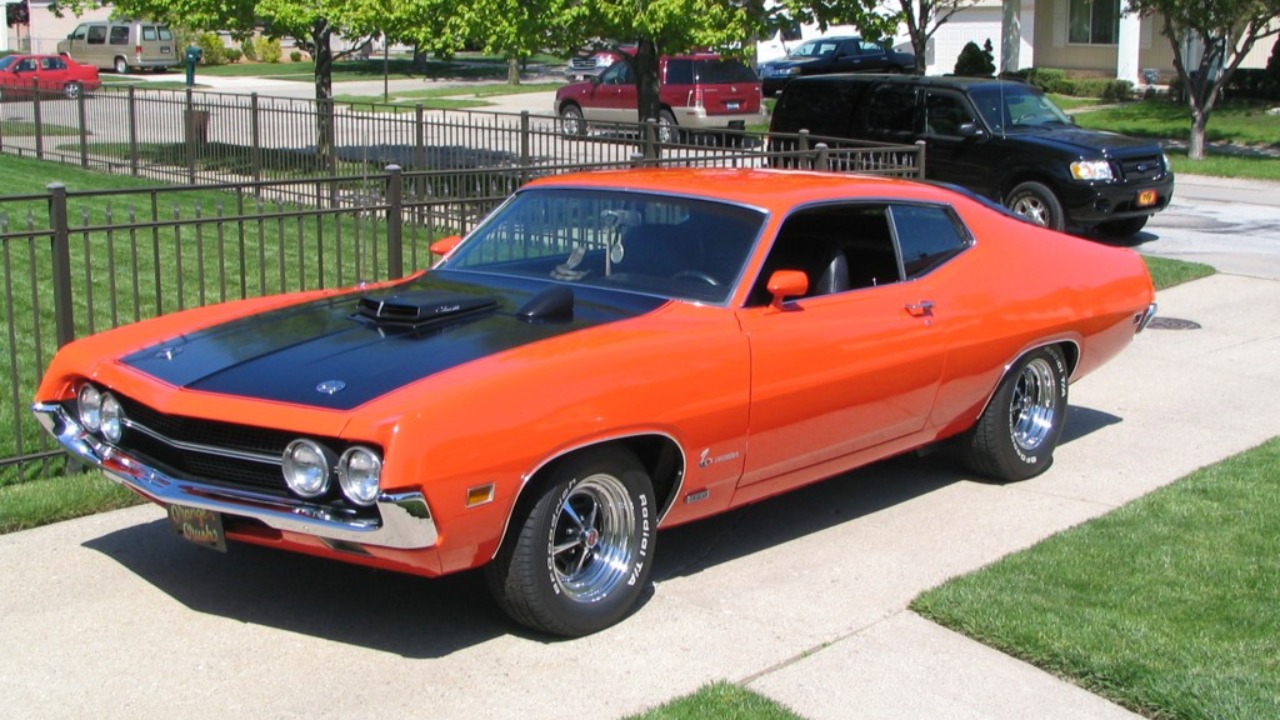
The Ford Torino Cobra arrived at the height of Detroit’s horsepower wars with a simple brief: run hard on Sunday and scare rivals on Monday. Built around big cubic inches and minimal frills, it was engineered to compete in NASCAR and on the drag strip, earning a reputation as a brutal, underrated muscle car that could embarrass more glamorous rivals. Decades later, the 1970 Ford Torino Cobra still stands out as a purpose-built performance machine that delivered on that mission.
From NASCAR aero wars to street brawler
Ford did not create the Torino performance line in a vacuum. The company had already pushed the limits of aerodynamics with the slippery fastback Torino Talladega, a car that, in 1968 and 69, had smoked the competition until rivals responded with wild shapes of their own. The Dodge Daytona and Plymouth Superbird arrived as wind-tunnel specials, and Ford needed a new answer that could keep the brand at the front of the pack.
That response fed into the broader Torino program. Earlier, Ford was all-in, and the Torino carried aggressive body lines and serious engine options that signaled its intent. The platform became a staple in stock car racing, and later accounts of its Racing Heritage The platform highlight how drivers like David Pearson used Torinos in NASCAR competition.
At the same time, Ford explored even more extreme ideas. The Torino King Cobra project, described as Torino King Cobra and intended as Ford’s answer to the Dodge Daytona and Plymouth Superbird on the NASCAR circuit, showed how far the company was willing to go. That car never reached full production, but the mindset behind it shaped the performance expectations that surrounded the Torino Cobra on the street.
1970 Ford Torino Cobra: built for speed, not comfort
By 1970, Ford had refined the formula into what enthusiasts now recognize as the definitive Ford Torino Cobra. Contemporary descriptions portray the 1970 Ford Torino Cobra as a no-nonsense, high-performance machine built for speed, power, and dominance on both street and strip, a view echoed in later coverage of the Ford Torino Cobra as an unsung muscle legend.
Under the hood sat the big-block 429, available in several levels of tune. With the available shaker scoop, this engine was called the 429 Cobra Jet Ram Air, but it remained at 370 bhp. Among the better points of that package were strong midrange torque and durability that made it ideal for sustained high-speed work.
The Super Cobra Jet, often abbreviated SCJ, pushed the concept further. Enthusiast accounts describe the 1970 Ford Torino Cobra 429 SCJ as a standout in Ford’s performance history. This car paired the big 429 with heavy-duty internals and drag-oriented gearing that could be nearly unbeatable on the strip when properly set up.
Inside, the Torino Cobra stayed focused on the job. One period description of the broader 429 Cobra Jet family notes that a typical car rode on 14-inch Magnum 500 wheels with Goodyear Polyglas GT tires, and that the Magnum-shod package was matched to a relatively spartan interior, with bucket seats and simple controls. The Torino Cobra followed that ethos, stripping away luxury in favor of performance hardware.
Engines that made the Cobra name
The heart of the 1970 Ford Torino Cobra was the 429 family. Entry-level cars could be ordered with a Thunderjet 429 rated at 360 horsepower, a figure cited in a drag race breakdown of a Torino Cobra that started with a Thunderjet 429 rated 360 hp before moving up to more serious setups. Stepping up to the Cobra Jet and Super Cobra Jet versions brought revised internals, better breathing, and optional Drag Pack equipment that transformed the car into a quarter-mile threat.
Performance-oriented coverage of the 1970 Ford Torino Cobra consistently highlights the 429 as a purpose-performance engine. One feature on the 1970 Ford Torino Cobra 429 SCJ notes that the big block was engineered as a drag and NASCAR-capable unit, and that the Peak Muscle Era configuration arrived in multiple levels of tune to suit different buyers.
Even outside Torino, the 429 Cobra Jet earned a reputation as one of the most legendary big-block engines. Later retrospectives describe how the 429 Cobra Jet is highly regarded among collectors and that its combination of displacement and torque has kept its legend alive for generations. That broader halo effect continues to benefit the Torino Cobra, which shared that hardware at a time when horsepower battles were near their peak.
Quarter-mile performance for pocket change
Raw numbers helped the Torino Cobra build its reputation. Modern testers who revisit well-tuned cars report that the 1970 Ford Torino Cobra delivered 13-second quarter miles for pocket change, a claim repeated in a video that calls it a cheap V8 muscle car that hid in plain sight and notes that the Ford Torino Cobra could run in the 13s while costing far less than some headline rivals.
That performance came from a mix of engine tuning and gearing. The Super Cobra Jet package, especially when paired with a Drag Pack, used steep rear axle ratios that let the 429 hit its stride quickly. Enthusiast coverage of the 1970 Ford Torino Cobra 429 SCJ emphasizes that this setup was almost unbeatable on the drag strip when launched correctly, and that the car’s combination of weight distribution and torque gave it an edge in real-world runs.
Yet the Torino Cobra carried a relatively understated image. A later feature that looked back at the car described it as an unassuming supercar slayer, noting that early assessment of the 70 Torino by some reviewers was lukewarm, even as owners quietly discovered that the big-block Ford could outrun many higher-profile machines.
Styling that split opinion but served speed
The 1970 Torino body that underpinned the Cobra carried more modern styling than earlier models, with a long hood, short deck, and a fastback roofline that nodded to the Torino Talladega and its NASCAR roots. Some buyers preferred the cleaner lines of earlier Fairlane-based cars, yet the 1970 shape gave the Cobra a distinctive presence.
Designers balanced that visual drama with functional elements. The shaker scoop on 429 Cobra Jet Ram Air cars was not just a styling cue; it was a way to feed cooler air to the engine. Descriptions of the Cobra Jet Ram Air configuration emphasize that, even as the car aged and styling trends shifted, this mix of form and function remained one of its better points.
Wheel and tire choices reinforced the performance message. Cars equipped with 14-inch Magnum 500 wheels and Goodyear Polyglas GT tires looked ready for the staging lanes straight from the showroom. The stance, combined with the fastback profile and minimal chrome, gave the Torino Cobra a purposeful attitude that matched its performance claims.
On the oval: Torino and NASCAR glory
Although the specific 1970 Torino Cobra did not become a separate NASCAR homologation special in the way that the Torino Talladega or the proposed King Cobra did, the broader Torino line had already cemented Ford’s reputation on the oval. A social media highlight of the Ford Torino Talladega describes it as Ford’s wind-cheating NASCAR homologation car, complete with a reworked front end, extended rocker panels, and a standard 428 Cobra Jet that turned the car into a high-speed weapon.
Drivers like David Pearson carried that legacy. A period look at David Pearson in his 1969 Ford Torino Talladega shows how the car of a champion represented Ford at the top level of stock car racing. That success fed directly into the marketing and engineering mindset behind the 1970 Torino Cobra, which was sold to customers who wanted a piece of that competition pedigree in their driveway.
Later enthusiasts have tied the road car back to this heritage. The Racing Heritage The Torino platform description notes that Torinos were heavily involved in NASCAR racing and that thousands of Torino Cobras were produced in 1970 for buyers who wanted a street-legal extension of that track identity.
Drag strip battles and the Super Cobra Jet mystique
If NASCAR gave the Torino line credibility, the drag strip gave the Torino Cobra its legend. Accounts of period matchups describe scenarios where a 1970 Torino Super Cobra Jet faced off against a 1974 Pontiac in heads-up racing, with commentators explaining that the Torino Cobra started life with a Thunderjet 429 rated 360 horsepower and could be upgraded to more aggressive combinations that transformed its quarter-mile performance.
The Super Cobra Jet package bundled heavy-duty internals, revised oiling, and specific gearing that made the car ideal for weekend bracket racing. Coverage of the 1970 Ford Torino Cobra 429 SCJ highlights how the Drag Pack option turned the car into a serious bracket contender, with some enthusiasts calling it nearly unbeatable on the drag strip when tuned correctly.
These stories reinforce why the Torino Cobra has retained a dedicated following among drag racers and collectors who value straight-line performance. While some rival muscle cars leaned more on image or luxury, the Torino Cobra focused on delivering consistent, repeatable speed.
Why the Torino Cobra stayed underrated
Despite its capabilities, the Torino Cobra never quite achieved the mainstream fame of some competitors. A profile of the 1970 Ford Torino Cobra notes that Torino Cobras were not as widely celebrated as certain Chevrolets or Mopars in their day, yet age has its good points for cars like this. The relative lack of hype helped keep prices reasonable for years, which in turn attracted enthusiasts who valued performance over badges.
Part of the reason may lie in timing. The 1970 model arrived at the tail end of the Peak Muscle Era, just before emissions regulations and insurance pressures began to cut into performance. A retrospective on the Legacy and Cult Status of the 1970 Ford Torino Cobra 429 SCJ frames it as a true product of 1970, a moment when horsepower battles were at their peak before emissions and insurance changes reshaped the market.
Another factor was Ford’s own corporate strategy. One modern video commentary argues that the 1970 Ford Torino Cobra delivered 13-second quarter miles for pocket change but that Ford killed its racing dreams before they started, suggesting that shifting priorities and factory support limited the car’s visibility in organized competition.
Cult status and collector appeal today
Today, the 1970 Ford Torino Cobra enjoys a growing cult following. Enthusiast pages that spotlight the 1970 Ford Torino Cobra 429 SCJ describe it as a Detroit muscle powerhouse and emphasize its status as a standout in Ford’s performance history. The combination of big-block torque, NASCAR-linked heritage, and relatively low production has made it a sought-after piece for collectors who want something different from the usual muscle car roster.
Specialists who track the market point out that having a 1970 Ford Torino Cobra SCJ in a garage has become a dream for many enthusiasts, and that surviving examples of these cars are treated as significant artifacts of Ford’s performance era. The car’s mix of straight-line performance, racing heritage, and understated styling has helped it transition from underrated street brawler to respected collectible.
More from Fast Lane Only