Ford once came remarkably close to putting a mid-engine supercar into American driveways, and at its heart sat a Yamaha-tuned V6 that later became famous in a family sedan. Conceived to challenge European exotics on their own terms, the Ford GN34 project fused racing-inspired packaging with the high-revving Ford-Yamaha SHO engine long before the Honda NSX reached showrooms. Its quiet cancellation left behind a tantalizing “what if” that still reshapes how I think about Ford’s performance history.
Reconstructing that story reveals a company willing to experiment far beyond the Mustang, only to retreat just as the concept matured. The GN34 was not a styling exercise or a one-off Prototype, but a serious attempt to build a mid-engine production car that could stand beside Ferrari. Understanding why it never reached the road helps explain how Ford’s priorities shifted toward volume products like SUVs, and why the Taurus SHO ended up carrying an engine that had been destined for something far more exotic.
Ford’s secret Ferrari fighter
In the early 1980s, Ford quietly authorized a program that aimed directly at the European supercar establishment, with the GN34 envisioned as a mid-engine coupe capable of running with Ferrari on performance and presence. Engineers from Ford Special Vehicle Operations treated it as a clean-sheet challenge, using a compact layout and low-slung proportions to package a transverse V6 behind the driver and ahead of the rear axle. Internal accounts describe the GN34 as a genuine Ferrari competitor rather than a halo version of an existing Mustang or Thunderbird, a car intended to meet the Italians on their own territory rather than simply evoke their style.
That ambition is clear in later reporting that traces the GN34 back to a broader Ford VS Ferrari Well narrative, where company insiders wanted a road-going answer to the track battles that had defined the 1960s. The project was not public, and even within Ford it remained a relatively quiet effort, but the intent was unmistakable: a mid-engine layout, a bespoke chassis, and performance targets aligned with contemporary European exotics. When later sources describe the GN34 as a secret mid-engine supercar that never made it, they are capturing the sense that this was meant to be more than a design study, it was a potential production flagship that simply never crossed the finish line.
The Yamaha-tuned heart of the GN34
At the center of the GN34 story sits the engine that gives this forgotten car its modern resonance, the Ford-Yamaha SHO V6. Ford had partnered with Yamaha to develop a high specific output V6 with four valves per cylinder and a free-revving character that contrasted sharply with the pushrod V8s that defined the Mustang at the time. In GN34 form, this Yamaha Tuned Mid Engined Supercar Before The Honda NSX Existed would have used that compact, sophisticated V6 mounted amidships, taking advantage of its relatively small footprint and willingness to spin to high rpm. The idea was to deliver European-style power delivery and refinement in a package that still carried a blue oval badge.
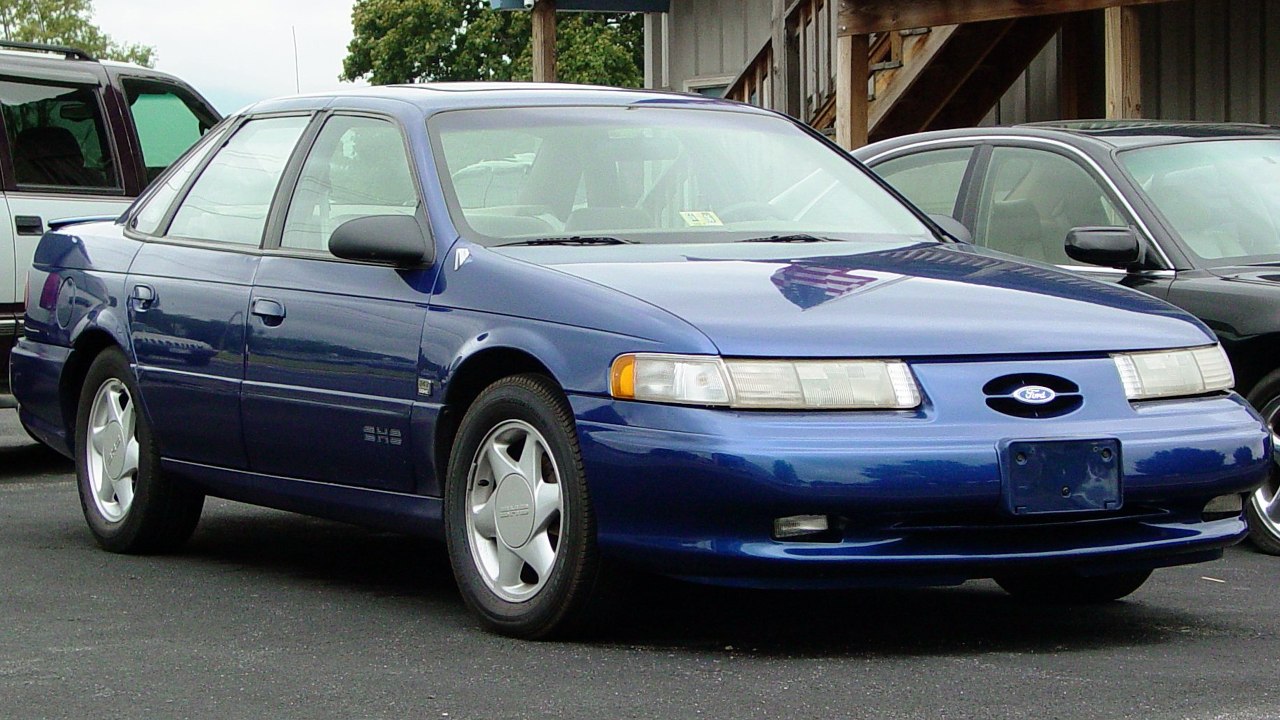
Later, that same engine architecture surfaced in the Ford Taurus SHO, where the Ford Taurus SHO entry lists Ford as Manufacturer and identifies the SHO as a distinct Model within the Taurus line. In the sedan, the Yamaha SHO V6 became a cult favorite, but in the GN34 it was meant to be the centerpiece of a full-blooded supercar. Accounts of The Ford GN34 Prototype Powered by the famous Ford Yamaha SHO V6 describe a car designed explicitly to compete with Ferrari, underscoring that the engine’s original mission was far more ambitious than powering a family four-door. The fact that this sophisticated V6 ended up in a front-engine sedan instead of a mid-engine flagship is one of the most striking twists in the GN34 saga.
Design, development, and the Prototype phase
By the time the GN34 reached its Prototype stage, the project had evolved into a credible production candidate rather than a speculative sketch. The Ford GN34 Prototype Powered by the Ford Yamaha SHO V6 embodied the engineering choices that defined the program: a mid-mounted engine, a low and wide stance, and proportions that clearly signaled supercar intent. Engineers leaned on research methods typical of serious development programs, building running mules to validate cooling, handling, and packaging before committing to full styling bucks. The result, according to those who have studied the surviving material, was a car that looked ready to take on contemporary Ferraris in both performance and visual drama.
Reports that describe the GN34 as a Mid Engine Supercar Cancelled at the Last Minute emphasize how close it came to production sign-off. Internal evaluations weighed the cost of specialized tooling, the complexity of low-volume assembly, and the challenge of selling a mid-engine Ford at a price that would still undercut European rivals. The GN34’s development path, from early sketches to a fully realized Prototype, shows that Ford was willing to invest real resources in a mid-engine architecture, not simply badge-engineer an existing platform. That seriousness makes its eventual cancellation feel less like the quiet end of a side project and more like a strategic pivot away from a bold performance statement.
Why the GN34 died and the SHO lived on
The decision to cancel the GN34, despite its advanced state, reflected a broader shift in Ford’s priorities as the 1980s gave way to the 1990s. Executives judged the projected costs of bringing a low-volume mid-engine car to market as too high, especially when weighed against the potential returns from more practical vehicles. Reporting on the GN34’s demise notes that Ford ultimately chose to focus attention on the Explorer SUV, a product with far greater sales potential and a clearer fit with the company’s mainstream strategy. In that context, a mid-engine supercar, however compelling, became difficult to justify.
Yet the engineering work did not vanish. The Yamaha-tuned V6 that had been developed for the GN34 found a new home in the Ford Taurus SHO, turning an otherwise conventional sedan into a performance outlier. The Ford Taurus SHO entry confirms that Ford positioned the SHO as a distinct Model within the Taurus range, effectively repurposing a supercar-grade powerplant for a mass-market platform. Accounts that trace how the Taurus SHO engine was originally supposed to be the heart of a Ferrari competitor underline the irony: the GN34 died, but its engine went on to define one of the most memorable American sport sedans of its era. In that sense, the SHO badge became the public face of a technology package that had been conceived for something far more radical.
How the GN34 reshapes Ford’s performance legacy
Looking back at the GN34, I see a project that complicates the usual story of Ford performance, which often centers on the Mustang and the occasional limited-run halo car. The GN34 shows that, inside Ford, there was a serious appetite for a mid-engine layout and for a partnership with Yamaha that could deliver a sophisticated V6 worthy of a supercar. When later commentators describe how Ford Built a Yamaha Tuned Mid Engined Supercar Before The Honda NSX Existed, they are highlighting that Ford’s engineers were exploring this territory before mid-engine Japanese exotics became a reality. The GN34 was not a reaction to the NSX; it was part of the same global wave of thinking about how to blend reliability, usability, and exotic performance.
For me, the most revealing detail is that the GN34’s core technology did not disappear into the archives but instead surfaced in the Taurus SHO, a car that quietly carried the legacy of a cancelled supercar into suburban driveways. The GN34’s cancellation, framed in later accounts as a Supercar Cancelled at the Last Minute, underscores how fragile such ambitious programs can be when they collide with shifting corporate priorities and market forecasts. Yet the project’s existence, and the survival of its Yamaha SHO V6 in a production Ford, expands the way I understand the company’s capabilities in that era. The forgotten mid-engine supercar may never have reached showrooms, but its Yamaha-tuned heart still beat on, leaving a trace of what might have been every time a Taurus SHO wound past the redline.
More from Fast Lane Only: