Lagonda won Le Mans in 1935 and later hired W.O. Bentley, yet most people still walk straight past the badge. American-born Wilbur Gunn founded the company in 1906 in Staines, England. Over the next half-century it built everything from the tiny Lagonda Rapier to a V12 grand tourer.
Then David Brown bought Lagonda in 1947 and merged it with Aston Martin, and the name slowly faded behind its sister brand. These are our picks for seven Lagondas that, in our view, deserved far better than obscurity.
1. 1933 Lagonda 16/80

The 16/80 is the Lagonda that did its homework. It used a 1,991 cc six from Crossley, but Lagonda stripped, checked and rebuilt every engine to its own standards first. As a result, it became the only Lagonda with a Crossley engine. The name suggests 80 horsepower, yet output fell well short of that, so the “80” may refer to a claimed 80 mph top speed instead. Only 261 left the works, according to the Lagonda Club. In our view, a car finished that carefully deserved a longer run than three years.
2. 1935 Lagonda Rapier

The Lagonda Rapier was a small car with big ambitions. Consultant Tim Ashcroft designed its 1,104 cc twin-cam four with one goal: Britain’s finest 1100 cc engine. It made 50 bhp, and most cars wore four-seat tourer bodies by E. D. Abbott. However, Lagonda hit financial trouble in 1935, so the rights passed to a London firm called Rapier Cars. Lagonda built 470, while Rapier Cars added only 46 more. A twin-cam baby that outlived its own maker deserves more than a footnote.
3. 1937 Lagonda LG6 drophead coupe

Think of the LG6 as the V12’s sensible sibling. It rode on the V12’s chassis, stretched 3.5 inches to fit a longer engine. That engine was a 4,453 cc Meadows six with pushrod valves, the same unit Lagonda had used in the LG45. Meanwhile, torsion-bar front suspension and Lockheed hydraulic brakes kept it modern. Want to spot one? Look for the twin long trumpet horns beside the grille. Lagonda made only 85 before production ended in 1940, which is a short life for a car this well engineered.
4. 1939 Lagonda V12 drophead coupe
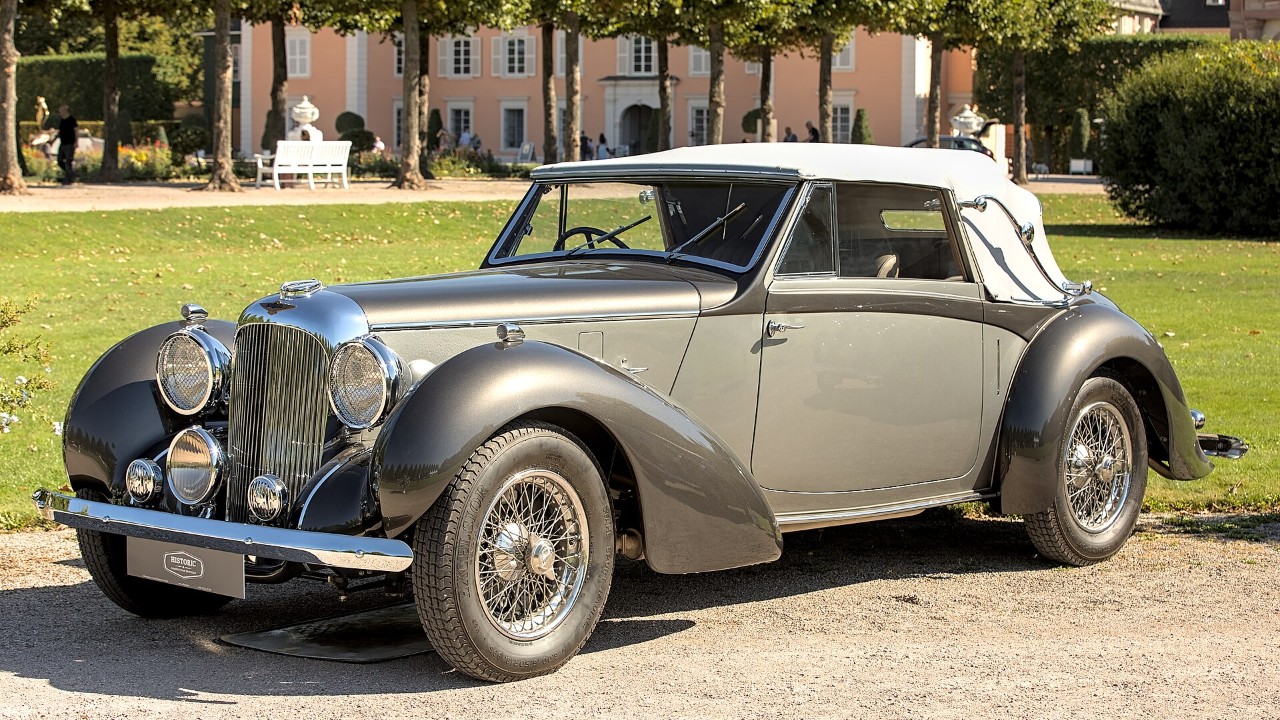
W.O. Bentley’s team designed this one, and it showed. The V12 used a 4,480 cc engine with one overhead camshaft per bank. In 1938, Lord Howe averaged 101.5 mph for an hour at Brooklands in a factory V12 saloon. That average even included a stop of 2 minutes 42 seconds to fix a puncture. The drophead coupe weighed about 1,880 kg, yet it still felt quick. We have covered the V12’s third and fourth places at Le Mans in 1939, but the road cars deserve the same spotlight. The Lagonda Club counts 190 sold and 69 survivors.
5. 1950 Lagonda 2.6-Litre drophead coupe

Here is the forgotten car behind a famous one. The 2.6-Litre arrived in 1948 as the first Lagonda of the David Brown era. Its twin-cam six, designed under W.O. Bentley, made 105 bhp. Better still, it had independent suspension at all four wheels, believed to make it the only British car so equipped at launch. Tickford added this drophead coupe in 1949, and Lagonda built 510 cars in all. Later, that same engine powered the Aston Martin DB2, DB2/4 and DB Mk III. Aston got the glory, while Lagonda got forgotten.
6. 1954 Lagonda 3-Litre Tickford drophead coupe

The 3-Litre was a grand tourer for buyers who didn’t want to shout about it. Its 2.9-litre twin-cam six made 140 bhp, and Tickford, a David Brown company, built the coupe and drophead bodies. This drophead coupe is the rarest style, with only about 55 made before production stopped in 1957. In 1956, Motor magazine recorded 104 mph and 0-60 mph in 12.9 seconds. That was brisk for a four-seat convertible of the day. Still, just 270 3-Litres of all body styles found buyers, and we think that’s a shame.
7. 1961 Lagonda Rapide

Aston Martin tried to revive the name with the Rapide, and the timing was all wrong. It borrowed the DB4’s bones and a 4.0-litre twin-cam six that later found its way into the DB5. Carrozzeria Touring styled it, with aluminium panels over a Superleggera tube frame. The grille, though, reminded some people of Ford’s Edsel. Each car was hand built to order at a base price of £4,950. A four-door Aston in all but name deserved a warmer welcome. Lagonda made only 55, and 48 of them survive.
More from Fast Lane Only