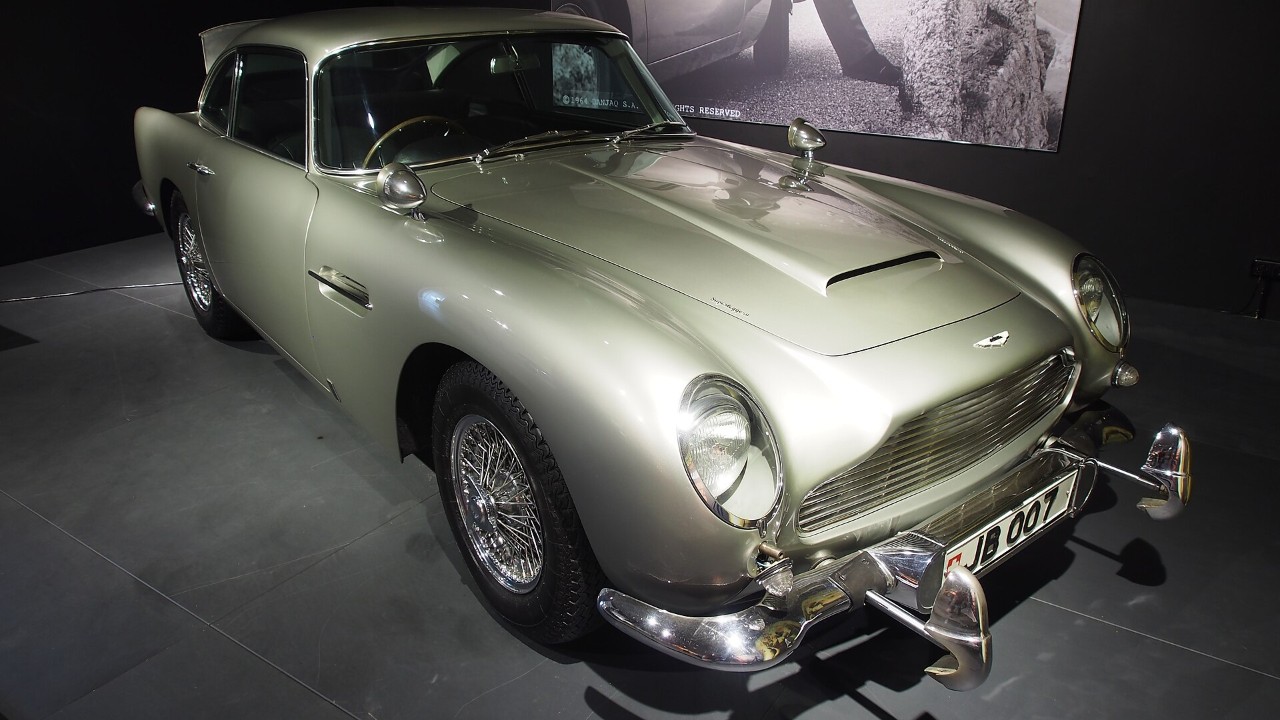
The first gadget-laden Goldfinger DB5 was not a fresh production car. It was Aston Martin’s own DB5 prototype, a development car that had started life painted Dubonnet Red. By the time Sean Connery drove it on screen in 1964, it wore silver paint, revolving plates and a set of tricks that changed movie cars for good.
The story matters because this car is the root of the whole Bond-Aston legend. Every later replica, toy and continuation car points back to it.
Yet the car itself has a short and strange record. It went from factory test car to TV extra, then to film star, then to a used car. Finally, it vanished from a Florida hangar.
A Goldfinger DB5 that began as a factory prototype
“The first James Bond car was also the DB5 prototype,” RM Sotheby’s notes in its 2019 lot history. Its chassis number carried a special prefix for a development project: DP/216/1. Hagerty, for its part, describes the car as the DB5 prototype built from a modified DB4. It also carried the registration BMT 216A, which in our view became the most famous number plate in film.
Before Bond ever touched it, the car had another screen job. Regtransfers’ history of the BMT 216A plate says it had already appeared in a 1964 episode of The Saint, still in its original Dubonnet Red. In other words, the prototype was a working promotional car long before it became a spy car.
Then the film crew came calling. Production designer Ken Adam and special effects man John Stears visited Aston Martin’s Newport Pagnell plant in late 1963, according to RM Sotheby’s. They wanted cars for the third Bond film, and Aston Martin agreed to lend them.
From Dubonnet Red to Silver Birch in six weeks
First, the prototype needed a new color. The factory repainted it from Dubonnet Red to Silver Birch and delivered it to Pinewood Studios in January 1964, according to the James Bond Vehicle Library. That silver shade later became the color most fans link with Bond.
Next came the gadgets. The same library says Stears’ special effects team fitted all of them within six weeks. Bold Entrance, in its look at the engineering, puts the timeline as “Christmas Eve drawings to a finished, fully weaponised car: six weeks.” Adam gave his partner the credit, too. “I was very fortunate to have Johnny Stears working with me because he was a brilliant engineer,” he said, as quoted by Bold Entrance.
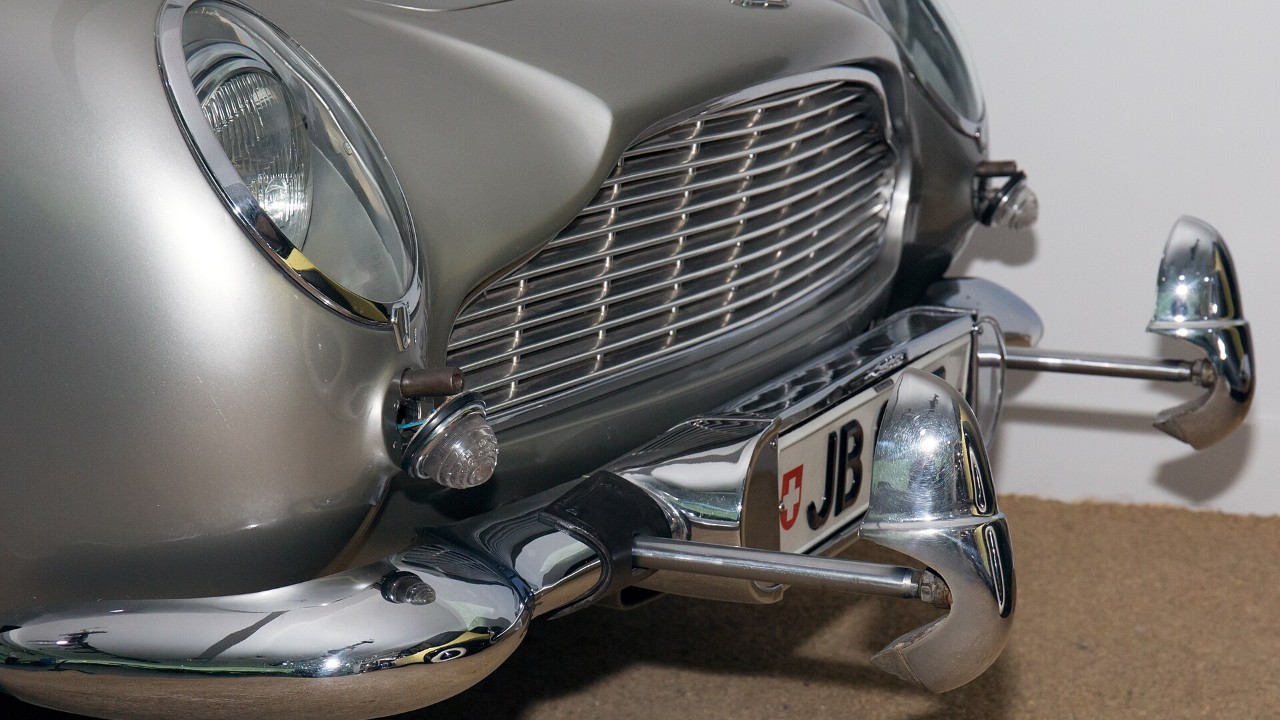
The kit was ambitious for 1964. RM Sotheby’s lists front and rear hydraulic over-rider rams among the equipment, and other histories add machine guns, tire slashers and a rear bulletproof shield. Still, RM Sotheby’s describes the prototype’s gadgets as “comparatively primitive,” built to work for a single take.
How many Goldfinger cars there were
The prototype didn’t work alone. Aston Martin also lent Eon Productions a second car, chassis DB5/1486/R, for Goldfinger, Regtransfers reports. Eon then ordered two more DB5s as promotional cars.
RM Sotheby’s names those two as DB5/2008/R and DB5/2017/R. That makes four Goldfinger-specification DB5s in all. Of the four, only the prototype and DB5/1486/R appeared in the film itself, while the other pair handled publicity duty.
The prototype also came back for the next film. The James Bond Vehicle Library lists it as a road car in Thunderball, after its gadget work in Goldfinger. Meanwhile, RM Sotheby’s says the two promotional cars went to the United States for media duties around Thunderball’s release.
The promotional cars proved valuable later on. RM Sotheby’s sold DB5/2008/R at Monterey in 2019 for $6,385,000. By comparison, the prototype has not appeared at any sale since the 1980s.
Back to ordinary life, then gone
After its film work, the prototype lost its gadgets and returned to standard specification, Regtransfers says. Later, it made one more notable screen appearance, in the 1981 comedy The Cannonball Run.
Ownership changed several times. Hagerty reports that the car went to Richard Loose of Utah in 1971. Later, Sotheby’s sold it in New York in 1986, and Florida developer Anthony Pugliese paid $275,000 for it, Hagerty UK reports.
Then, in 1997, the car disappeared from an aircraft hangar in Boca Raton, Florida, and it hasn’t been seen since. As a result, RM Sotheby’s counts only three surviving Goldfinger-specification cars.
Today, the Goldfinger DB5 prototype is still missing. Its last confirmed public sale was the 1986 Sotheby’s auction in New York, at $275,000.
More from Fast Lane Only