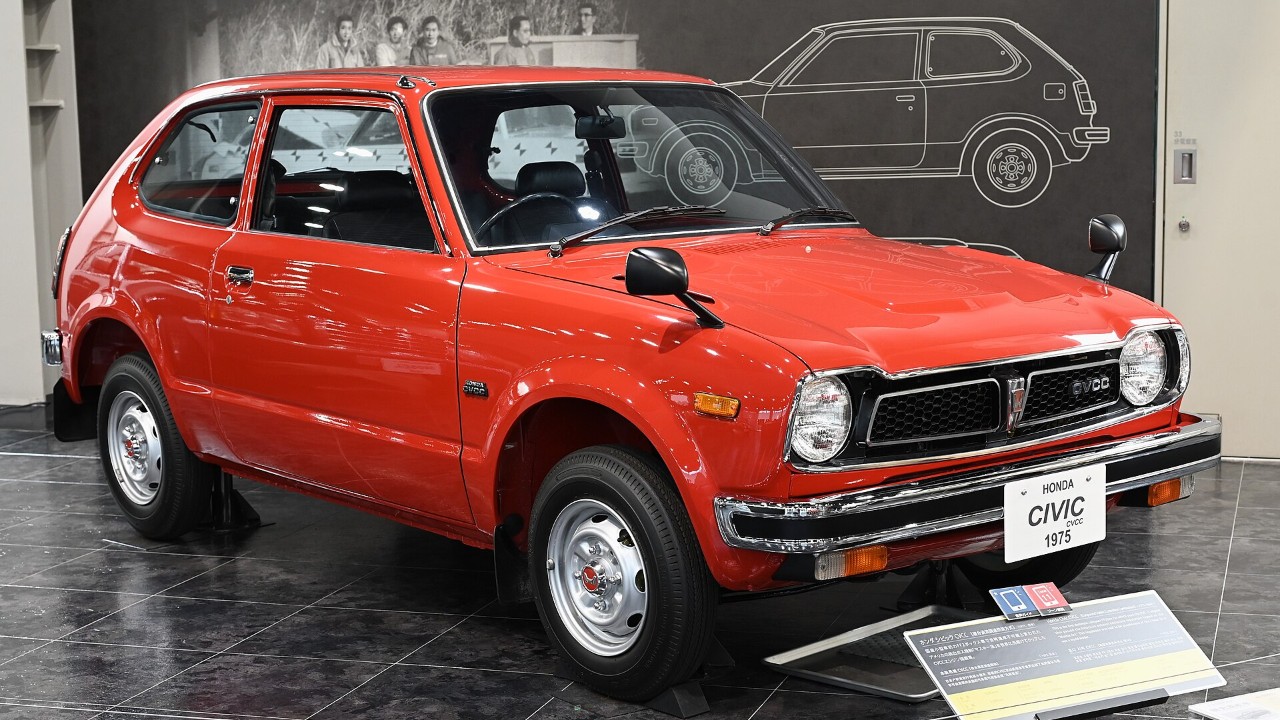
Honda’s CVCC engine met America’s 1975 emissions standards by burning its fuel more cleanly inside the cylinder. In fact, it did that without a catalytic converter on the exhaust. That trick put the small Civic on the map in the United States.
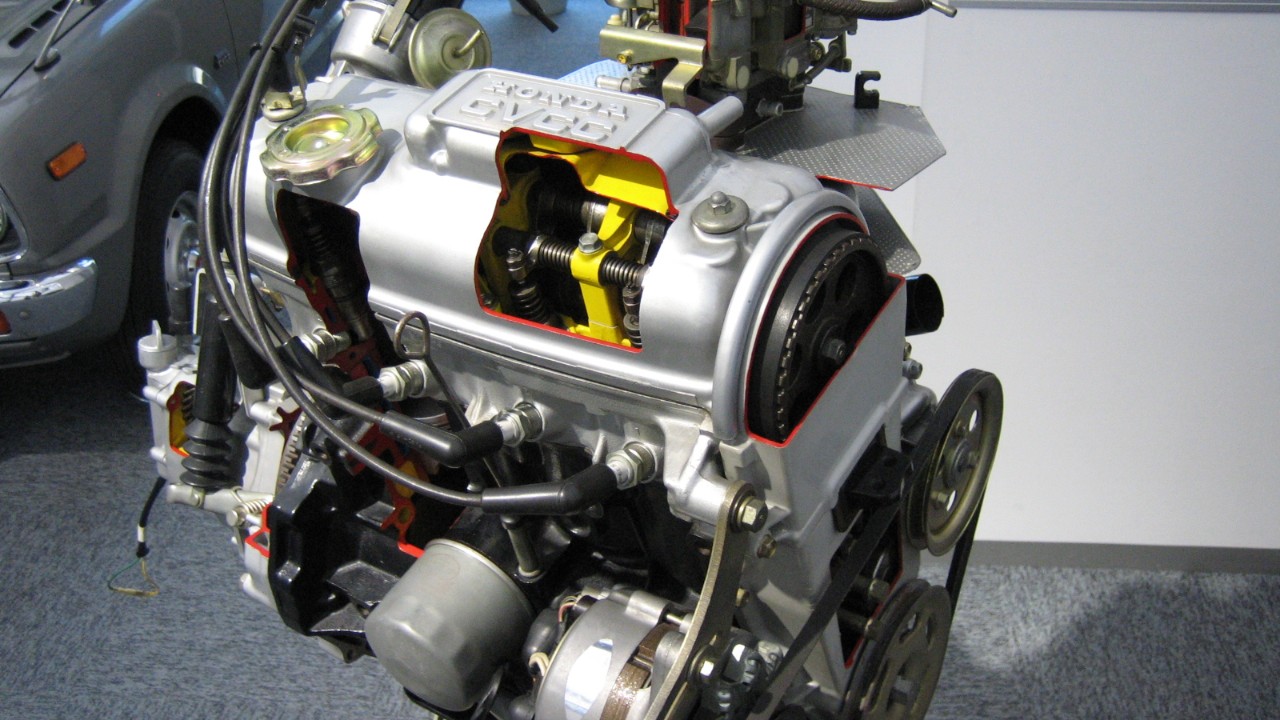
First, the letters stand for Compound Vortex Controlled Combustion. Behind them, however, sits a simple idea: light a small, rich flame first, then use it to burn a lean mixture completely.
Here’s how Honda got there, from a research group formed in 1965 to a week of government testing in Michigan. It ends with the Civic CVCC arriving in America for the 1975 model year.
The law behind the Honda CVCC engine
The pressure came from Washington. According to Honda’s heritage history of the CVCC, Congress passed the 1970 Clean Air Act on December 31, 1970. The law grew out of Senator Muskie’s clean-air bill, and the rules it set were steep.
Honda summarizes the targets this way, because the numbers were the whole challenge. Cars from 1975 onward had to emit one-tenth the carbon monoxide and hydrocarbons of then-current models. Then, from 1976, they also had to cut nitrogen oxides to one-tenth.
Honda had started early, though. Its history says Honda R&D set up a ten-member Air Pollution Research Group in the summer of 1965. Between December 1969 and February 1970, the team ran its first tests on a converted two-cylinder, 479 cc GD90 diesel engine. Then, by January 1970, it had finished a single-cylinder 300 cc trial engine based on the N600.
How the CVCC engine burned cleaner
Honda’s own breakdown of the name is a good guide. The first “C” for Compound meant two combustion chambers, a main one and an auxiliary one. Next, the “V” stood for the vortex in the main chamber. Finally, “CC” meant controlled combustion speed.
Here’s the sequence. A small prechamber received a rich fuel mixture, and the burn started there. A jet of flame then shot through a nozzle into the main chamber. There, it swirled through a lean mixture, which normally burns unevenly. As a result, the lean charge burned more completely.
Similarly, Japanese Nostalgic Car describes the same process. According to its 50th-anniversary history, the rich mixture in the prechamber ignited and forced a jet of flame into the main chamber. That flame swirled the lean air-fuel mixture and ensured a more complete burn.
That’s why Honda skipped the converter. In the company’s words, “Because clean, complete combustion took place internally in the engine, additional devices such as catalytic converters were not necessary.”
The announcement and the EPA test
Soichiro Honda made the first public promise on February 12, 1971. Honda’s heritage page quotes him: “We now have the prospect of developing a reciprocal engine (CVCC) that meets emission regulation standards for 1975.” At the same time, he said Honda would launch commercial production of the engine in 1973. The quote appears as Honda published it in English.
Honda then revealed the complete CVCC engine at Tokyo’s Akasaka Prince Hotel on October 11, 1972. Afterward, its own history called that day a landmark in the company’s history.
Next came the hard part. Honda still had no car big enough for the CVCC engine at that stage, so its test data came from a Nissan Sunny with the engine installed. Finally, Honda sent three cars to the EPA’s lab in Ann Arbor, Michigan. Two had covered 15,000 miles, and one had covered 50,000 miles.
Overall, the EPA testing ran from December 7 to 14, 1972. According to Honda, the vehicle became the first to pass the 1975 emissions requirements of the 1970 Clean Air Act.
From test engine to the Civic CVCC
The Honda Civic went on sale in Japan on July 12, 1973. Later, Honda added a four-door Civic CVCC 1500 to the Japanese lineup.
For America, the timeline ran a little later. Honda brought the 1975 Civic CVCC before the EPA in November 1974. Shipments to the U.S. then began with the 1975 model year.
Meanwhile, the U.S. car was small and simple. The Audrain Automobile Museum lists its engine as a 1.5-liter inline-four producing 53 hp. Buyers could choose a four-speed manual or an optional two-speed Hondamatic automatic. The museum also calls the Civic CVCC the first car to meet EPA standards without a catalytic converter.
Why the Honda CVCC engine mattered
Clean air wasn’t the only payoff. Honda says the Civic CVCC ranked number one for fuel economy for four straight years, through the 1978 model. Likewise, Japanese Nostalgic Car gives the same four-year run, from 1975 to 1978.
Other makers took notice, too. According to Honda, it eventually signed licensing agreements for the CVCC with Ford, Chrysler and Isuzu. In addition, Japanese Nostalgic Car reports that Toyota sent a representative looking to license it.
The record that made the Honda CVCC engine famous dates to one week in Ann Arbor. Between December 7 and 14, 1972, Honda’s test cars became the first to pass the 1975 Clean Air Act requirements, according to Honda, with no catalytic converter.
More from Fast Lane Only
- Unboxing the WWII Jeep in a Crate
- 15 rare Chevys collectors are quietly buying
- 10 underrated V8s still worth hunting down
- Police notice this before you even roll window down
This article was created with the help of AI and was reviewed and edited by Fast Lane Only editors before publication.