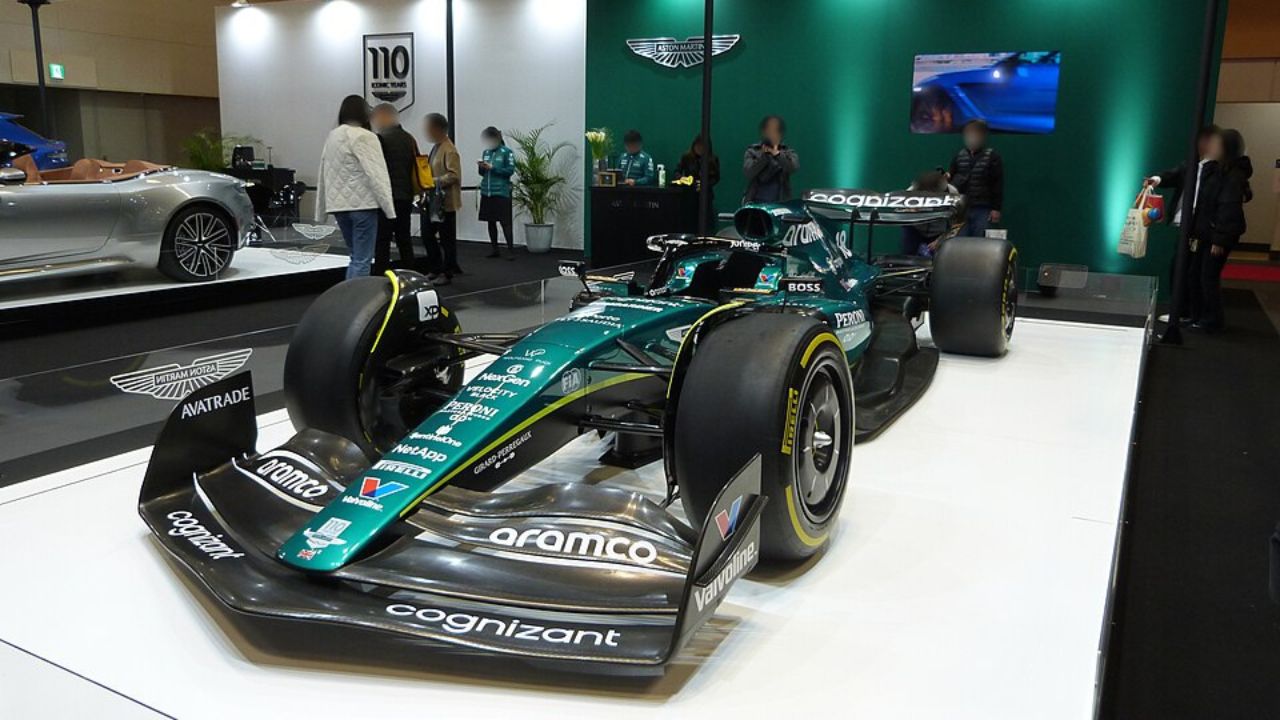
Honda has chosen a very visible way to announce its next Formula 1 chapter, planting a fresh corporate badge on the 2026 Aston Martin machine that will carry its new power unit. The move signals more than a logo tweak, it marks Honda’s return as a full works partner with a team that expects to fight at the front of the grid. As the sport pivots to a new engine rule set, the combination of a rebranded Honda identity and an ambitious Aston Martin project could reshape the competitive order.
Honda’s new badge meets Aston Martin’s green machine
When Honda pulled the covers off its 2026 Formula 1 engine, the company did not just talk about kilowatts and hybrid splits, it showed off a new corporate emblem already sitting on the Aston Martin chassis that will house the power unit. I see that as a deliberate statement that the brand wants fans to associate this updated “H” with the sharp end of the grid, not with a supplier quietly working in the background. The engine will not be going to Red Bull Racing this time, and the visual of the new badge on the Aston Martin bodywork underlines that the Japanese manufacturer has chosen a different partner for its next works adventure, one that expects to be a headline act rather than a customer footnote, as highlighted when Honda pulled the wraps off the project.
The visual pairing of British racing green and a refreshed Japanese badge also hints at how carefully both sides are managing perception. Aston Martin has spent the current rules cycle building a reputation as a rising force, while Honda has been reshaping its motorsport identity after its previous exit and partial return. By putting the new logo on the 2026 Aston Martin F1 car at this early stage, Honda is effectively telling fans that this is the car, and this is the team, that will define its next era in Formula 1, rather than the Red Bull Racing partnership that dominated the last one.
A Tokyo launch and a very public works partnership
The decision to unveil the 2026 power unit in Tokyo, with the Aston Martin project front and center, shows how much corporate weight Honda is throwing behind this alliance. At the event in Tokyo, the company presented the engine that will power Aston Martin in its first season as a full works partner, framing the project as a flagship for Honda’s future in top level motorsport. From my perspective, choosing Tokyo rather than a European venue underlines that this is as much about Honda’s global brand story as it is about lap times, with the power unit launch positioned as a major milestone in the company’s Formula 1 journey, as reflected in the Tokyo presentation of the project.
Honda has also used the occasion to formalize its status as a works supplier, rather than a background partner, to the Aston Martin Aramco Formula One Team for the 2026 season. That distinction matters. A works partnership typically means the chassis and engine are developed in lockstep, with resources and priorities aligned around a single competitive goal. Honda officially launched this works relationship with the Aston Martin Aramco Formula One Team for the new rules cycle at a Tokyo event that was framed as a strategic step in its broader growth and sustainability goals, a positioning that was made clear when Honda officially launched the partnership.
Inside the 2026 power unit and the new F1 rulebook
Underneath the fresh badge, the 2026 Honda power unit has been designed around Formula 1’s incoming regulations, which put a far greater emphasis on electrical power and sustainable fuels. The company has described how the new engine architecture responds to those rules, with a hybrid system that must deliver a much larger share of total output and an internal combustion engine that runs on fully sustainable fuel. From a technical standpoint, that means Honda’s engineers have had to rethink how energy is harvested, stored, and deployed over a lap, and how the combustion side can be optimized for efficiency rather than simply peak power, a shift that is detailed in the way Honda’s 2026 power has been laid out to meet the new demands.
The engineering challenge is not just about meeting the letter of the regulations, it is about exploiting them better than rival manufacturers. Honda has been explicit that the 2026 design is built to handle the higher electrical load that will be required for the engine, which in practice means more robust energy recovery systems and a battery that can cope with repeated high power deployment. For Aston Martin, having a works partner that has already committed to this level of integration is crucial, because the team’s chassis and aero concepts will need to be tuned around how the hybrid system delivers its power and how the energy flows over a race distance, something that is baked into the technical brief of the new Honda power unit that will be supplied to Aston Martin.
Brand reboot: the “New H” and what it signals
Honda is not shy about treating this project as a brand reboot, and the new badge on the Aston Martin is part of a broader “new year, new me” narrative around its Formula 1 presence. The company has framed the rebranded engine for Aston Martin Honda as the centerpiece of a refreshed identity, with the updated logo and visual language intended to signal a clean break from the stop start commitments of the past decade. I read that as an attempt to reassure both fans and partners that Honda is in this for the long haul, with the new emblem serving as a shorthand for a more stable and forward looking motorsport strategy, a message that comes through clearly in the way The New H branding has been wrapped around the Engine for Aston Martin Honda project.
For Aston Martin, aligning with that refreshed identity is a calculated move. The team gains not just a competitive power unit, but also the marketing heft of a manufacturer that is actively reintroducing itself to the sport. The fact that Honda is talking about the Engine for Aston Martin Honda in such explicit branding terms suggests that both sides see value in being tightly linked in the public mind, rather than maintaining a more arms length supplier relationship. As a fan, I see the new badge on the car as a visual contract, a promise that this partnership is meant to be seen, scrutinized, and judged on track, not hidden in the small print of a technical supply deal.
Why this partnership could reshape the 2026 grid
The competitive implications of Honda’s move away from Red Bull Racing and toward Aston Martin are hard to ignore. By choosing Aston Martin as the works outlet for its 2026 engine, Honda is betting that the Silverstone based team can convert a strong recent trajectory into a sustained front running presence under the new rules. The launch of the F1 2026 power unit in this new partnership has been framed as a strategic pivot, with Honda emphasizing that the most demanding environment is the race track and that this is where its next generation technology will be proven, a point underscored when Honda launches its F1 2026 power unit in new partnership with Aston Martin.
More from Fast Lane Only