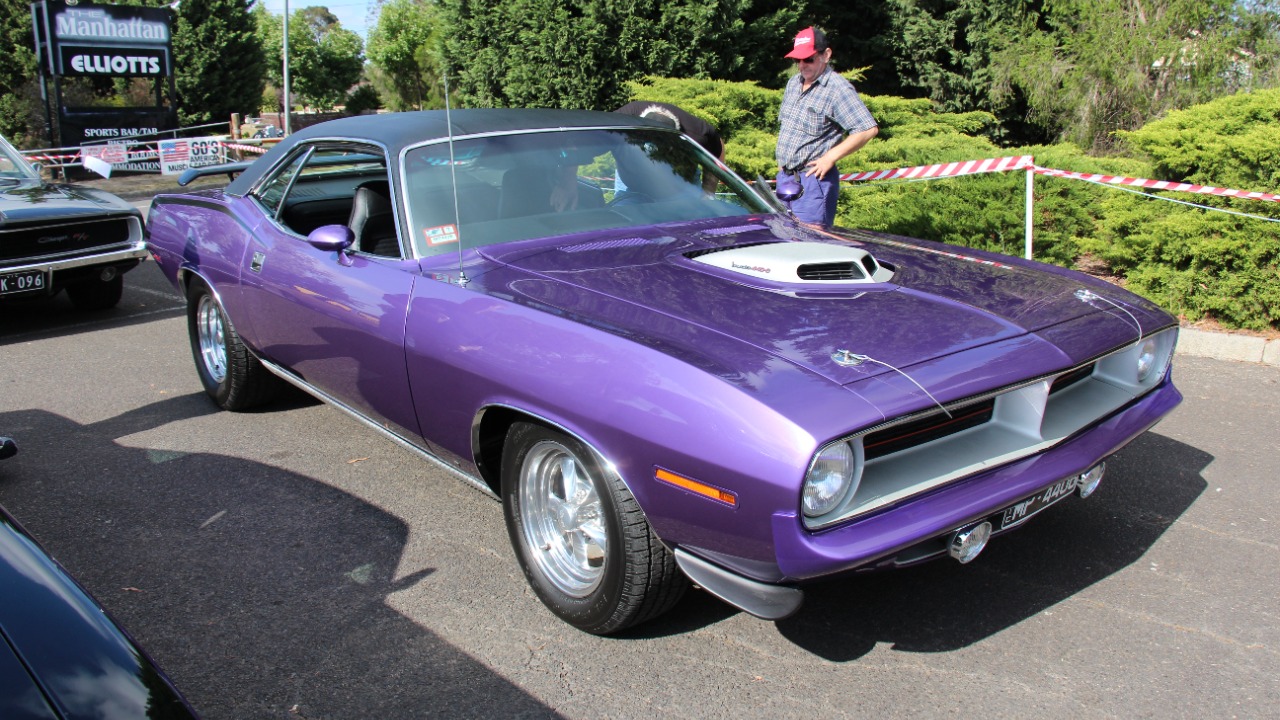
The 1970 Plymouth Hemi Cuda did not ease its way into history, it kicked the door in and claimed the room. In a single model year, this short wheelbase brute with a race-bred V8 turned from a wild option package into a benchmark that still defines what a factory muscle car can be. I want to trace how that happened so quickly, and why the legend has only grown louder with every passing decade.
To understand how the car became an overnight icon, I need to look at three things: the hardware that made it so outrageous in period, the way Plymouth positioned the ’Cuda as more than just a Barracuda, and the cultural afterlife that turned a rare performance option into a seven‑figure obsession. The result is a story about how engineering excess, clever branding, and a bit of racing swagger fused into one of the most mythologized Mopars ever built.
The race-bred heart that changed the stakes
For me, the legend of the 1970 Plymouth Hemi Cuda starts under the hood, with an engine that was never meant to be polite. The 426 Hemi was a race-bred V8, developed for competition and then detuned just enough to survive street duty, and the 1970 Plymouth Hemi ‘Cuda Packs A Race Bred Engine Under The Hood in a way that still feels almost confrontational. Contemporary rivals had big blocks and bravado, but the way this car delivered its power was so abrupt and so unapologetic that it reset expectations for what a showroom muscle car could be.
That brutality is exactly why the car is still described as the 1970 Plymouth Hemi Cuda the undisputed apex predator of the muscle car world, a phrase that captures how completely it dominated the performance conversation among American V8s of its era. When I look at that combination of displacement, cylinder head design, and the signature shaker scoop, I see a package that was engineered first for the drag strip and only second for suburban streets. It goes without saying that the power ‘Cuda offered was unmatched in its day, and that imbalance between what anyone reasonably needed and what Plymouth actually sold is a big part of why the car’s reputation exploded so quickly.
Not just a Barracuda: how the ’Cuda became its own animal

What fascinates me is that the ’Cuda name itself helped the car break free from the rest of the Plymouth lineup. Here, I have to stress that Not Just a Barracuda is more than a slogan, because Many assume “‘Cuda” is just short for Barracuda, yet the way Plymouth used the badge turned it into a distinct identity. The ’Cuda trim signaled the most aggressive engines, the boldest colors, and the least compromise, which meant buyers were not just ordering a Barracuda with options, they were stepping into a separate, more dangerous circle of the Mopar world.
That separation is why I see the 1970 model year as a pivot point, the moment when the ’Cuda stopped being a derivative nickname and became a standalone legend. The car sat within a broader Mopar performance push, but the combination of the Hemi, the short name, and the visual drama made it feel like a factory hot rod built for insiders. When enthusiasts talk about this Mopar icon today, they are not thinking of the whole Barracuda family, they are thinking of the narrow slice of cars that wore the ’Cuda badge and carried the most extreme hardware.
Design, color, and attitude: the instant iconography
Power alone does not make a legend, and I am convinced the 1970 Plymouth Hemi Cuda became unforgettable because it looked as wild as it drove. The body lines were muscular without being bloated, and the shaker hood, hockey-stick stripes, and low stance gave the car a coiled, ready-to-strike posture. One of my favorite details is how Hemi kudos came in a lot of bright colors, but take a sip of this one in Citron, a shade that turned an already loud car into a rolling exclamation point, as seen in a detailed Video Transcript of a 1970 426 Hemi 4-speed ’Cuda.
When I picture that Citron paint wrapped around a 426 Hemi with a four-speed, I see why the car’s image burned itself into enthusiast memory so quickly. The styling cues were not subtle, but they were cohesive, and they told the truth about what the car could do. The shaker scoop was not just decoration, it was a functional air intake that vibrated with the engine, broadcasting the Hemi’s idle to anyone within earshot. That honesty between form and function, where every stripe and bulge hinted at real performance, helped the ’Cuda become instantly recognizable even to people who never drove one.
From showroom terror to cultural touchstone
Over time, the 1970 Plymouth Hemi Cuda has shifted from new-car shock to rolling Americana, and I see that evolution as central to its enduring myth. Regarded as one of the last true muscle cars, the Plymouth Hemi Cuda packed insane muscle among classic cars of the era, and that status has only solidified as the original muscle era has receded into history. The car now carries layers of meaning: it is a symbol of Detroit’s most unrestrained engineering, a reminder of when gas was cheap and safety rules were loose, and a kind of mechanical time capsule that enthusiasts treat with almost museum-level reverence.
Racing heritage deepens that aura. American racing drivers Swede Savage and others helped tie the Plymouth Hemi Cuda to competition, and that connection reinforces the idea that this was never just a styling exercise, it was a serious performance machine. When I look at how collectors talk about this bundle of American history, I see a car that has transcended its original role as transportation and become a story people want to own, preserve, and pass down. The legend is no longer just about quarter-mile times, it is about what the car represents in the broader narrative of American muscle.
Why the legend keeps getting louder
What strikes me today is how the 1970 Plymouth Hemi Cuda continues to gain cultural volume even as the cars themselves become rarer and more valuable. Modern coverage still frames it as a benchmark, with detailed breakdowns of how the 1970 Plymouth Hemi ‘Cuda Packs A Race Bred Engine Under The Hood and why that combination of hardware and attitude has never really been duplicated in a mass-produced street car. When I read that the power ‘Cuda offered was unmatched, I am reminded that the car’s reputation is not nostalgia alone, it is rooted in objective performance and engineering choices that were extreme even by period standards.
That ongoing fascination shows up in how people talk about the Plymouth Hemi Cuda the apex predator of its world, a phrase that keeps resurfacing in modern video features and enthusiast commentary. One short feature on the Plymouth Hemi Cuda the apex predator highlights how the shaker hood, the stance, and the Hemi itself still command attention in a way newer performance cars struggle to match, and I think that speaks to the car’s emotional impact as much as its numbers. The legend keeps growing because every new generation of enthusiasts discovers that this old Mopar still feels dangerous, still looks outrageous, and still carries a sense of occasion that modern, more polished performance cars sometimes lack.
The ’Cuda’s long shadow over modern Mopar culture
Even in a world of modern Hellcats and supercharged SUVs, I see the 1970 Plymouth Hemi Cuda casting a long shadow over Mopar culture. Enthusiasts still dissect 10 facts about this Mopar legend, from how Not Just a Barracuda became a distinct identity to how builders today recreate the look and feel of the original car with modern materials. One detailed rundown of 10 facts about this Mopar icon notes how Here, the focus on the ’Cuda’s unique details, including quirks like the way certain components under the hood caused radio interference, shows that people are still obsessed with the minutiae of how these cars were built.
That level of attention tells me the ’Cuda has moved beyond simple nostalgia into something closer to folklore. Builders and collectors chase original parts, debate correct stripe placement, and argue over the most authentic shades of high-impact paint, all in service of honoring a car that had only a brief production window. When I step back and look at the whole picture, from the race-bred 426 Hemi to the Citron paint and the way the ’Cuda name broke free from Barracuda, it is clear why the 1970 Plymouth Hemi Cuda became a legend almost overnight. It was not just fast, it was fully committed to being outrageous, and that kind of commitment never really goes out of style.