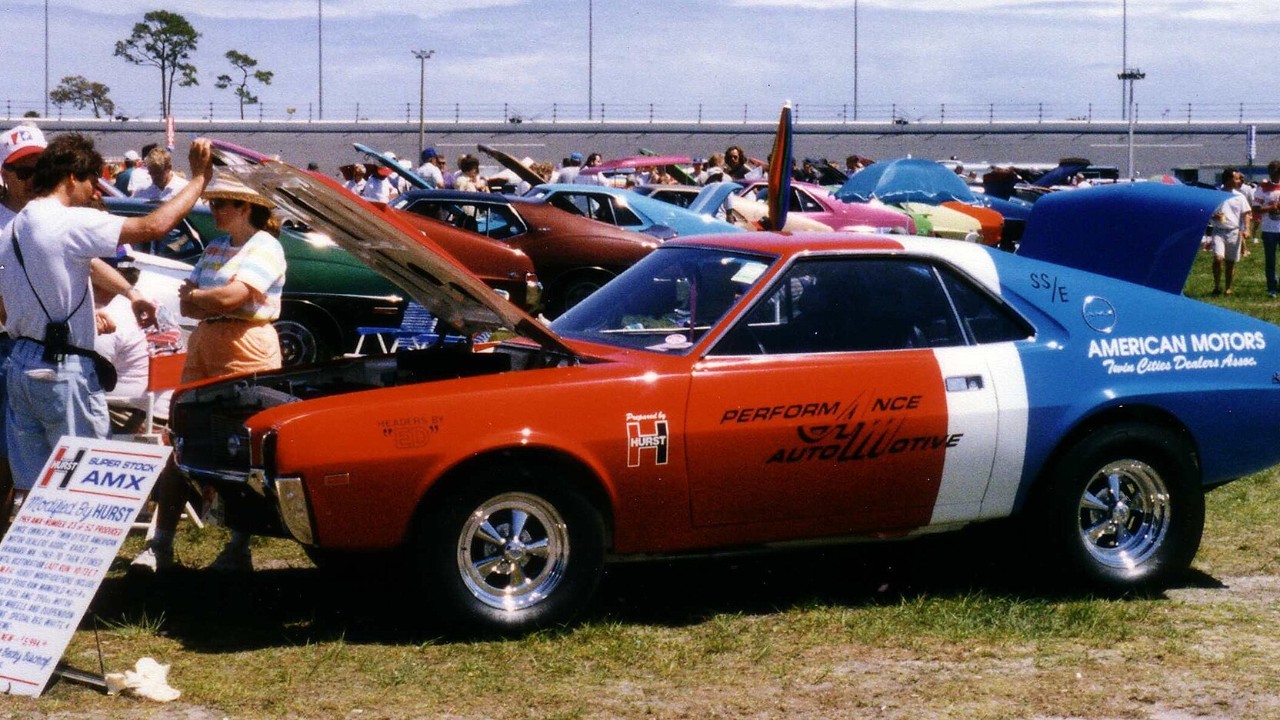
The 1969 Super Stock AMX was a two-seat American Motors coupe turned into a drag car by Hurst. AMC put its 390 V8 at 340 hp on the paperwork. However, the NHRA did not accept that number and rated the car at 420 hp instead.
That gap also tells you what the car was. AMC and Hurst built 52 of them for one job, Super Stock drag racing, and sold each one for $5,994. At least 40 survive, a good record for a car that went straight to the strip.
Here is how a small company from Kenosha, Wisconsin, ended up with a factory race car, and why the official horsepower number never matched what the engine made.
Why AMC hired Hurst and the Shahans
AMC wanted younger performance buyers, and it turned to drag racing to reach them. According to Mac’s Motor City Garage, the company teamed up with Hurst Performance to build a limited run of race cars. Hurst had done the same job for Chrysler a year earlier, with the Hemi Dart LO23 and Barracuda BO29 Super Stockers.
First, AMC needed a prototype. It hired drag racer Shirley Shahan, known as “The Drag-On Lady,” and her husband H.L. Shahan, who served as her crew chief. Their test car was running in the 11-seconds-flat range at better than 120 mph, Mac’s reports.
Then came the numbers game. Mac’s says NHRA Super Stock rules required a minimum build of 50 cars. AMC’s run of 52 cars cleared that bar.
How Hurst built 52 Super Stock AMX cars
All 52 production cars started as Frost White AMXs with consecutive serial numbers, according to Mac’s. Then they left AMC’s Kenosha plant and went to Hurst for conversion. Mac’s places that work at Hurst’s Detroit facility.
Before the cars even left Kenosha, AMC stripped out what a drag car didn’t need. Street Muscle lists the deleted items as radios, one of the two horns, clocks, heaters, undercoating and sound deadening. As a result, the cars reached Hurst with special wiring harnesses that lacked connectors for those parts.
Next, Hurst went to work on the chassis. According to Street Muscle, the front anti-roll bar came off. The rear got revised link geometry, forged axles from Henry’s Axles of California, Cure Ride drag shocks and stiffer Rockwell springs. Hurst also moved the right rear leaf spring pocket.
Every car got a Borg-Warner four-speed manual, which Street Muscle identifies as a T-10, and 4.44:1 rear gears. AMC built no automatic cars, Mac’s says. In the end, the finished car weighed 3,050 pounds, and Hurst saw no need for lightweight body panels.
Inside the 390 V8
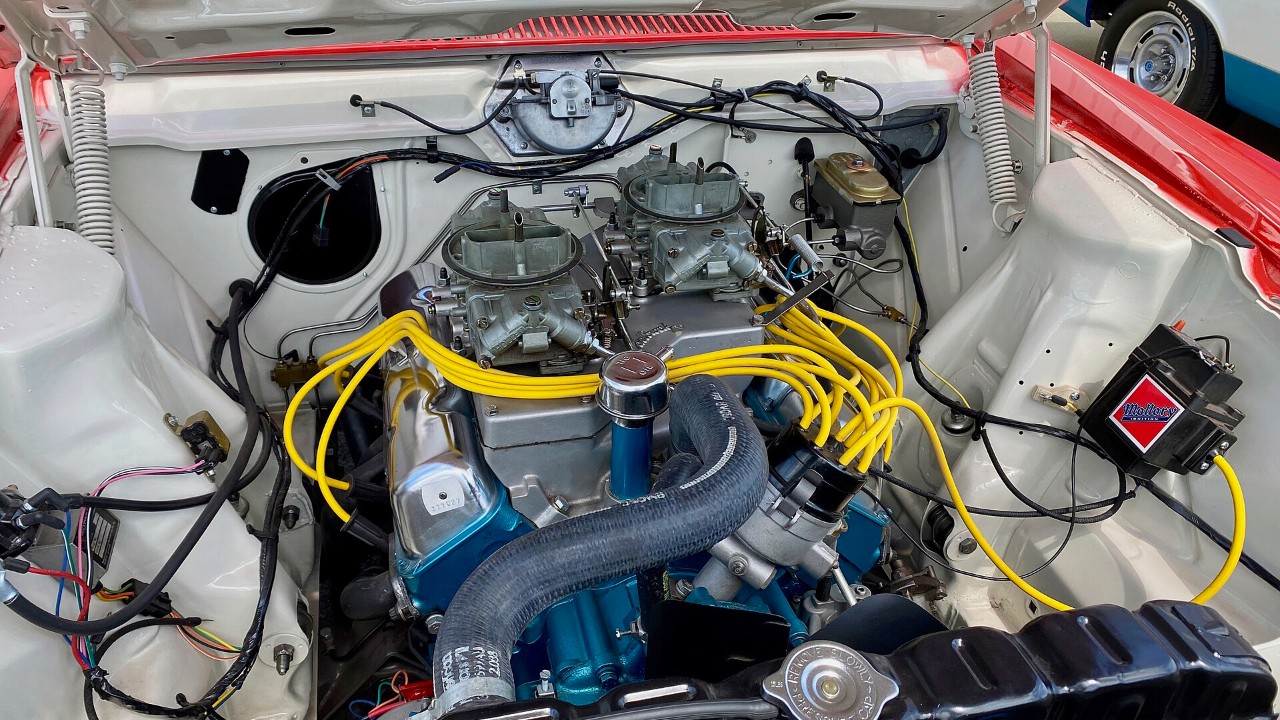
The engine kept the AMX’s 390-cubic-inch displacement. However, almost everything around the crank changed. Mac’s lists JE pistons with 12.3:1 compression, Crane-modified cylinder heads and an Edelbrock cross-ram intake carrying two Holley 650-cfm four-barrel carburetors.
The rest of the list reads like a 1960s speed-shop catalog. There was a Mallory dual-point distributor and a set of Doug’s tubular headers. Street Muscle adds that Crane ported and polished the heads and changed the valves.
Oddly, the stock camshaft stayed in. According to Mac’s, AMC expected racers to pick their own cam, so it left that choice to the buyer. H.L. Shahan prepared the engines.
Why the Super Stock AMX rating jumped to 420 hp
On paper, AMC rated the engine at 340 hp. Mac’s points out that was “only 25 more than stock,” a modest claim for an engine with this much hardware.
The NHRA saw it differently. After reviewing the paperwork, it factored the engine at 420 hp, both sources agree. That rating placed the Super Stock AMX in SS/E, and later in SS/D and SS/C, according to Mac’s.
Meanwhile, the real number was higher. Mac’s says the engines “were reportedly good for 510 to 525 hp on the dyno.” In other words, even the NHRA’s figure sat roughly 90 to 105 hp below those dyno results.
What it cost and how it raced
As for price, both sources give $5,994. Mac’s puts that at around $2,500 more than a standard 390 AMX, and it notes a few racers got special deals. Street Muscle puts the base 1969 AMX at about $3,500.
Even so, not every car stayed white. According to Mac’s, some kept their Frost White paint, while a local Detroit body shop painted others in AMC’s red, white and blue racing colors.
On the track, the cars paid off quickly. Mac’s says the Super Stock AMX set and reset SS/E speed and elapsed-time records. In addition, Shirley Shahan won class honors in its first trip to the U.S. Nationals at Indianapolis. Street Muscle goes further and says nearly all 52 cars and the prototype held at least one track record that season.
For 1970, AMC offered an update kit with the new front sheet metal and better cylinder heads, Mac’s reports. However, NHRA officials did not like the package. According to Street Muscle, the NHRA required each car to run either full 1969 or full 1970 specs, and racers who had converted went back to 1969 trim.
Today, the Super Stock AMX has a strong survival rate for a race car. Mac’s says at least 40 of the original 53, the 52 Hurst cars plus the Shahan prototype, are believed to exist today. Street Muscle gives the same count of 40 accounted for, with 12 unknown.
More from Fast Lane Only