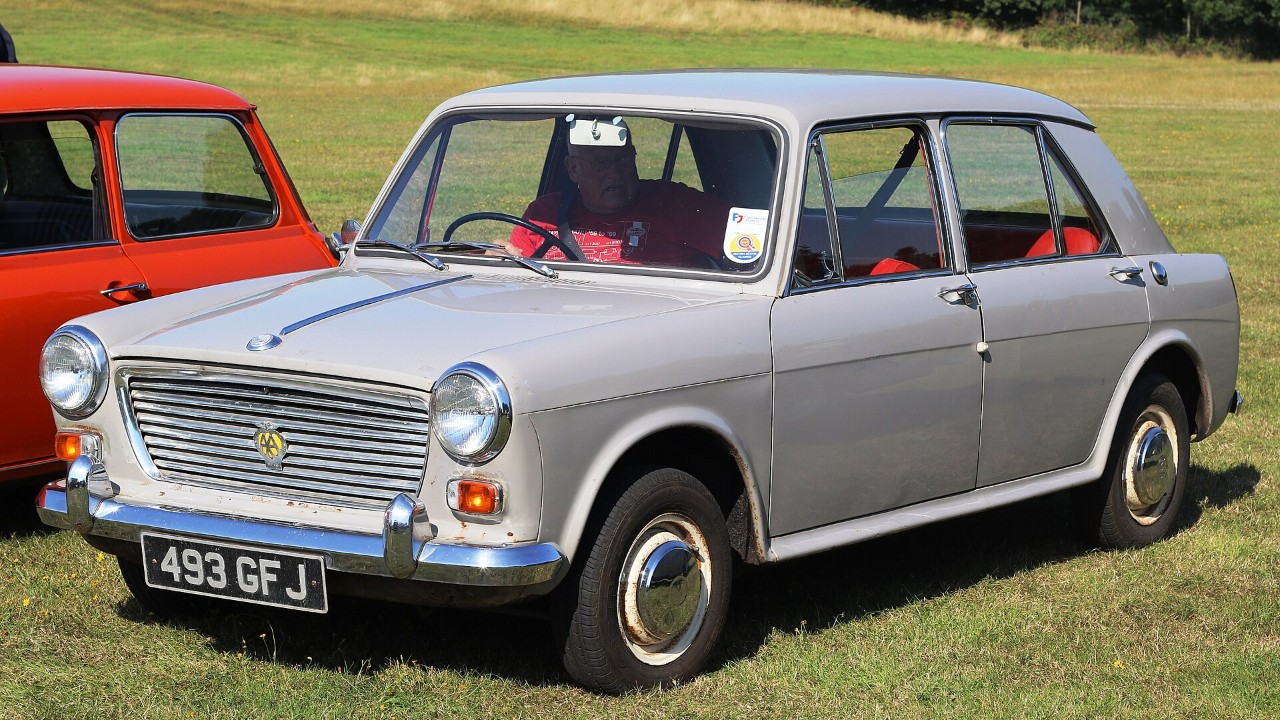
In 1962, BMC launched a family sedan with no steel springs and no shock absorbers. Instead, each wheel of the new 1100 sat on a sealed rubber unit full of water and alcohol. A pipe tied the front wheel to the rear wheel on the same side. Engineer Alex Moulton called it Hydrolastic suspension. It went on to ride under the Mini and a whole family of BMC sedans, and some of them carried it into the 1970s.
The idea sounds odd at first. Water is not a spring, after all. But the fluid in a Hydrolastic car was never meant to be the spring. It was the messenger. It carried a bump at one end of the car to the other end before the body could pitch.
Here is how the system worked, which cars got it, and why the Mini gave it back.
Where Hydrolastic suspension came from
Moulton started with rubber. He studied at King’s College, Cambridge, and in 1950 he co-wrote a paper on rubber springs with physicist Philip Turner, according to a University of Cambridge Department of Engineering profile. In 1953, a Morris Minor on his rubber suspension became the first to cover 1,000 miles on the pavé without a fault. That’s according to the same profile.
Meanwhile, Moulton and Alec Issigonis had already tried an interconnected rubber-and-fluid layout on the Alvis TA/350 project, begun in 1952, Driven to Write reports. Issigonis set one firm condition. “You can only use this interconnected system with all independent springing,” he said.
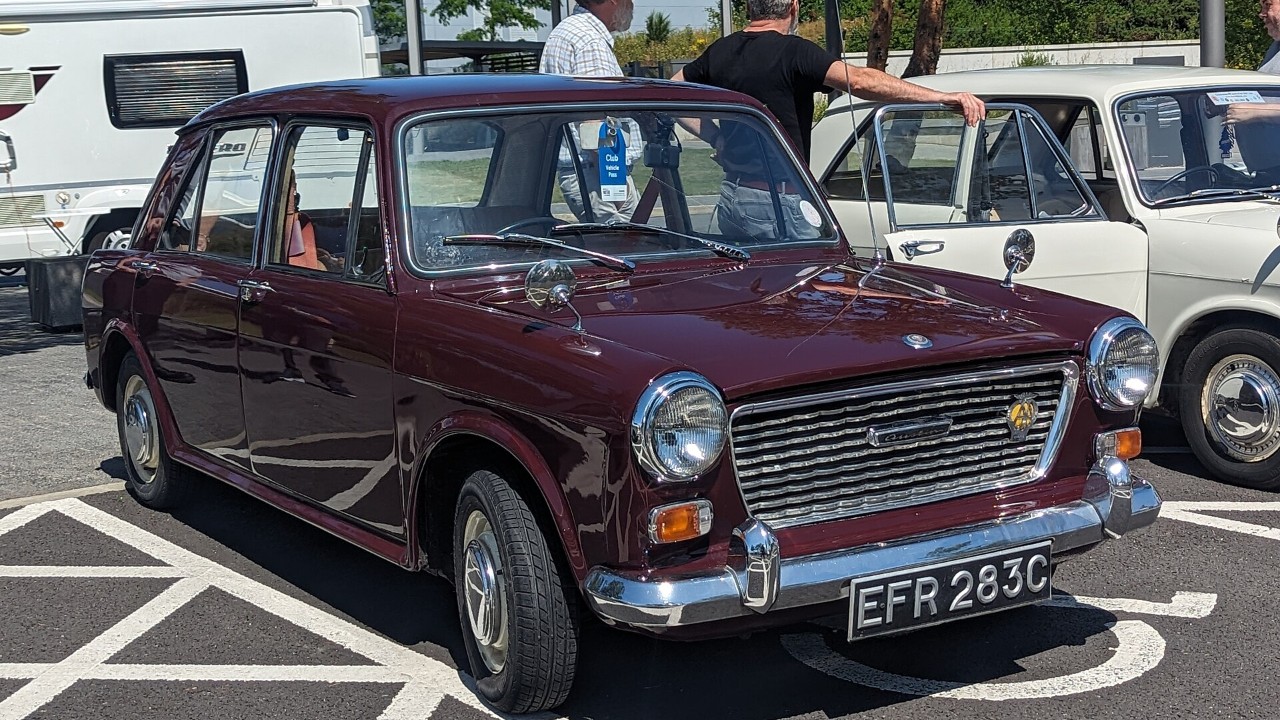
The 1959 Mini used plain Moulton rubber cones, because Hydrolastic wasn’t ready in time, the Cambridge profile says. Then the BMC 1100 arrived in 1962 with Morris badges. It was the first car with Moulton’s Hydrolastic interconnected suspension, according to the Alex Moulton Charitable Trust. Moulton test-drove one at Bradford on Avon on August 14, 1962, the day before launch.
Inside a displacer
Each wheel got one displacer unit in place of a spring and a damper. A displacer is a sealed can of sheet steel and rubber, explains Unique Cars and Parts. A nylon-reinforced rubber diaphragm splits it into an upper and a lower chamber.
The upper chamber holds a conical rubber spring, Driven to Write explains. Below it, a tapered piston rises and falls with the upper suspension arm. In addition, a valve between the two chambers meters the fluid, and that valve does the job a shock absorber would normally do.
The fluid itself was mostly water and alcohol with an anti-corrosion additive. Driven to Write gives an exact recipe: 49% water, 49% methyl alcohol, 1% corrosion inhibitor and 1% dye. Other sources simply describe a water-and-alcohol mix, so treat that split as one outlet’s figure.
How the pipes kept the body level
The clever part was the plumbing. A pipe linked the front and rear displacers on each side of the car. So the nearside front worked with the nearside rear, and the offside front worked with the offside rear, Unique Cars and Parts notes.
Picture the front wheel hitting a bump. First, the tapered piston pushes fluid up through the valve, and that pressure loads the rubber spring. Next, fluid flows down the pipe to the rear displacer on the same side. As a result, the rear wheel is pushed down, and the back of the car rises to match the front. The body stays level instead of rocking nose-up.
In corners, the job changes. Both displacers on the outside of the turn take load at once, so they resist the lean together, according to Driven to Write. On the 1100, BMC also added twin anti-pitch torsion bars at the rear and a conventional rear anti-roll bar.
How it drove
Period testers liked it, with reservations. Autocar praised the 1100’s ride on poor roads, cobbles included, Driven to Write recounts. However, the magazine also found the car “not entirely free from pitch effects on undulating surfaces.”
John Cooper ran Hydrolastic on his Cooper Junior racers. He summed it up this way, as the Moulton Trust quotes him: “the ride is like a Cadillac, until you turn left or right and then it’s like a Grand Prix car.”
Buyers voted with their wallets. The 1100 was Britain’s best-selling car throughout the 1960s, according to the Moulton Trust. BMC soon built over 5,000 a week, and factories in more than ten countries produced it.
Which cars got Hydrolastic suspension
The Mini switched to Hydrolastic in 1964 and kept it through 1971, Classic Motorsports reports. On the Mini, the rear displacer lies horizontally and works through a rocker arm, which saved interior space. Even so, Moulton later admitted it “simply didn’t work on the smaller car,” Driven to Write notes, and the Mini went back to rubber cones.
The bigger cars kept it longer. Unique Cars and Parts lists the Morris 1100 family, the 1800s and the Wolseley 18/85. Classic Motorsports adds the Austin America, the MG 1100 and the Morris 1500.
Living with one today
Hydrolastic needs special tools. A shop can overhaul the system only after a dedicated machine has depressurized it, and then it must be pumped back up, Unique Cars and Parts says. Also, a front wing that sits low for good can point to a blocked pipe.
Displacer parts are now hard to find, Classic Motorsports notes. For that reason, many owners have converted their cars to conventional “dry” suspension.
Moulton’s work did not stop there. Later, his company swapped the rubber spring for a nitrogen gas spring to create Hydragas, used on the Austin Allegro in 1973, the Princess in 1975 and the Metro in 1980, the Cambridge profile says. Counting cone, Hydrolastic and Hydragas systems together, Moulton units went under more than 12 million British cars, starting with the 1959 Mini.
More from Fast Lane Only