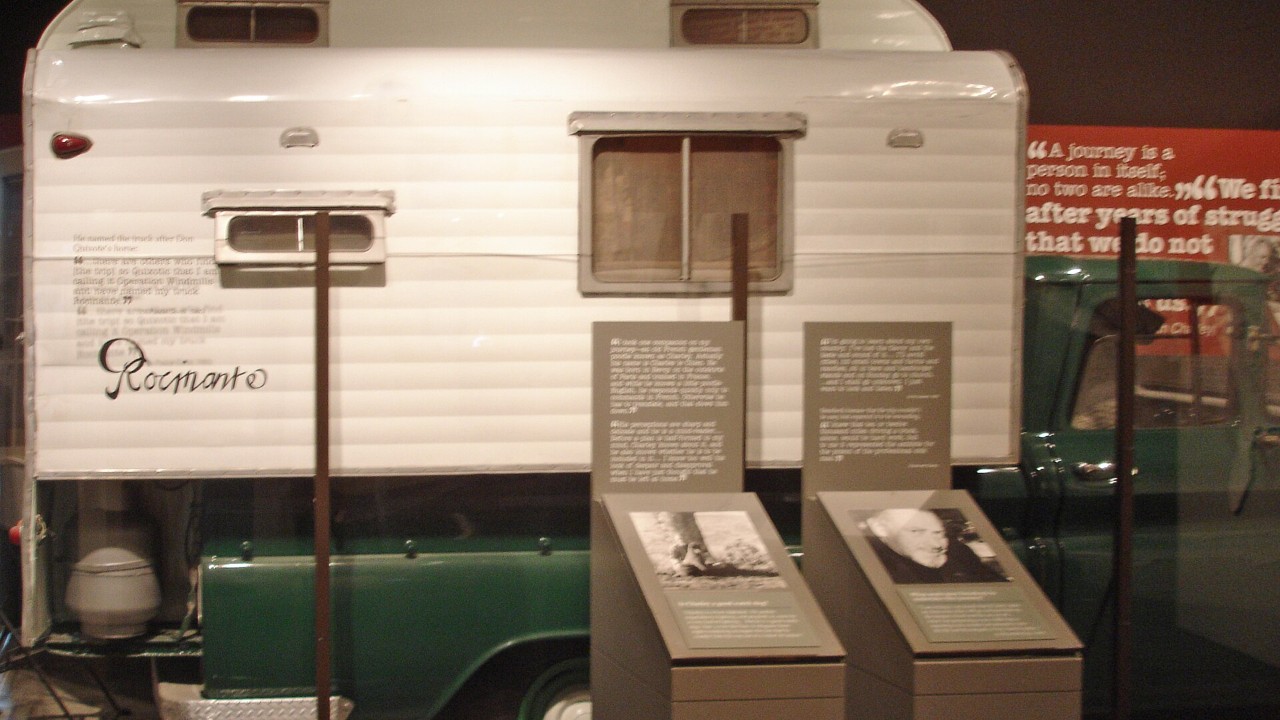
John Steinbeck left New York on September 23, 1960, in a dark green pickup with a small camper over its bed. He named it Rocinante, after Don Quixote’s horse. For nearly three months he drove the Rocinante truck more than 10,000 miles, coast to coast and back. That loop became the book Travels with Charley, and the truck still exists in his hometown of Salinas, California.
Steinbeck was 58 when he set out. His passenger was Charley, a French poodle. He waited for Hurricane Donna to pass before he left, and then he pointed the truck toward a question he wanted to answer: what are Americans like today?
Underneath the story sits a working rig: a General Motors pickup with a V6 and a camper from a Michigan maker. However, the way Steinbeck set it up, named it and lived in it made this green truck a piece of American literary history.
What the Rocinante truck actually is
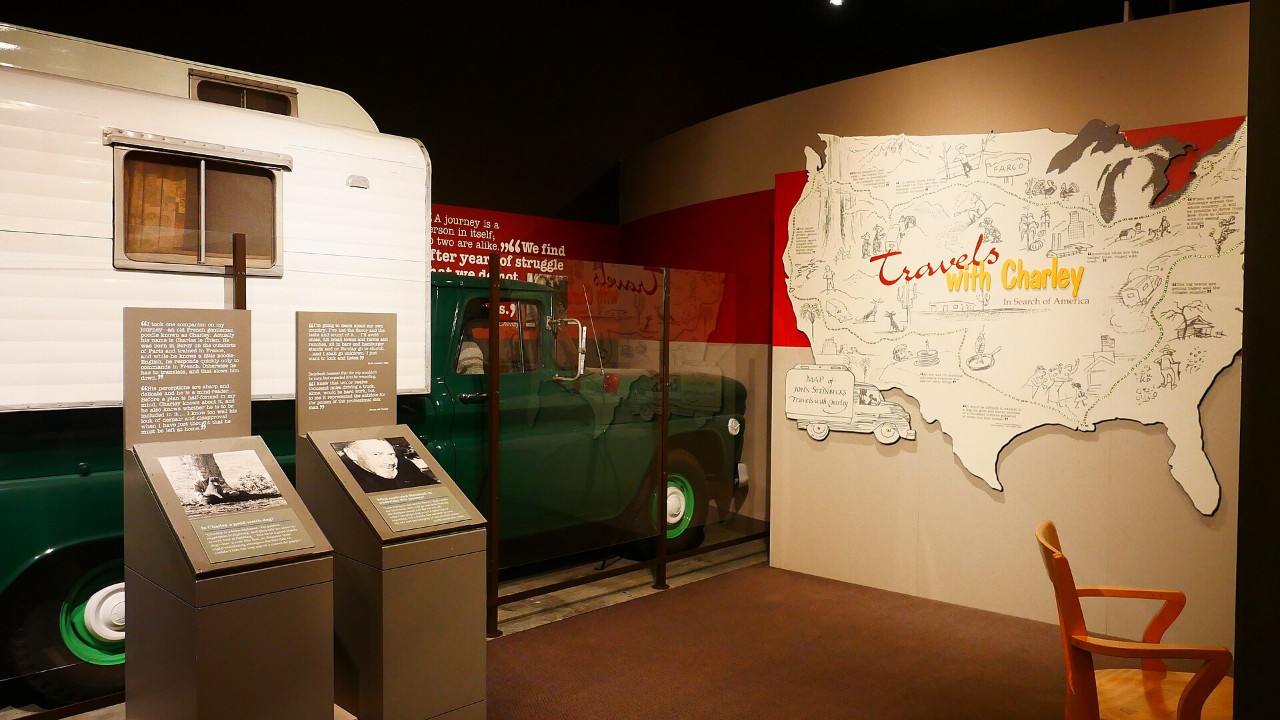
Steinbeck’s truck is a GMC pickup topped by a camper, according to ClassicCars.com Journal, which visited it at the museum. The National Steinbeck Center’s own archive record, held by the California State University digital archive, describes it as a General Motors V6 truck. The record also names the Wolverine Camper Company of Michigan as the maker of the camper.
Humanities writer Clay Jenkinson, writing for Lewis and Clark’s America, calls Rocinante a green three-quarter-ton pickup. In fact, none of these sources gives a model year or a GMC series. So this story doesn’t guess at one, and it doesn’t guess at an engine size beyond “V6.”
A camper from Gladwin, Michigan
The camper came from Wolverine Camper Co. of Gladwin, Michigan, according to ClassicCars.com Journal. Howard Smith Jr. confirmed the connection for that story. The company once worked from downtown Gladwin and supplied campers to GM dealers. Today, the Journal reports, it builds only a handful of units each year.
Steinbeck wanted the camper to feel like “the cabin of a boat,” Jenkinson writes. Inside, he describes 1960-era brown veneer cabinets and a chemical toilet. He also lists a table, a black portable typewriter and a kerosene lamp that Steinbeck bought early in the trip.
Over 10,000 miles with Charley
The Steinbeck in the Schools overview gives the trip’s shape. Steinbeck left New York on September 23, 1960. Then he spent nearly three months away from home and covered over 10,000 miles, from the East Coast to the West Coast and back again.
He wasn’t in a hurry, at least at first. “I drove as slowly as custom and the impatient law permitted,” he wrote, in a line ClassicCars.com Journal quotes. “That’s the only way to see anything.” Meanwhile, his wife, Elaine, joined him at several points along the route, Jenkinson notes.
The pace did not hold. According to Jenkinson, Steinbeck lost interest around New Orleans, about three-quarters of the way through, and hurried home. Still, the road had given him his book. Viking Penguin first published Travels with Charley in Search of America in 1962, per the Steinbeck in the Schools overview. That same year, Steinbeck won the Nobel Prize for Literature, Jenkinson adds.
From William Plate’s driveway to a museum floor
Rocinante didn’t go straight to a museum. After the trip, Steinbeck sold the truck to a man named William Plate, according to the National Steinbeck Center’s archive record. Plate later donated it to the center in 1990.
Even then, the truck waited. It sat in storage until 1998, the record says. That year, Gene Cochetti’s Body Shop in Salinas restored it. The shop did about $3,000 of work and charged nothing for it.
As a result, the green pickup that crossed the country in 1960 came back to its owner’s hometown. It also came back in one piece, with its camper still riding on the bed.
Seeing the Rocinante truck in Salinas
Rocinante is a centerpiece of the National Steinbeck Center, according to Roadside America, which lists the museum at 1 Main St. in Salinas. The museum is organized mostly around Steinbeck’s major works. Those include Of Mice and Men, The Grapes of Wrath, Cannery Row, East of Eden and, of course, Travels with Charley.
Visitors see the truck and camper behind tall plexiglass, ClassicCars.com Journal reports. The camper’s back door stands open, so you can look straight into the little room Steinbeck lived in. A metal sign hangs on the back.
For a car fan, the appeal is simple. This is the actual truck from the book, and it survived a private sale, a donation and years in storage. William Plate gave it to the National Steinbeck Center in 1990, and after the 1998 restoration it now sits on display at 1 Main St. in Salinas, California.
More from Fast Lane Only