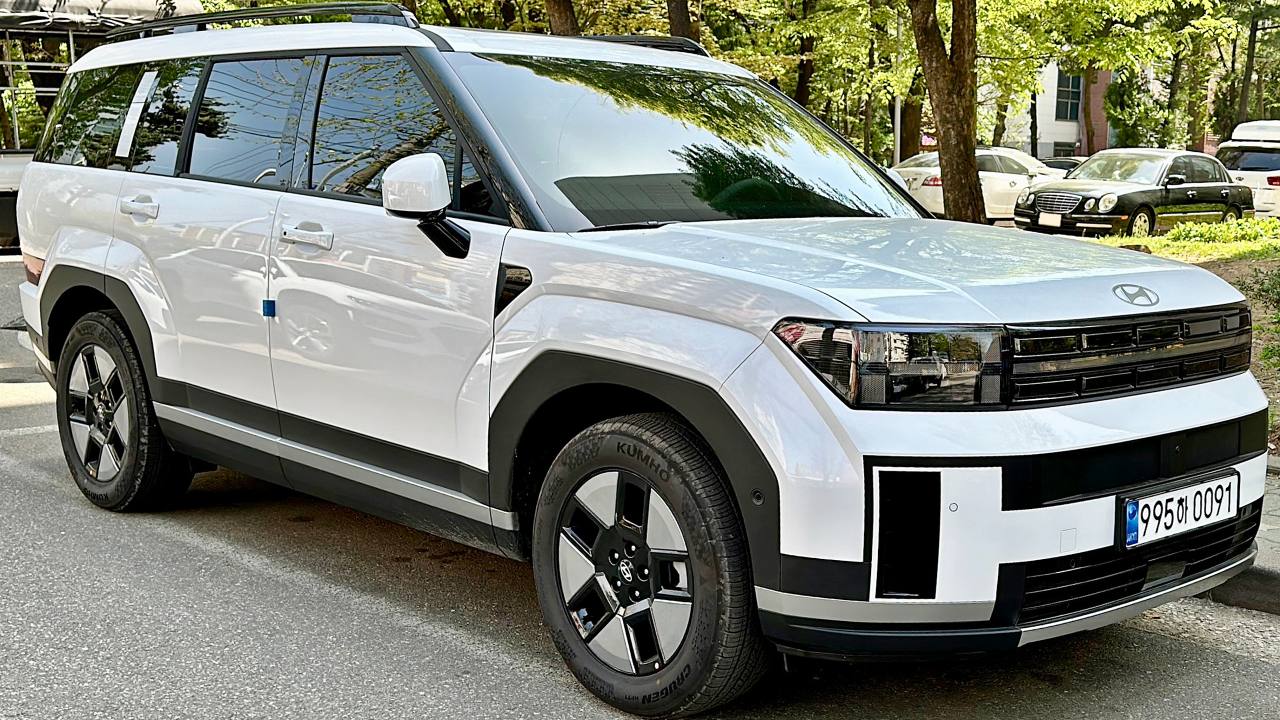
Hyundai is quietly using the familiar Santa Fe body to hide something far more radical underneath, a next-generation electric SUV that signals how quickly the brand’s family lineup is pivoting to batteries. The camouflaged test mules look like ordinary midsize crossovers at a glance, but the hardware and strategy behind them point straight at Hyundai’s coming wave of three-row EVs. As I see it, this is less about a single prototype and more about how the company is rehearsing its electric future in plain sight.
By leaning on the Santa Fe as a development workhorse, Hyundai can refine new electric and range-extended systems without tipping its full hand on styling or final badging. That approach fits neatly with the broader shift already visible in the company’s SUV range, from the all-new Palisade to the emerging IONIQ family, and it helps explain why this disguised EV SUV matters well beyond spy shots.
Why Hyundai is hiding a radical EV in a Santa Fe suit
When I look at Hyundai’s recent moves, the decision to cloak a radical EV SUV prototype in a Santa Fe shell feels almost inevitable. The current fifth-generation Hyundai Santa Fe arrived with a boxier stance and a more upright profile, and that squared-off body is a perfect disguise for testing new underpinnings. The brand has already teased a “New Look With” for this generation, and that phrase lands differently once you realize the same silhouette is now doubling as a lab for future EV hardware. Using a known body lets engineers focus on drivetrains, batteries, and cooling without the noise of unfinished exterior design.
At the same time, the Santa Fe is central enough to Hyundai’s lineup that any experimental tech tested here can scale quickly. The midsize Santa Fe sits right between compact crossovers and big three-row haulers, which makes it an ideal mule for a radical EV SUV that might eventually stretch up or down in size. By keeping the prototype’s skin familiar, Hyundai can run it on public roads, gather real-world data, and still keep the final EV’s styling and branding under wraps until the timing lines up with its broader electric rollout.
The Santa Fe EREV hints at Hyundai’s flexible powertrain play
The clearest window into what is hiding under those test mules is the emerging extended-range version of the Santa Fe. Reports on Santa Fe EREV describe a setup that pairs a 2.5-liter turbocharged gasoline engine, used solely as a generator, with a large traction battery. That layout turns the engine into a range extender rather than the primary power source, which is a very different philosophy from traditional hybrids. It is easy to imagine Hyundai using a similar skateboard and battery architecture as the basis for a pure EV SUV, simply deleting the generator and scaling up the pack.
Spy shots of a camouflaged Santa Fe EREV prototype running on South Korean roads show how seriously Hyundai is treating this as a bridge technology. For a radical EV SUV, that bridge matters: it lets the company validate battery packaging, thermal management, and software in a configuration that still reassures buyers with a fuel tank. Once those systems are proven, a fully electric variant using the same basic layout can arrive with fewer surprises and a lot more confidence baked in.
EV Santa Fe mules and the road to a three-row IONIQ future
The Santa Fe-based EV mules also sit in the shadow of Hyundai’s dedicated electric family haulers. The company has already confirmed the 2026 Hyundai IONIQ, described as an EV that blends space and versatility in a refined package, and that model will sit at the top of its electric SUV range. On the consumer side, the IONIQ 9 is billed as Hyundai’s first-ever three-row electric SUV, combining aerodynamics with family-friendly packaging. That is exactly the kind of vehicle that benefits from early testing in a Santa Fe body, where engineers can quietly refine ride quality and energy use with three-row proportions in mind.
Hyundai’s own specs for the IONIQ 9 hint at the performance envelope these prototypes are chasing. Official materials cite an EPA-estimated range of up to 335 miles, with a quoted 335-mile driving capability depending on conditions. To hit those numbers in a big family hauler, Hyundai needs to understand exactly how a tall, boxy SUV behaves in real traffic, with real aero drag and weight. That is where the Santa Fe mules come in: they let the company simulate three-row duty cycles long before the final IONIQ 9 bodywork is ready for public roads.
How the broader SUV lineup sets the stage
Zooming out, the radical EV SUV hiding in a Santa Fe shell is only one piece of a much larger puzzle. Hyundai is overhauling its entire utility range, with the Hyundai Palisade moving to an all-new model for 2026 and “Hyundai SUV and” signaling that every model is seeing changes. Analysts have framed the 2026 lineup as a “Three Rows or Bust moment, where New family haulers dominate the story. In that context, a radical EV SUV prototype is not a side project, it is a test bed for the next phase of that three-row strategy.
On the electric side, Hyundai is already positioning the 2026 IONIQ 9 as “Our first-ever three-row electric SUV,” described as “Equal parts aerodynamics and family dynamics.” That language tells me Hyundai is not content to simply electrify existing shapes; it wants EVs that are purpose-built for families. The Santa Fe mules, with their mix of familiar sheetmetal and experimental guts, are the rehearsal stage where those ambitions are being worked out before the curtain rises on the full electric cast.
Performance expectations and the EV SUV arms race
There is also a performance angle to these prototypes that is easy to miss if you only focus on range. Hyundai’s latest electric SUV has already been described as “outperforming all expectations” ahead of launch, with coverage noting it was Published on Aug 032 in a nod to how wild its acceleration feels. That kind of rhetoric sets a high bar for any future EV SUV wearing a Hyundai badge, radical prototype or not. If the company wants its next big electric family hauler to feel like more than a sensible appliance, it has to bake in that same sense of surprise and agility.
Clues about how Hyundai is thinking come from coverage of a Santa Fe-based EV that is “sort of” an electric version rather than a clean-sheet design. Reports by Peter Johnson describe a midsize Hyundai SUV that is already due for a facelift, with 8 Comments swirling around its design and range claims. That conversation, blending practicality with long-distance capability, is exactly the backdrop against which a more radical EV SUV will be judged. The Santa Fe mules are not just testing batteries; they are helping Hyundai calibrate how much performance and range it needs to stay ahead in an increasingly crowded EV SUV arms race.
More from Fast Lane Only