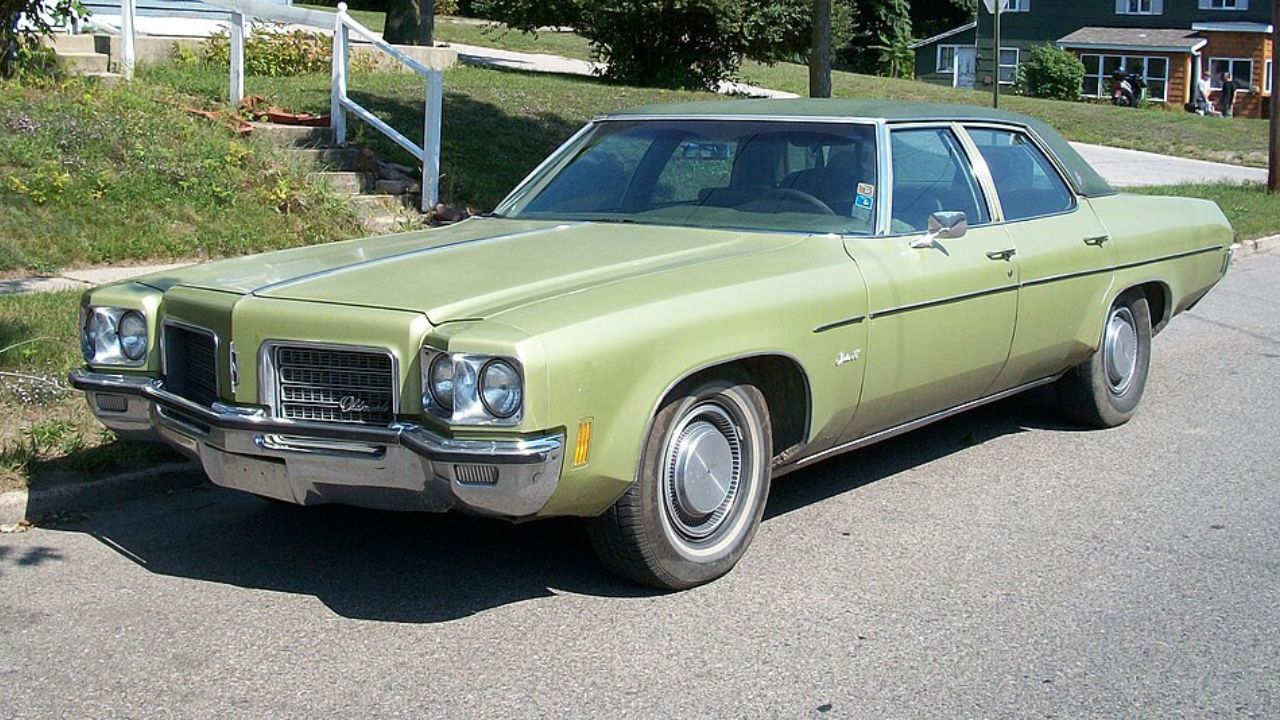
You feel it the moment the door thunks shut on a 1971 Oldsmobile Delta 88: the outside world goes a little muffled, the cabin settles, and the car seems to float away from the pavement. That sense of separation was not an accident or a side effect, it was the point. Oldsmobile spent the early seventies turning full-size comfort into a science experiment in quiet, and the Delta 88 became its rolling isolation chamber.
Instead of chasing raw performance or flashy gimmicks, the 1971 Delta 88 wrapped you in a carefully engineered cocoon of soft suspension, thick insulation, and unhurried power. You were meant to glide, not hustle, and to arrive less tired than when you left. To understand why this car still resonates with you today, you have to look at how obsessively Oldsmobile designed it to keep the noise and chaos of the road at arm’s length.
The G-Ride System and the science of quiet
If you want to see how seriously Oldsmobile took ride comfort, you start with the G-Ride System. On paper, it was a blend of chassis tuning, suspension geometry, steering refinement, and sound deadening, but in practice it was a philosophy: every component had to serve the goal of calm. Period brochures describe the G-Ride System as a coordinated package of engineering advances in the frame, suspension, steering, and insulation, a kind of holistic approach that treated the Delta 88 as a single, tuned instrument rather than a pile of parts, and you can see that thinking laid out in the full-line Ride System material.
Oldsmobile did not just stiffen a spring here or add a bushing there. Company engineers, described in another period brochure as “And for 1971, Olds engineers,” developed an upgraded ride package with exclusive components branded as Supershocks for the smoothest and most comfortable ride they could claim with a straight face. The G-Ride System was marketed across the Toronado, Ninety-Eight, Delta 88, Cutlass, 4-4-2, and even the station wagons, but in the Delta 88 it became the core of the car’s identity, the reason you chose it over a leaner, sportier sibling.
How a 4,300‑pound hauler still felt composed
On the road, that isolation did not mean the Delta 88 was a sloppy barge. A vintage test of a 1971 Olds Delta 88, captured in period footage, makes a point of how manageable the car feels despite its size. The driver calls it a “big 4,300lb hauler” and yet notes that he can bring the 88 through corners with comparative ease, a reminder that comfort and basic competence do not have to be enemies.
Watch that same car in another period road test and you see the same pattern: the body leans, the suspension breathes over bumps, but the car never looks nervous. You, as the driver, are cushioned from the worst of the road, yet the steering still tells you enough about what the front tires are doing. That balance is part of what made the Delta 88 such an effective long-distance tool. You could load it with family and luggage, settle into the wide bench, and let the car’s mass and tuning iron out the miles without feeling like you were wrestling a wallowing boat.
Marketing a cocoon: how Oldsmobile sold the Delta 88
Oldsmobile knew exactly what it was selling you, and the advertising leaned hard into that promise of separation from the outside world. A period print ad for a 1971 Oldsmobile Delta 88 Car, sized at roughly 10 by 13 inches, carried the caption beginning with the word “Intr,” a teaser that pulled you toward the idea of being drawn inside the car’s quiet space. The copy framed the Oldsmobile Delta as a place you entered, not just a machine you operated, and that subtle shift in language told you that comfort and isolation were the main features, not afterthoughts.
The same ad, offered again in collector listings as a 1971 Oldsmobile Delta 88 Car piece, repeats the focus on that “Intr” caption and the generous layout, treating the car almost like a living room on wheels. When you see the ad described in another listing for the same Car, the emphasis is still on the visual drama of a full-page spread that invites you to imagine yourself sealed inside, away from traffic noise and weather. Oldsmobile was not shy about telling you that the Delta 88 was a refuge, and the marketing made that emotional pitch as clearly as any spec sheet.
Why critics called it a “better than average hauler”
Contemporary reviewers picked up on the same theme, even when they were talking about performance or value. In one televised test, host Car and Track presenter Bud Lindemann looked at the redesigned 1971 Oldsmobile Delta 88 and concluded that it was the best version yet, praising it as a “better than average hauler” that gave you more car for the money. He framed the Oldsmobile Delta 88 as a smart buy precisely because it combined that isolation with honest utility, a car that could haul people and cargo without beating them up.
When you hear Lindemann talk about the Delta 88, you can sense that he is impressed by how the car manages to feel substantial without becoming punishing. The phrase “better than average hauler” is telling: it acknowledges that the Delta 88 is a workhorse, a big sedan built to move people and stuff, but it also hints that the way it shields you from the grind of that work is what sets it apart. For you as a driver, that meant a car that did the heavy lifting quietly, with a minimum of fuss.
Looking back from the era of downsizing
To appreciate the 1971 Delta 88 today, you also have to see it against what came later. By the time you get to the 1973 Oldsmobile Delta 88, critics are already talking about the car in the context of “deadly sins,” pointing to bloat and changing market tastes. One retrospective notes that it is a bit of a surprise that General Motors managed to build the fantastic Caprice Classic only a few years later, and singles out the 77 and 79 model years as high points for that car’s balance of size and efficiency.
In that same discussion, a commenter identified as Reply user Btrig, with a note that it was Posted April 9, reflects on how quickly the full-size formula evolved after the early seventies. Another look at the Nov piece on the 1973 Delta 88 underscores how the market’s patience for sheer bulk was already thinning. From your vantage point, that makes the 1971 car feel like a snapshot taken just before the downsizing wave hit, a moment when isolation and mass were still seen as virtues rather than liabilities.
More from Fast Lane Only