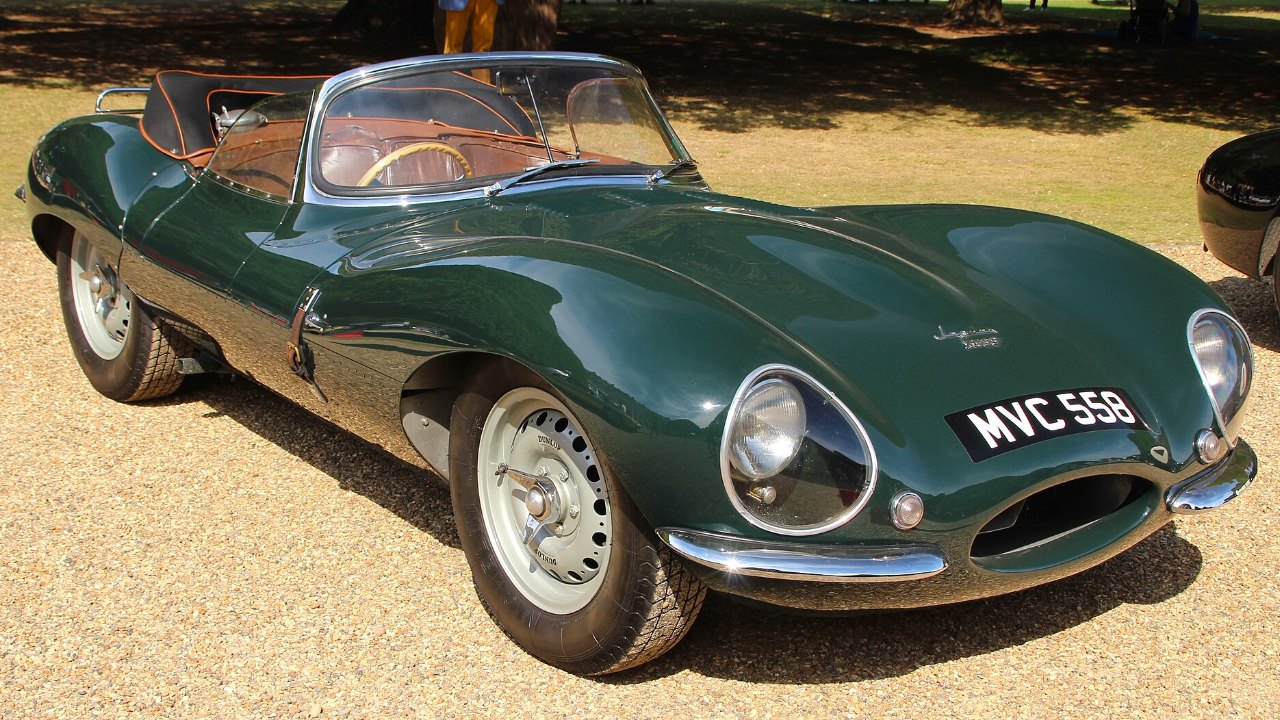
Jaguar planned 25 XKSS roadsters, but the Jaguar XKSS fire at its Browns Lane factory in Coventry cut that run to 16. The nine cars still waiting to be finished burned with the building. For almost six decades, the road-going D-Type stayed at that number. Then, in 2016, the company decided to finish the job.
Jaguar never planned a long production run for the XKSS. Instead, it was a way to turn unsold race cars into something an American buyer could drive on the street. The fire simply ended the plan sooner than anyone expected.
Here is how the cars came about, what happened at Browns Lane and how Jaguar closed the gap 60 years later.
Race cars with nowhere to race

The XKSS started with a surplus of D-Types. Jaguar won the 24 Hours of Le Mans three years running with the D-Type, from 1955 to 1957. However, the factory pulled out of racing after the 1956 season, according to RM Sotheby’s. That left both finished and unfinished D-Types sitting unsold in factory stock.
Founder Sir William Lyons then chose to convert 25 of those remaining cars into road cars, Jaguar says in its 2016 announcement. RM Sotheby’s adds that the company aimed them at the American market. On January 21, 1957, Jaguar went public with its plans for the run of 25, according to a Gooding & Company press release.
The changes from race car to road car were simple but visible. RM Sotheby’s lists them in its catalog for a continuation car. Jaguar removed the divider between the seats and the large tail fin. It also added a passenger door and a full-width windshield with a chromed frame. Side screens, chromed bumperettes and a simple folding top finished the conversion.
The night of the Jaguar XKSS fire
The plan lasted only a few weeks. On the evening of February 12, 1957, fire swept through the Browns Lane plant, Gooding & Company says. By then, Jaguar had completed 16 cars to XKSS specification. The blaze destroyed the other nine chassis, according to both Jaguar and RM Sotheby’s.
Jaguar’s later account says those nine lost cars were bound for North America. As a result, the XKSS ended at 16 cars. No one built the rest until Jaguar returned to them in the 2010s.
One of the survivors shows how the cars went on to live. Gooding & Company says chassis XKSS 716 first went to Montreal, Canada. Its owner raced it locally from 1957 to 1961. Gooding offered that car at its Amelia Island sale in March 2017 with an estimate of $16 million to $18 million.
Steve McQueen’s 1956 XKSS
Another survivor belonged to a movie star. The Petersen Automotive Museum owns Steve McQueen’s 1956 XKSS and calls it one of just 16 built. Its listing gives a 3.4-liter Jaguar XK inline-six rated at 250 bhp and a top speed of 150 mph.
The car arrived white with a red interior. Later, McQueen had it repainted green, polished the Dunlop wheels and retrimmed the cabin in black. Eventually, he decided the car was too rare and valuable to race. He sold it to collector Bill Harrah in the early 1970s, the Petersen says. However, he bought it back and kept it until his death in 1980. Today it sits in the museum’s Vault in Los Angeles.
Nine continuation cars, 60 years later
In March 2016, Jaguar announced it would build the nine lost cars, RM Sotheby’s says. The work took place at Jaguar Classic’s Experimental division in Coventry. Each car would carry hand-rolled panels rather than pressed ones, just as in period, according to Jaguar. Before that, the team spent 18 months on research, including digital scans of several original cars, RM Sotheby’s adds.
Jaguar then unveiled its “new original” XKSS at the Petersen Museum in Los Angeles, according to its November 17, 2016 release. The continuation cars use a 3.4-liter straight-six rated at 262 hp, fed by three Weber carburetors. They also wear magnesium-alloy bodies and period chassis numbers from the original XKSS chassis log. Jaguar priced each one at more than £1 million and estimated 10,000 man-hours per car.
“The XKSS is one of the most important cars in Jaguar’s history,” said Kev Riches, Jaguar Classic engineering manager, in that release. Meanwhile, Jaguar said it would deliver all nine in 2017 to mark the model’s 60th anniversary.
One of those nine has since changed hands at auction. RM Sotheby’s sold continuation chassis XKSS 775-21 at its Elkhart Collection sale in Elkhart, Indiana. The car showed only 51 actual miles when the house catalogued it, and it sold for $1,985,000.
More from Fast Lane Only
- Unboxing the WWII Jeep in a Crate
- 15 rare Chevys collectors are quietly buying
- 10 underrated V8s still worth hunting down
- Police notice this before you even roll window down
This article was created with the help of AI and was reviewed and edited by Fast Lane Only editors before publication.