Modern cars treat brake failure as an emergency requiring a warning light, a service appointment, and probably a tow truck. In 1953, Hudson treated it as a design problem with an actual mechanical solution built directly into the car. If the hydraulic brake line ever failed and the pedal sank toward the floor, a steel rod running straight from the pedal to the rear drums would catch partway down and lock the rear brakes anyway, giving the driver a way to slow the car with no hydraulic pressure at all. It’s the kind of feature nobody advertised at the time and almost nobody remembers now, which is exactly the kind of detail Jay Leno lives to dig up.
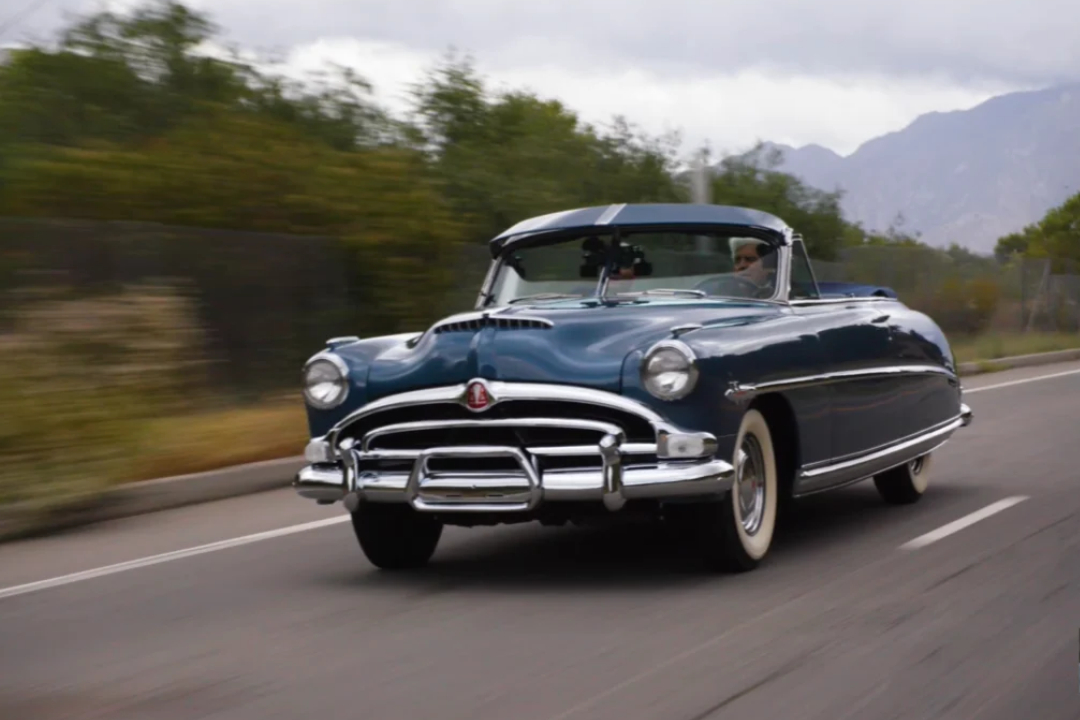
The car wearing that trick is a meticulously restored 1953 Hudson Hornet Convertible Coupe, owned by Chris Dwan and brought to life over three and a half years by a small army of Chicago-based specialists led by restorer Steve Stratos. It’s not a subtle build. Underneath the single-stage red paint sits a 308-cubic-inch flathead inline-six making 170 horsepower through Hudson’s signature Twin H-Power dual carburetor setup, more power than the contemporary Oldsmobile Rocket 88’s V8 could manage, despite Hudson sticking stubbornly with six cylinders while GM was already moving to overhead-valve V8s.
A frame built low enough to win NASCAR races
That horsepower number matters more than it might seem, because the Hornet wasn’t just quick in a straight line. Hudson’s postwar “step-down” design lowered the car’s floor below the frame rails rather than above them, dropping the center of gravity in a way nothing else on the road at the time could match. The result won NASCAR championships in 1951, 1952, and 1953, with Hudsons famously getting outrun on the straights by more powerful cars only to reel them back in through the corners. It’s a genuinely unusual origin story for a road car nearly seventy years later: a Hornet built for regular driveways carrying the same low-slung chassis logic that made the racing version nearly unbeatable for three straight seasons.
That dominance didn’t last. By 1955, Chrysler’s Hemi-powered 300 had taken over, and Hudson, unable to fund a V8 program of its own, faded fast, eventually merging into American Motors. The Hornet convertible sitting in Leno’s garage represents the tail end of the brand’s best years, built right before the six-cylinder holdout finally caught up with the company.
Chrome, restored down to individual pieces
The restoration itself is less a repaint and more a full-scale reconstruction. Over 310 chrome pieces cover the body, with another 103 in the convertible top mechanism alone, adding up to more than 400 individually plated components, each one stripped, restored, and reinstalled by chrome specialist Mark Solich, whose regular client list includes Pebble Beach show cars. Someone on the team half-joked about not wanting to calculate the total cost at even $100 per piece, a bit that lands harder once you register just how much chrome is actually on this car.
Under the hood, the high-performance cylinder head was finished in gold to match the factory spec, paired with bright red oil-bath air cleaners stamped with the Hudson horn logo, a maintenance system that requires physically draining and refilling oil to trap incoming dirt, and which Steve readily admits makes an absolute mess if you forget it’s there before pulling it apart. The car kept its original 6-volt electrical system rather than being converted to a more modern setup, running instead through a rebuilt generator that internally reworks the six-volt output to behave like a full-power unit, a period-correct compromise rather than a concession to unreliability.
Some of the smaller original touches border on genuinely strange by modern standards. A tissue box dispenser mounted under the dash. An optional eight-tube vacuum radio. Cable-driven windshield wipers pulled by a wire and pulley system Leno compared, not unkindly, to tiny men yanking a rope. None of it reads as luxury by today’s standards. All of it reads as exactly the kind of top-trim flex a 1953 buyer would have paid extra to show off.
Nine years, three and a half of them spent actually restoring
The car’s road to Leno’s garage wasn’t smooth. It had already sat unfinished at a previous restoration shop before the current team, led by Steve Stratos and a rotating cast of Chicago specialists, took over and spent three and a half years bringing it back properly, working from boxes of parts and leaning heavily on Russ Moss of 21st Century Hudson for reference material and reproduction pieces as original Hudson parts grow increasingly difficult to source.
Some fixes required serious ingenuity. A single-color leather interior replaced a badly deteriorated original two-tone scheme, since finding period-correct materials that matched properly took nearly a year on its own. Interior door panels sit on complex off-axis angles, meaning upholsterer “Little Joe” had to spend countless hours making the leather pleating line up seamlessly across surfaces that weren’t actually flat to begin with. A missing rear key flap trim piece, unavailable anywhere except as a cheap plastic reproduction, got hand-machined from brass and rechromed by the team specifically to replace it properly, a piece Steve presented to Leno during the visit as a matching part for Leno’s own 1951 Hudson.
Steve, citing a figure he attributed to Chris, put total 1953 convertible production at roughly 130, with perhaps only ten surviving today by his own separate estimate, drawn from general Hudson club knowledge rather than confirmed factory records. That distinction matters less than the headline number itself: even taken generously, this is one of a small handful of these cars left anywhere, well before accounting for the restoration quality.
Driving it like it’s still 1953, because you can
Out on Southern California roads, the Hornet handled less like a museum piece and more like a genuinely usable car. Leno pushed it comfortably to freeway speeds, describing the sensation of a fully open, top-down convertible as something closer to riding in a toboggan than driving a modern car, all while noting it could still cruise at 65 mph without complaint. The four-speed Hydramatic automatic, purchased directly from General Motors since Hudson never developed its own automatic transmission, shifted smoothly enough that both men repeatedly praised how well the drivetrain had aged.
None of this happened by accident or by budget. Steve was candid that owners who try to shortcut a restoration like this one almost always regret it, often overpaying at auction for cars missing critical original parts, then sinking unplanned money into fixing problems they didn’t know existed. This Hornet went the opposite direction: every removed part got cataloged and kept rather than discarded, on the logic that a shelved original piece might eventually prove better than whatever replacement could be sourced later. It’s a philosophy that shows up everywhere in the finished car, right down to a brake system safety net that most Hudson owners in 1953 probably never even needed to test.