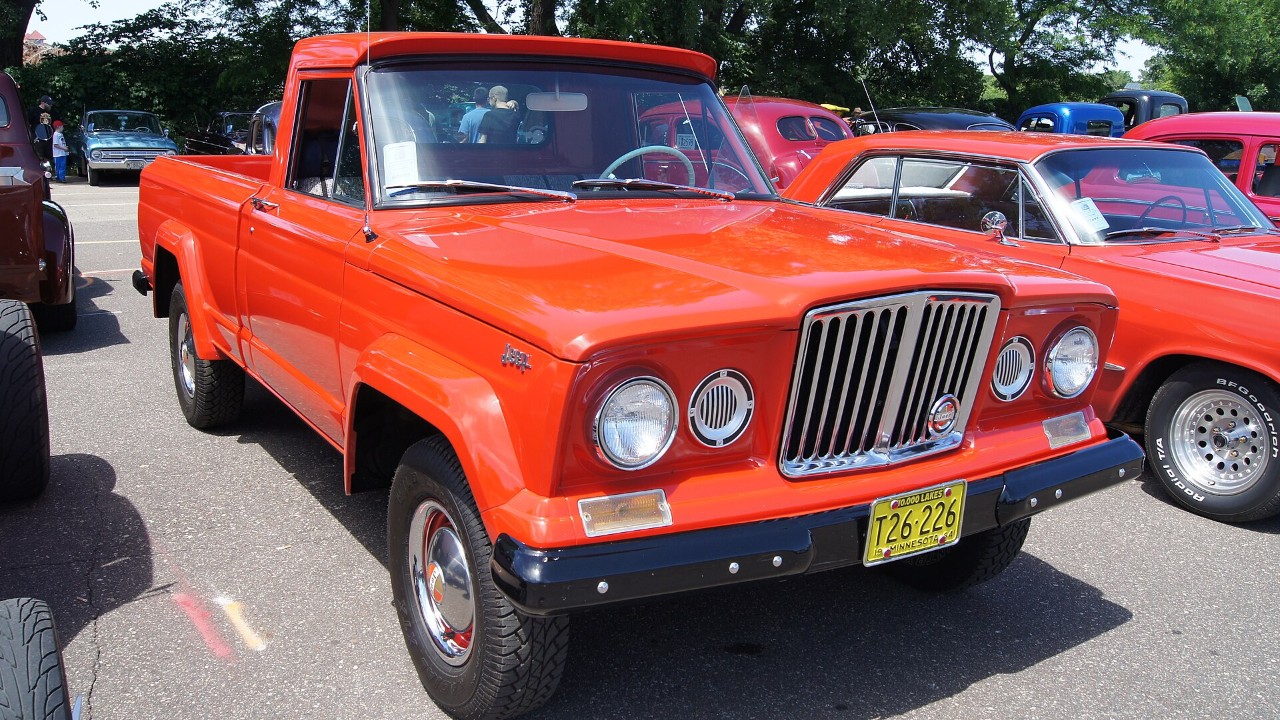
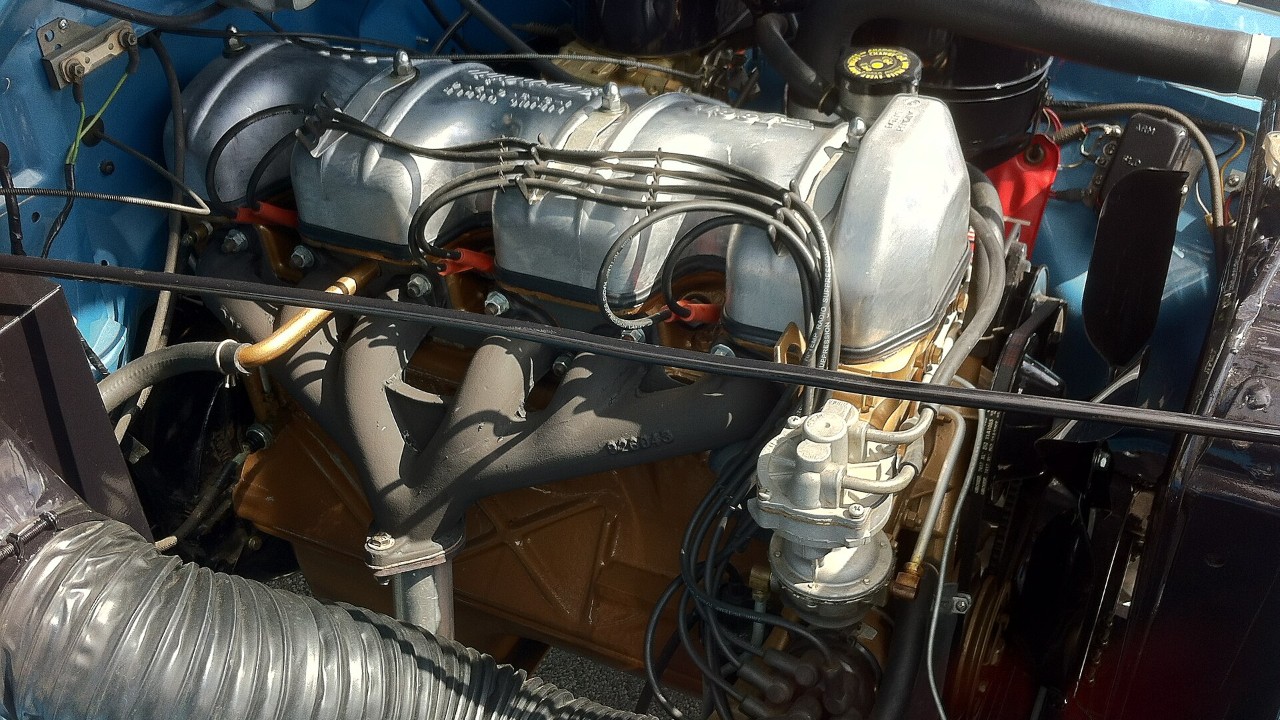
When Kaiser Jeep launched its new full-size pickup in the fall of 1962, the big news sat under the hood. The 1963 Jeep Gladiator came with the Jeep Tornado engine, a 230-cubic-inch inline six with a single overhead camshaft. In America at the time, that was a rare design for any engine, let alone a truck engine.
The Tornado did not last long in civilian Jeeps. Still, it put a modern valvetrain in a work truck years before most car buyers could get one, and it lived on in South America for two decades.
Here is who designed it, how it worked, why it was dropped and where it kept running.
A new truck with a new engine
The Gladiator came out in the fall of 1962 as a 1963 model, at the same time as the Wagoneer, Old Cars Weekly notes. The two shared their body-on-frame construction and front end. Brooks Stevens contributed the “rhino grille.”
The truck came in 2WD or 4WD, on 120-inch and 132-inch wheelbases. Buyers could also order an optional independent front suspension with torsion bars. In addition, Old Cars Weekly says the Gladiator was the first four-wheel-drive to offer an automatic.
The headline feature, though, was the engine. Old Cars Weekly describes the 140-horsepower Tornado as the first mass-produced, US-designed overhead-cam engine. It also reached market two years before Pontiac’s Sprint overhead-cam six.
That rarity is easy to forget now. In fact, Mac’s Motor City Garage points out that in 1962 just one US automaker offered an overhead-cam engine at all, and that was Kaiser Jeep.
Sampietro’s Jeep Tornado engine
The man behind the Tornado was Achille Carlo “Sammy” Sampietro, chief engineer at Willys and Kaiser Jeep from 1961. Historian Karl Ludvigsen called him “the thinking man’s engineer,” according to Mac’s Motor City Garage.
Sampietro did not start from a blank sheet. Instead, he began with the 226-cubic-inch L-head Hurricane six that Willys had inherited from Kaiser Motors in 1953. He widened the bore from 3.31 to 3.435 inches but kept the 4.375-inch stroke. As a result, displacement grew to 230 cubic inches.
The new cylinder head moved the valves overhead. Each cylinder had two valves at a 70-degree included angle. Compression rose from 6.86:1 to 8.5:1, and a Holley 2300 two-barrel carburetor fed the engine, MCG reports.
The camshaft was clever, too. It had just six lobes, so one lobe worked both valves of each cylinder. MCG says that layout “isn’t unique in automotive history,” but it is certainly uncommon.
The numbers
The old flathead made 105 horsepower at 3,600 rpm. By comparison, the Tornado made 140 horsepower at 4,000 rpm and 210 lb-ft of torque at just 1,750 rpm, according to MCG.
The JeepTech engine file at Offroaders.com lists the same 140 hp and 210 lb-ft. It also lists a low-compression version at 7.5:1, rated at 133 horsepower and 199 lb-ft. That engine went into some Jeep pickups and wagons in 1964 and 1965.
Better still for Kaiser Jeep, the conversion was cheap. Manufacturing cost rose “a mere six percent,” Sampietro told Roger Huntington in the July 1962 issue of Hot Rod, as MCG recounts. JeepTech also notes the engine was undersquare, which favored low-speed torque, a good trait in a truck.
Why the Tornado was dropped
The design looked good on paper, yet it struggled in service. MCG says the Tornado suffered from “excessive oil consumption” and suggests its development budget may have been thin. Old Cars Weekly adds that the independent front axle also flopped and was dropped in 1965 because of poor sales.
Kaiser Jeep then changed suppliers. In the middle of the 1965 model year, AMC’s 232-cubic-inch overhead-valve six, rated at 145 horsepower, replaced the Tornado. That same year, the Gladiator got its first V8, AMC’s 327 rated at 250 horsepower, Old Cars Weekly reports.
The military kept the Tornado longer. JeepTech lists it in the M715 and M725 trucks through 1969, and MCG notes the military trucks used it “with no better results.”
Where the Tornado kept running
The engine found a better second life in Argentina. There, IKA kept building it after US production ended, JeepTech says. In 1973 it became the “Torino” engine, with a refined block and crankshaft that moved from four main bearings to seven.
Meanwhile, the Gladiator itself carried on. The Jeep pickup ran until 1988, ending a 25-year run. In Argentina, Torino car and engine production continued through 1982, and MCG says the engine found real success there.
More from Fast Lane Only