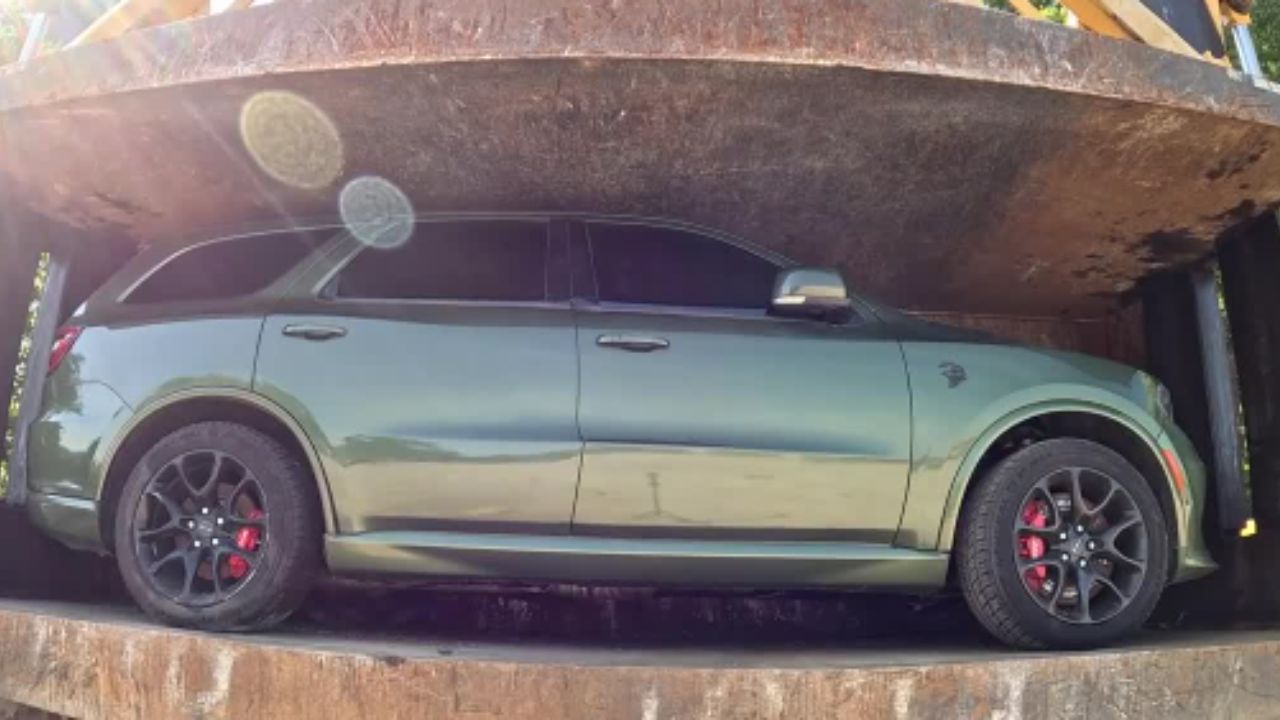
The 2021 Dodge Durango Hellcat was built to be outrageous, a supercharged family hauler that could out-accelerate many sports cars. In Louisville, it ended its life as a flattened hulk under a scrapyard crusher, its $100,000 potential sacrificed in the name of public safety. Kentucky police say the SUV was pieced together from stolen parts and used in dangerous street racing, and they wanted its destruction to send a message.
The spectacle has ignited a debate that stretches far beyond one Durango Hellcat: how far should cities go to deter illegal street takeovers, and when does a show of force turn into a publicity stunt that wastes valuable property?
The moment the Hellcat disappeared
In LOUISVILLE, Ky., the 2021 Dodge Durango Hellcat sat on the concrete at an impound lot, flanked by officers and city officials as cameras rolled. A heavy machine inched forward, its metal jaws closing around the SUV until the roof buckled and the frame collapsed. The performance was not hidden behind a fence; it was staged as a public warning aimed at those who use high powered cars for street racing and so called takeovers.
Video from the Louisville Metropolitan Police Department shows officials describing the SUV as a high value, high risk vehicle that could not simply be auctioned or repurposed. In a social media post that framed the event as “Crushing Crime, One Car at a Time,” the department said that Today, Louisville took a bold step in its ongoing fight against illegal street racing and reckless driving, presenting the crushed Hellcat as a symbol of that push Crushing Crime.
The city had already telegraphed what was coming. Earlier, Louisville officials had said the 2021 Dodge Durango Hellcat was seized as part of the city’s street racing ordinance and would not return to the road under any circumstances Louisville officials said. By the time the crusher descended, the destruction was less a surprise than a final act in a carefully choreographed campaign.
How a $100,000 SUV ended up under a crusher
The Durango Hellcat did not arrive at the impound lot as a stock family SUV. In a short clip shared on Instagram, an official stands in front of the vehicle and tells viewers, “What you see behind us is a 2021, I believe Hellcat Durango, this car is pieced together from several different stolen cars, the …” before the audio cuts off in the summary. The point is clear: investigators say the vehicle was a Frankenstein build, assembled from stolen components that could not be traced back to a single legal owner What you see.
Louisville authorities have linked the SUV to illegal street racing. Officials said the Dodge Durango Hellcat was seized under the city’s street racing ordinance, which allows the city to confiscate vehicles used in organized, high risk events that block intersections, spin donuts, and race on public roads. In one account, the SUV was taken during a crackdown on a street takeover where multiple cars were allegedly racing and performing stunts in front of crowds Durango Hellcat.
Authorities in Kentucky have described the SUV as valued at roughly $100,000, a figure that aligns with the limited production and high performance of the Durango Hellcat model. Louisville officials and police repeatedly emphasized that the city could not simply add the vehicle to its own fleet or sell it at auction because of liability and cost concerns tied to its history and modifications. In a community post, they said the Dodge Durango Hellcat, which they said was valued at $100,000, was confiscated and ultimately crushed instead of being reused valued at $100,000.
Inside Louisville’s street racing crackdown
The destruction of the Durango Hellcat did not happen in a vacuum. Louisville has spent the past several years trying to get a handle on illegal street racing and so called takeovers that have frustrated residents and alarmed police. Officials say these events often involve dozens of cars and spectators, with drivers blocking intersections to perform burnouts and high speed runs that leave rubber and debris on the pavement.
City leaders have leaned on a mix of ordinances, enforcement operations, and public messaging. The street racing ordinance used to seize the Dodge Durango Hellcat gives Louisville a direct tool to take vehicles away from repeat offenders. Alongside that, Louisville Mayor Craig Greenberg has publicly framed the crackdown as a warning to anyone thinking about organizing or joining a takeover. In one statement, Louisville Mayor Craig Greenberg said the city is sending a clear warning to street takeover participants after the Metro Police destroyed the Hellcat, presenting the move as part of a broader effort to restore order on city streets Louisville Mayor Craig.
The Louisville Metropolitan Police Department has also highlighted technology as a key part of its strategy. In a community update, officials described plans to buy cameras to fight street racing and car thefts, and in the same discussion they noted that Today, the city of Louisville crushed a 2021 Dodge Durango Hellcat that was seized under the ordinance. By linking the destruction to new investments in enforcement tools, the city framed the Hellcat as both a symbol and a case study in how it intends to tackle vehicle based crime Today, the city.
The official explanation: liability, cost, and stolen parts
After footage of the crushed SUV spread online, Authorities in Kentucky issued a detailed statement explaining why the Dodge Hellcat could not be resold or repurposed. In that statement, they said the Louisville Metropolitan Police Department had seized the 2021 Dodge Hellcat during a street racing enforcement effort and determined that the vehicle was assembled from stolen parts. Officials argued that returning such a car to the road, even through an auction, would expose the city to serious liability and the risk of future criminal misuse Authorities in Kentucky.
The department’s social media messaging echoed that reasoning. In the “Crushing Crime, One Car at a Time” post, the Louisville Metropolitan Police Department described the destruction as part of an ongoing effort to protect lives from reckless driving behavior and illegal activity. They argued that a vehicle built from stolen components and tied to street racing could not safely join the city fleet due to liability and cost concerns, and that crushing it removed any chance it would end up back in the underground racing scene Today, Louisville took.
Police have also stressed the deterrent value of the spectacle. In a short video clip circulated widely, a commentator notes that Kentucky police just crushed a Hellcat and says they are hoping it sends a message to others involved in takeovers. The clip frames the 2021 Dodge as a cautionary tale for anyone who invests in a high performance car and then uses it to commit crimes Kentucky police just.
Public reaction: applause, criticism, and car culture backlash
Reaction to the crushing has been sharply divided. On one side, some Louisville residents and supporters of the Louisville Metro Police Department have praised the move. In a community group post titled “Great job Louisville Metro Police Department,” commenters cheered the decision and repeated the “Crushing Crime, One Car at a Time” slogan, arguing that bold steps are needed to curb dangerous driving that puts bystanders at risk Great job Louisville.
On the other side, car enthusiasts and civil libertarians have questioned whether destroying a six figure SUV was the best use of public resources. Some critics have described the event as a glorified public relations stunt that sacrificed a rare vehicle for optics. One automotive outlet characterized the decision as Police Crushed a Dodge Hellcat To Teach Everyone a Lesson, and argued that the spectacle did more to generate headlines than to address the root causes of illegal street racing Police Crushed a.
Others have focused on due process and property rights. Although the sources provided do not detail the full legal journey of this particular SUV, critics of similar forfeiture practices often argue that crushing or selling property tied to alleged crimes can punish owners before every legal avenue is exhausted. In this case, Louisville officials maintain that the vehicle was both contraband, because of the stolen parts, and a public safety hazard, because of its use in street racing, which in their view justified its destruction.
Street takeovers and the Hellcat problem
The Durango Hellcat sits at the intersection of two trends that have challenged cities across the United States: the rise of social media fueled street takeovers and the popularity of high horsepower “Hellcat” branded vehicles in that scene. The Dodge Hellcat badge has become shorthand for outrageous power, and both Chargers and Durangos with that nameplate have featured heavily in videos of illegal races and intersection takeovers.
In Louisville, officials have described the seized SUV as a 2021 Dodge Durango Hellcat used in street racing and valued at $100K, and they have linked it directly to the city’s effort to deter those events. One report described how the vehicle was “pancaked” at the impound lot on a Wednesday, with Louisville officials saying the destruction was intended to show that the city would not tolerate Hellcat style antics on public roads valued at $100K.
Nationally, police agencies have repeatedly associated Hellcat models with high speed chases, theft rings, and takeover crews. Louisville’s decision to crush a Durango Hellcat instead of quietly disposing of it fits into a broader pattern of law enforcement using the symbolism of these cars to send a message. The hope, at least from the police perspective, is that showing a coveted performance SUV reduced to scrap will make some would be racers think twice.
What the video shows, and what it leaves out
Footage of the crushing has circulated widely online, including through a clip that shows Kentucky officers standing in front of the SUV before the crusher moves in. In one segment, an official explains that the car was seized during a street race and cannot be sold or used because of its stolen parts and the risk it poses if it returns to the road. The video emphasizes the physical destruction, lingering on the moment the roof caves and the wheels splay outward, as if to underline the finality of the city’s decision video shows Louisville.
What the video does not fully explore is the legal path that led to that moment. The sources provided do not spell out how long the vehicle sat in the impound lot, how many court hearings it was linked to, or whether any parties contested its forfeiture. Viewers see the beginning and the end, the street race and the crusher, but the middle remains largely procedural and off camera.
More from Fast Lane Only