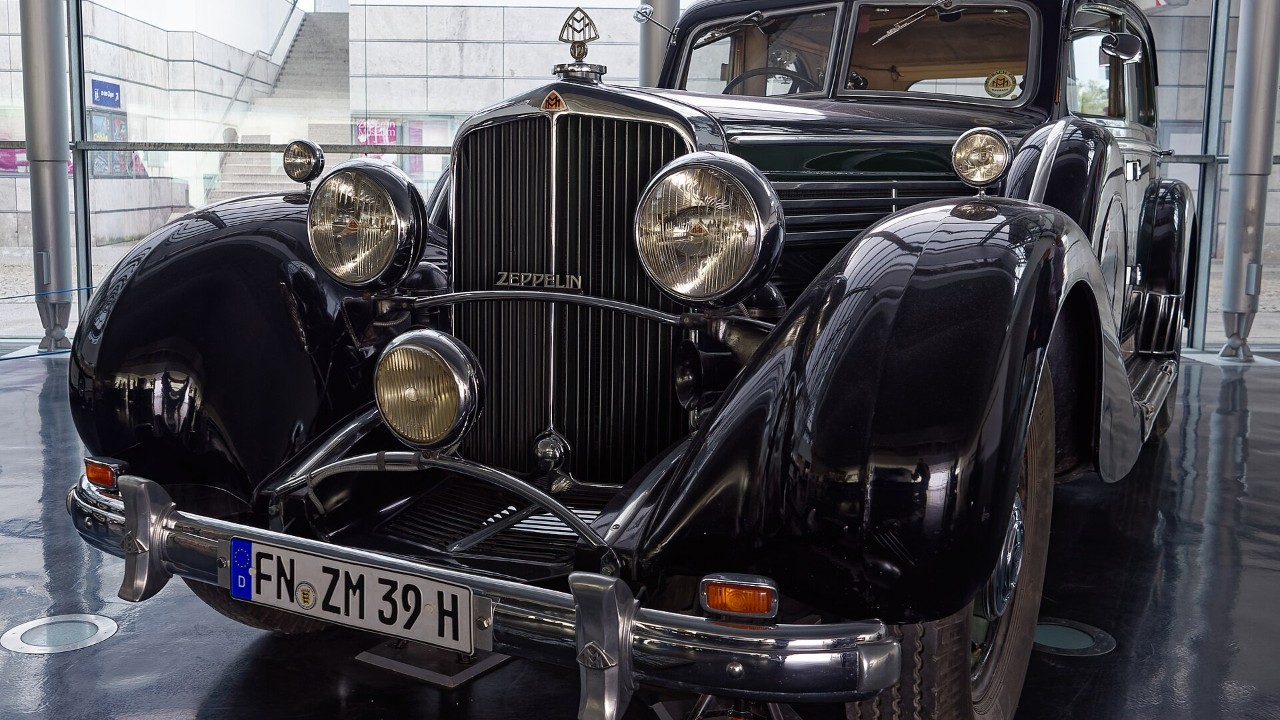
Maybach built about 1,800 cars before the war ended its car business. Roughly 200 of them were Zeppelins, and no more than about 25 were the Maybach Zeppelin DS 8, with an 8-liter, 200-hp V12.
The car took its name from the airships that Maybach engines once powered. It also cost 35,000 Reichsmarks, a price that kept buyers away in hard economic times.
Here is where the DS 8 came from, what its name means and where to see one now.
From airship engines to cars
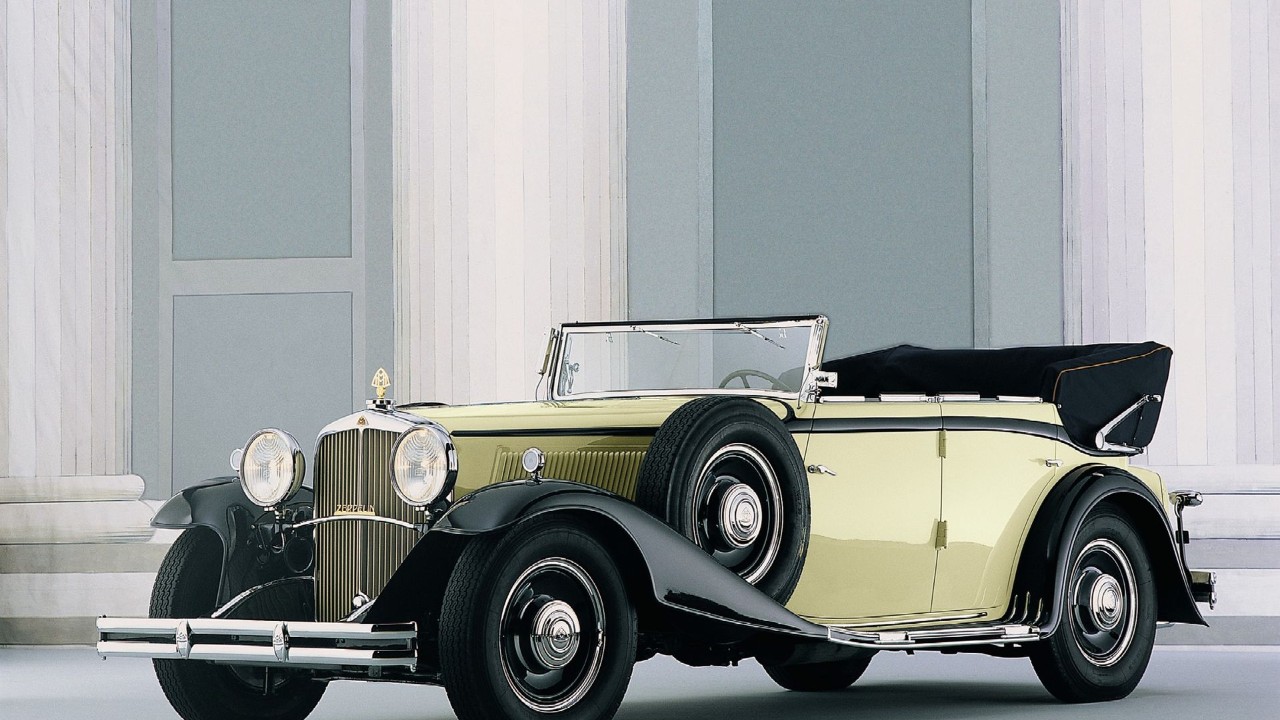
Wilhelm Maybach and his son Karl founded Luftfahrzeug-Motorenbau GmbH in Bissingen in 1909. Its job was to build engines for zeppelins, according to the German Patent and Trade Mark Office. Over time, Wilhelm moved into an advisory role, and Karl took over technical management.
After the First World War, the Treaty of Versailles banned aircraft construction in Germany. As a result, the company became Maybach-Motorenbau GmbH. It built railway engines in Friedrichshafen and started on cars of its own.
The first, the Maybach W 3, appeared at the 1921 Berlin Motor Show. It had a 70-hp inline six and a top speed of 110 km/h, the patent office says.
Why the Zeppelin name
Maybach engines powered the Zeppelin airships that crossed the Atlantic in the 1930s. So the company named its most prestigious car after them, notes Classic Driver. At the time, airships were the most elite way to travel.
The model code is just as literal. “DS” stands for “Doppel-Sechs,” or double six, meaning 12 cylinders, and the “8” means 8 liters, explains GTspirit.
Maybach Zeppelin DS 8 specs
From 1931, Maybach offered the Zeppelin as the DS 8 with an 8.0-liter V12, and from 1934 it replaced the DS 7. The engine made 200 hp and gave a top speed of 160 km/h, according to the Technik Museum Sinsheim. Classic Driver adds that the earlier engine was a 7-liter unit with 150 PS.
The DS 8 also got a seven-speed gearbox in place of the earlier five-speed. However, it kept Maybach’s preselector mechanism, the museum says.
GTspirit, which drove a DS 8 Cabriolet in California, describes how it worked. Only first gear needed the clutch. After that, the driver chose gears with a dial on the steering wheel, and a vacuum system made the shift.
The same car had built-in hydraulic jacks, so a tire change needed no separate jack. It measured 5.3 meters long and seated four. For comparison, GTspirit says most cars of the era made about 40 PS or less.
Why so few were built
The DS 8 cost 35,000 Reichsmarks. That high price, plus the tough economy of the time, kept demand low, according to the Sinsheim museum. Classic Driver says the car cost about twice as much as a supercharged Mercedes-Benz.
The totals reflect that. Maybach built at most about 1,800 vehicles, about 200 of them Zeppelins. Of those, no more than about 25 were DS 8 models with the 8-liter engine, the museum says.
Survivors are rarer still. Classic Driver, citing the Maybach Club register, counts 11 open DS 8s among the surviving V12 Maybachs. It adds that only three DS 8s still have their original seven-speed gearbox.
The end of Maybach cars
Car production ran until 1941. From then on, the company had to build tank engines instead. After 1945 it returned to large engines, but it never restarted car production, the patent office says.
Later, Daimler-Benz took over the company in 1960. Then, in 1969, it became part of MTU Friedrichshafen.
Wilhelm Maybach did not live to see the DS 8. Born in Heilbronn on 9 February 1846, he died in Stuttgart on 29 December 1929, the patent office records. By then, his son Karl had long since taken over technical management of the company.
Where to see a DS 8
The Technik Museum Sinsheim in Germany shows a DS 8 in its Hall 2. The museum lists the car as a 1938 model with the 8-liter, 200-hp V12, even though it dates DS 8 production to 1931–1934.
Classic Driver has also listed a 1938 DS 8 “Streamline Cabriolet,” a one-off body. According to the listing, its first owner was likely in North America, and the second owner bought it in 1984.
More from Fast Lane Only