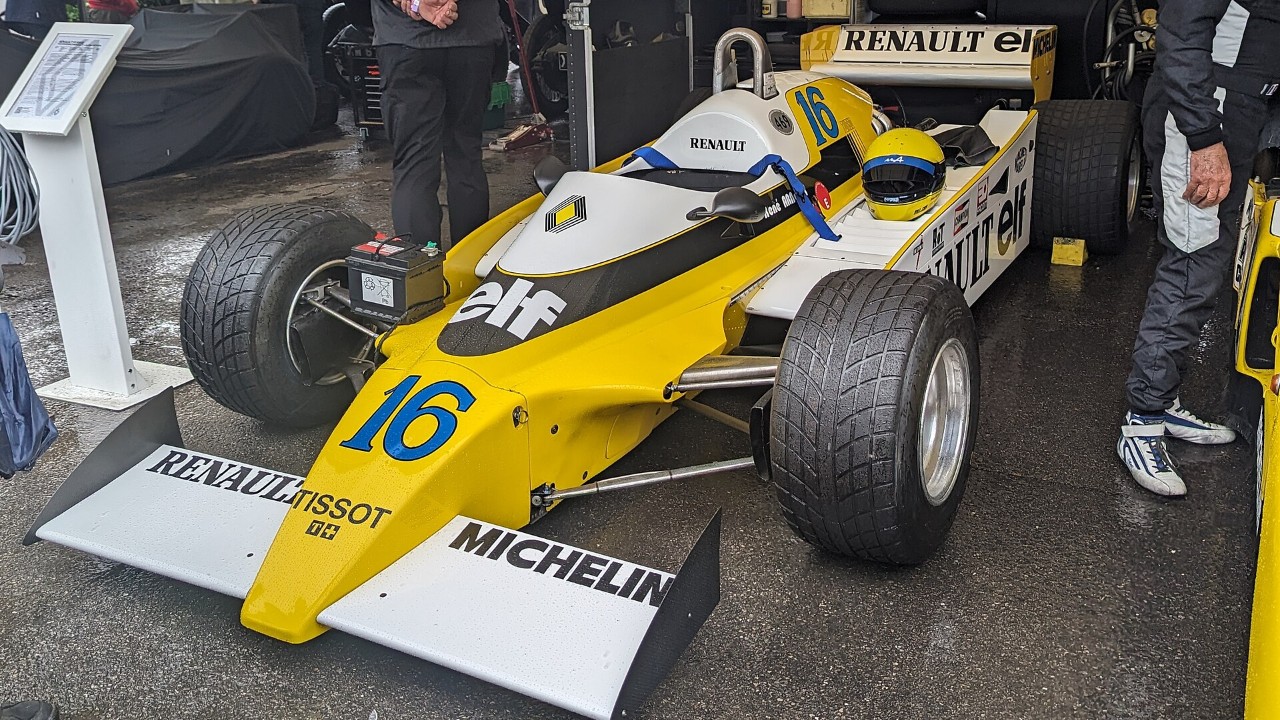
On July 1, 1979, Jean-Pierre Jabouille drove the Renault RS10 to victory in the French Grand Prix at Dijon-Prenois. It was the first Formula 1 win for a turbocharged car. The engine behind it displaced just under 1.5 liters, half the size of the engines it beat.
Renault had needed two years to get there. Its first turbo car, the RS01, had smoked and broken its way through 1977 and 1978. Rivals joked about it. Then, on a French circuit, with a French driver, the idea finally worked.
That afternoon changed what a Grand Prix engine looked like. Within a few seasons, the three-liter engines that had won every Grand Prix until then were on their way out. What follows is how the Renault program got from a smoking debut to a home win.
Why the Renault RS10’s engine was different
Before that July day, Grand Prix wins went to three-liter engines with eight or twelve cylinders. Renault took the other route the rules allowed. According to Zwischengas, the company raced a 1,492 cc V6 with a turbocharger, half the size of the three-liter engines.
Renault was also alone in this. Zwischengas notes that it entered F1 in 1977 as the only factory with turbo engines. The team was also the only one racing on Michelin radial tires. As a result, the car, the engine, the tires and the driver all came from France.
The project started on paper well before that. Race Tech Magazine reports that Renault decided on its F1 entry in 1975, and the plan took effect in 1977 with the RS01.
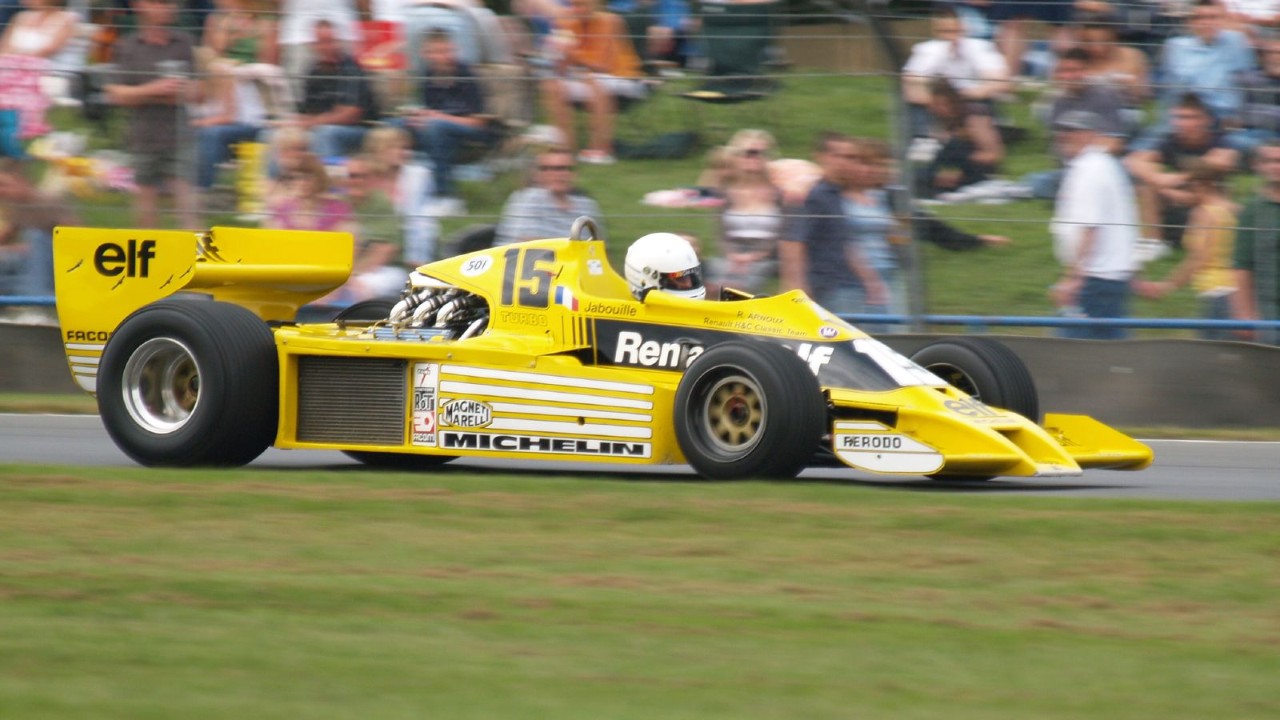
The RS01 and the “Yellow Teapot”
The RS01 was supposed to debut at the French Grand Prix at Dijon in 1977. However, it missed that date, as Autosport’s obituary of Jabouille recalls. Instead, the car first appeared at the British Grand Prix at Silverstone.
The official Formula 1 results for that race, held on July 16, 1977, show Jabouille in car No. 15. He started 21st of 26 on the grid. Then he retired after 16 of the 68 laps, while James Hunt won for McLaren.
Early reliability was poor. “In the beginning, we had four to five engine failures per test day!” Jabouille told Zwischengas. Many engines also failed in races, and the gearbox caused trouble too.
The car’s habit of trailing smoke gave it a nickname. Race Tech Magazine says Tyrrell team boss Ken Tyrrell joked that the yellow RS01 looked like a “Yellow Teapot” as it passed his garage. Soon, the whole paddock used the name.
From first finish to first pole
Progress came slowly. According to Autosport, the RS01 did not finish a race until Monaco in 1978. Later that season, Renault scored its first F1 points at Watkins Glen. Motorsport.com notes this was Jabouille’s fourth place in the 1978 United States Grand Prix.
Speed arrived before results. Autosport says Jabouille’s first pole came at altitude, at Kyalami in South Africa. He then topped qualifying at Dijon as well.
By then, Renault had a new car. Zwischengas describes the RS10 as a “wing car (with twin turbo),” and Jabouille helped develop both the RS01 and the RS10. Race Tech Magazine also points out that he was both an engineer and the driver of the RS01.
Dijon, July 1, 1979
Renault locked out the front row. The official 1979 French Grand Prix starting grid shows Jabouille on pole with a 1:07.190. René Arnoux, in the second RS10, qualified second with 1:07.450, and Gilles Villeneuve’s Ferrari started third.
Villeneuve, however, controlled much of the race. Motorsport.com reports that he led for 46 laps before his brakes and tires faded. Jabouille then took over at the front.
Behind him, Arnoux and Villeneuve fought for second in a duel that Autosport recalls. Arnoux later explained his side of it. “He had a big problem with the tyres and I had a problem with the fuel pressure,” he told Motorsport.com, adding that his engine “would stop for two seconds” at the big bend at the top of the circuit.
The official race result settles the order. Jabouille won after 80 laps. Villeneuve finished second, 14.590 seconds back, and Arnoux was third, 14.830 seconds behind the winner. In fact, only 0.24 seconds separated second and third.
What the Dijon win led to
Arnoux summed it up simply. “Dijon was a very good day for everybody because it was the first race Renault had won in F1,” he told Motorsport.com. Also, Autosport notes that Jabouille and Arnoux took four more poles before the 1979 season ended.
Jabouille won one more Grand Prix. According to Autosport, it came at the Österreichring in 1980, in a Renault RE20, ahead of Alan Jones’s Williams. He made 49 F1 starts in all.
Meanwhile, the turbo idea spread. Zwischengas writes that the three-liter engines were “soon consigned to the scrapheap,” and the 1.5-liter turbos ruled until they were eventually banned. For the 40th anniversary, Renault restored an RS10, and Jabouille drove it again on a small track near Paris.
The record from Dijon does not change. According to Formula 1’s official results, Jabouille covered the 80 laps in 1:35:20.420 and won by 14.590 seconds, the first win for a turbocharged Formula 1 car.
More from Fast Lane Only