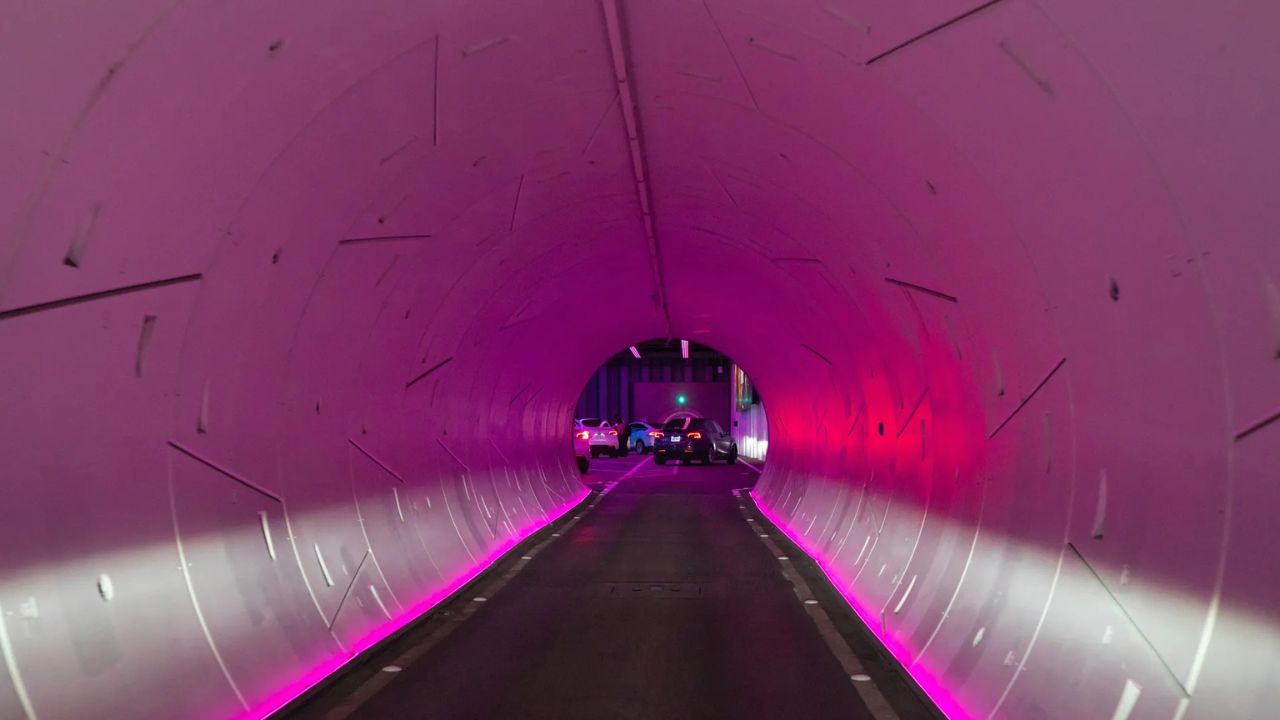
Nashville just handed you a case study in how cities weigh tech hype against transit reality. By rejecting Elon Musk’s Loop-style tunnel as a preferred solution, your local leaders essentially argued that a decade after the first pitch, there is still no clear proof that this car-based tunnel system can outperform a straightforward subway.
If you care about how your city moves people, the fight over the Music City Loop forces you to confront a basic question: do you want to bet your mobility future on an experimental, car-centric tunnel, or on higher-capacity rail that already has a track record?
How a flashy tunnel met a narrow rebuke
You watched a project that once looked inevitable run into an unexpectedly stiff headwind. Earlier this week, Nashville’s Metro Council voted 20-15 for a nonbinding resolution that formally opposes The Boring Company’s underground system, a tally that shows how closely divided your local representatives are on the idea of a Tesla tunnel connecting the airport and downtown. That opposition targets the Music City Loop concept that The Boring Company and Elon Musk have promoted as a quicker, cheaper alternative to traditional rail, even as critics point out that after roughly a decade of marketing, there is still no hard evidence that such a Loop can move more people, more efficiently, than a subway, a concern highlighted in coverage that noted Fred Lambert and the figure 59 Comments alongside the debate.
You also saw how symbolism and rhetoric shaped the outcome. One local critic captured the skepticism with a viral line calling the Loop “a train” dressed up as something else, while others framed it as a vanity project that risks locking you into an expensive one-off system instead of a network that can grow. The Metro Council’s 20-15 split is now on record as the official position of the body, even if the resolution is not binding on state officials or on The Boring Company, and it feeds directly into a wider argument over whether the Loop model has ever proven it can beat a subway on capacity, safety, or long-term cost.
Inside the Music City Loop promise
To understand what you are saying no to, you have to look at what The Boring Company is actually offering. On its own project page, the company describes the Music City Loop as a system that would connect Nashville International Airport to downtown through underground tunnels, with construction framed as being in project planning, design, and permitting, and moving toward a start of tunneling on what it calls an aggressive schedule, language that appears in the section that begins with When you can expect work to begin. The pitch to you is simple: you would ride in Teslas through dedicated tunnels, bypassing surface congestion in a trip that is marketed as “safe, fast, and fun,” a phrase that Steve Davis, a leader at The Boring Company, echoed when he said that Music City Loop will be a safe, fast, and fun public transportation system and that the company is excited to build it in Nashville, a claim tied directly to Davis in a statement about Music City Loop.
The state has already moved to clear a path for that vision. Tennessee Governor Bill Lee announced on a Monday that The Boring Company, also referred to as TBC and owned by Elon Musk, plans to build the Music City Loop, and that the state would provide a lease and permit for the underground Tesla tunnel that would run from the airport (often called BNA) to Broadway, signaling early support for the project from the governor’s office and describing it as privately funded in coordination between TBC and state officials, according to an announcement that explicitly linked Tennessee Governor Bill and The Boring Company. Separate reporting from NASHVILLE, Tenn, also noted that The Boring Company, owned by Elon Musk, has already said that tunneling for Nashville’s underground Tesla project has begun, describing how the company announced that the tunneling process is officially underway for a route that would connect the city’s international airport to downtown, as described by NASHVILLE, Tenn coverage.
Why council members balked at the Loop
Despite that momentum, your local representatives did not simply fall in line with the state. In a close and sometimes tense meeting, Nashville council members raised concerns about safety, transparency, and the basic question of whether a car-based tunnel is the best use of scarce right of way under the city. One report from Davidson described how Nashville pushes back on the Boring Co tunnel project in a close vote, with members questioning whether the company had provided enough information about emergency procedures, capacity, and long-term maintenance, and framing the resolution as a push for more clarity on the question of safety and transparency around the Boring Co proposal.
The debate also exposed how split your council is on technology-driven transit. One account described how She and 19 of her peers had just narrowly voted to pass a resolution that officially positions the council as objecting to the Elon Musk tunnel project, and how the final vote count shook out in a way that left both supporters and opponents claiming to represent the city’s future, a dynamic captured in a passage that begins with “She and 19 of her peers” and references Elo as shorthand for Elon Musk. Another local outlet noted that Metro Nashville Council members voted to formally oppose the proposed Music City Loop tunnel project, even as some members stressed that their objections were not political but grounded in concerns about how the system would affect your daily commute, your tax exposure, and the shape of future transit investments, a framing that appeared in coverage of the Metro Nashville Council vote.
The subway comparison that will not go away
If you are trying to decide whether to support the Loop, you eventually run into the question of how it stacks up against a subway. Critics point out that the Loop model, which moves riders in Teslas or small shuttles, has not yet demonstrated the kind of passenger throughput that heavy rail systems routinely deliver, and that there is still no data showing it can move more people per hour than a subway train. One analysis framed the Nashville debate in the context of a decade of Boring Company announcements in places like Chicago Fort Lauderdale and Los Angeles, noting that despite flashy rollouts, to date the Boring Company has not produced a system that clearly outperforms conventional rail, a point that surfaced in a short video about Boring Company projects.
That skepticism is not limited to Nashville. A separate report described how Elon Musk’s proposed Tesla tunnel loop met with organized opposition in Nashville, Tenn, where by Jonathan <attise and Kristin M. hall wrote about protests and legal questions, and noted that The Boring Company’s CEO Steve Davis said the system could open by the first quarter of 2027, while disability advocates raised concerns about compliance with the Americans With Disabilities Act, all in a piece that also referenced Iran live updates, the Pentagon, American troops, and Kuwait as part of a broader news package that included the figure 53 in an update timestamp, details that appeared in coverage of Nashville protests. When you set that against decades of subway operations in cities around the world, the burden of proof falls heavily on any new system that promises to be cheaper and faster yet has not shown it can reliably move large crowds at peak times.
What the fight reveals about who transit is for
More from Fast Lane Only