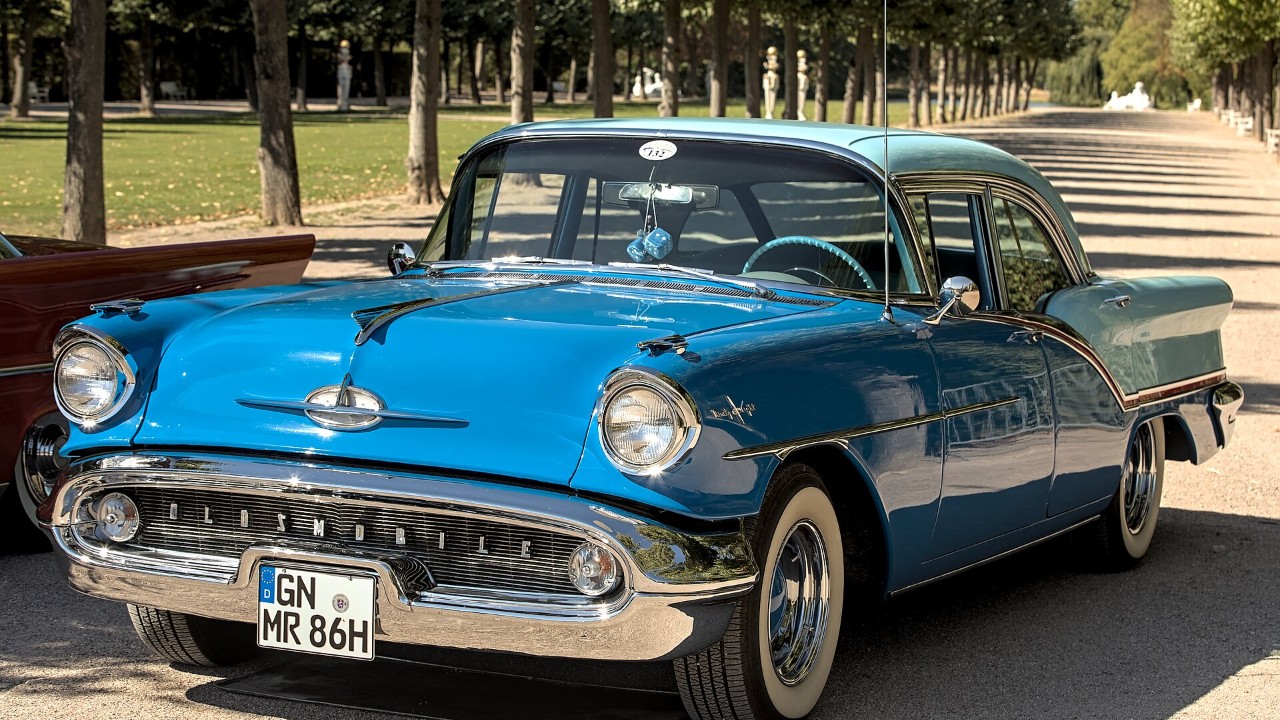
For $83 in 1957, the Oldsmobile J-2 option turned the new Rocket 371 V8 into a 300-horsepower engine with three carburetors. Order code W was open to any Oldsmobile buyer. However, it lasted only two model years, and most owners never used all of it.
The J-2 arrived in January 1957, about a month after Pontiac showed its own three-carburetor setup. Pontiac kept its version for roughly a decade and made the name Tri-Power stick. Oldsmobile’s version, by contrast, was gone after 1958.
That short life makes it easy to miss. Still, the J-2 says a lot about the horsepower race of the 1950s, NASCAR rules and the trouble with clever hardware on a family car.
What the Oldsmobile J-2 added to the Rocket 371
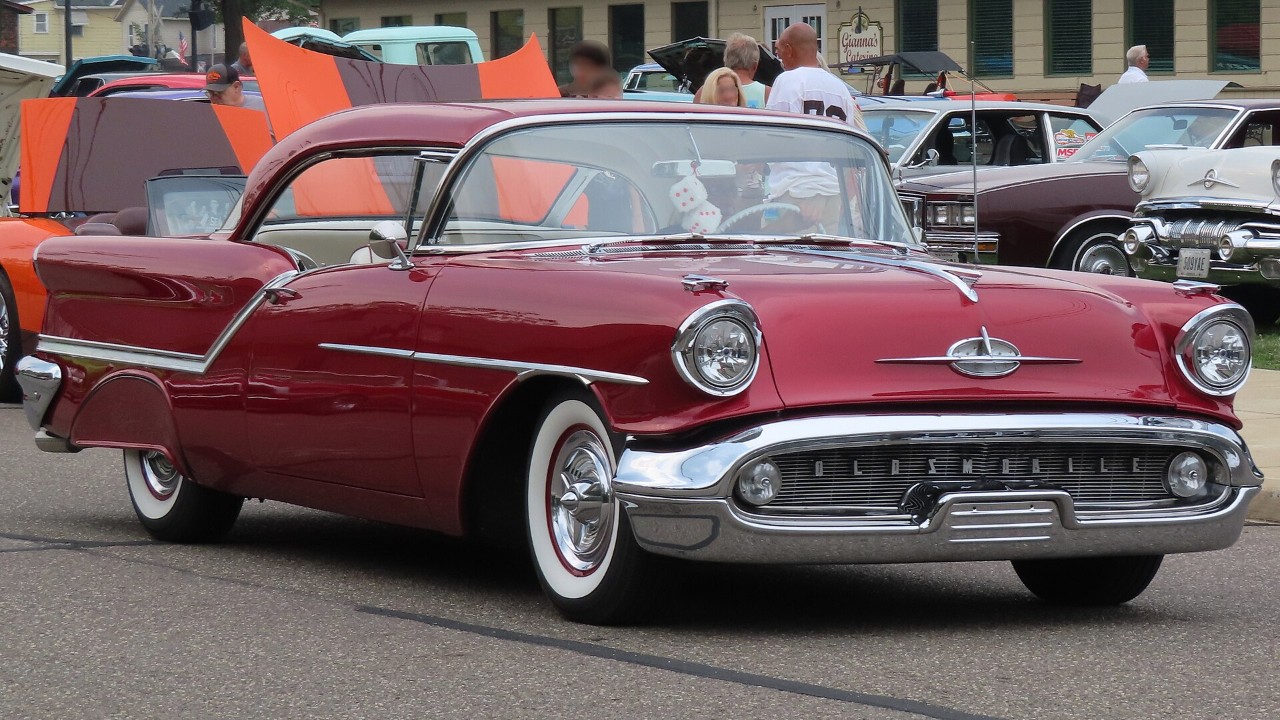
First, the base engine. According to Mac’s Motor City Garage, the standard 1957 Oldsmobile ran a 371-cubic-inch V8 with one four-barrel carburetor. It made 277 hp.
The J-2 changed three things, Mac’s reports. A thinner head gasket raised compression to 10:1. Then a new cast-iron intake carried three Rochester 2G-series two-barrel carburetors. Finally, the output rose to 300 hp at 4,600 rpm and 415 lb-ft of torque at 2,800 rpm.
The name was a nod to JATO, the jet-assisted takeoff rockets the military used, according to the same source. Oldsmobile printed it both as “J2” and “J-2” in its own literature.
How three carburetors shared the work
In normal driving, only the center carburetor did anything. It was the only one with a working choke and idle circuit, Mac’s notes. The two end carburetors waited for a heavy right foot.
Past about 75 percent throttle, a vacuum switch on the center carburetor let a vacuum servo snap the front and rear throttles open. So the system was progressive overall, but the end carburetors were all or nothing. When they opened, owners got a loud roar and a sudden surge of power.
Early cars wore a batwing air cleaner with two filter elements. Later cars switched to a large round air cleaner over all three carburetors, with a J2 sticker on the lid. Over-Drive Magazine’s 1957 Oldsmobile fact sheet also lists dual exhaust as standard with the J-2.
What $83 bought next to the rest of the options list
Price is where the J-2 looks almost too good. The Over-Drive fact sheet lists the J-2 at $83. By comparison, power steering cost $100, Hydra-Matic cost $215 and air conditioning cost $430.
That made 23 extra horsepower one of the cheapest upgrades in the book. RM Sotheby’s catalog for a 1957 Starfire Ninety-Eight J-2 convertible puts that top model at $3,838 before options. In other words, the J-2 added only about two percent to the sticker of the most expensive Oldsmobile.
Buyers could also go further. Mac’s says Oldsmobile sold a J-2 competition kit, called J2-W2 or J-2R, over the counter for $395. It included forged pistons and a solid-lifter camshaft with more lift and duration. It also added adjustable rocker arms and dimpled valve covers to clear them.
The NASCAR connection
The racing kit had a clear target. Lee Petty and other drivers ran the J-2 hardware in NASCAR, Mac’s reports. Then the series banned multiple carburetors midway through the 1957 season. The same ban covered superchargers and fuel injection, so the whole effort lost its point.
RM Sotheby’s catalog adds two details. It says Bill France Sr. objected that Oldsmobile was not offering the J-2 to the public, and that Oldsmobile answered by putting it on the options list. The catalog also says the J-2 Olds of Richard Petty’s father reached 144.9 mph at Daytona Beach.
Production is harder to pin down. Mac’s Motor City Garage gives no total. RM Sotheby’s writes only that it is believed fewer than 750 cars got the J-2 in 1957, so treat that as an estimate.
Why the J-2 disappeared after 1958
For 1958, Mac’s says, the J-2 rose to 312 hp. That was also its final year. The clever linkage turned out to be its weak point in daily use.
Most owners rarely pressed past 75 percent throttle. As a result, the two end carburetors sat unused and gummed up. Fixing them often meant a costly teardown and cleaning, and dealers reportedly began steering customers away from the option.
Meanwhile, Oldsmobile moved on to sheer size. For 1959, according to Mac’s Motor City Garage, the V8 grew to 394 cubic inches, and the four-barrel version carried a 315-hp rating. That was more than the last J-2, and it came from a single carburetor.
More from Fast Lane Only
- Unboxing the WWII Jeep in a Crate
- 15 rare Chevys collectors are quietly buying
- 10 underrated V8s still worth hunting down
- Police notice this before you even roll window down
This article was created with the help of AI and was reviewed and edited by Fast Lane Only editors before publication.