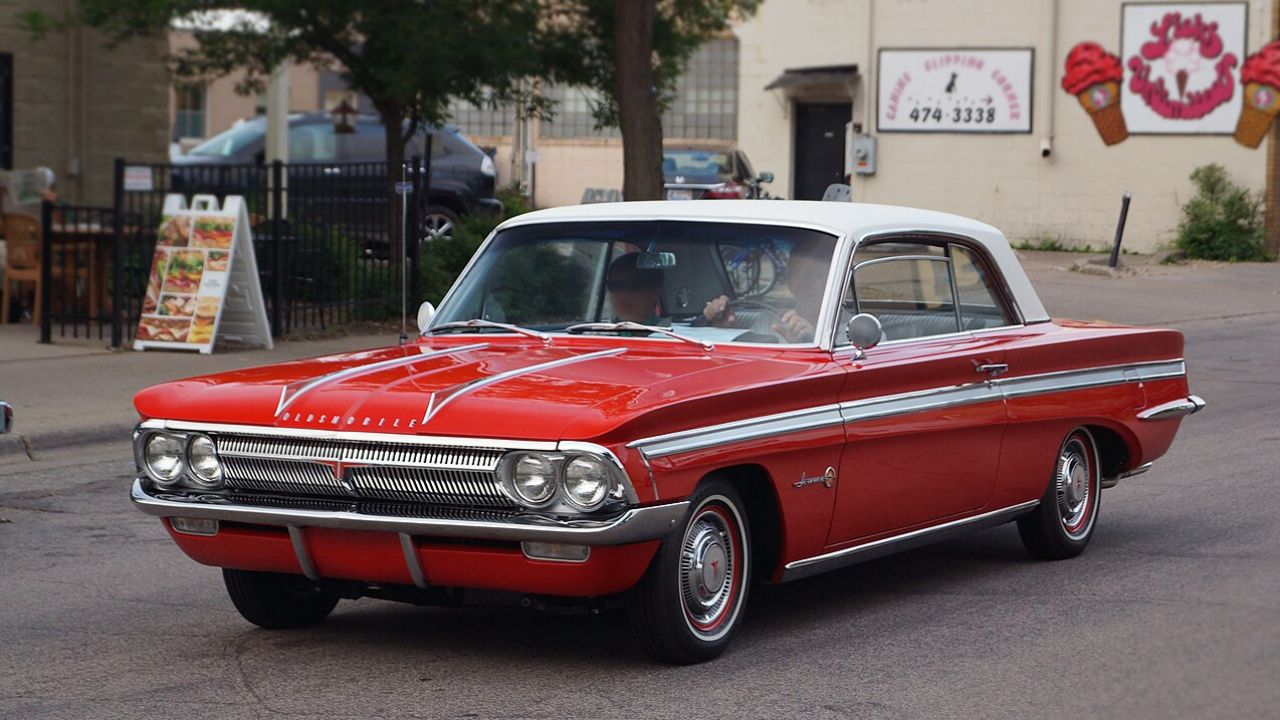
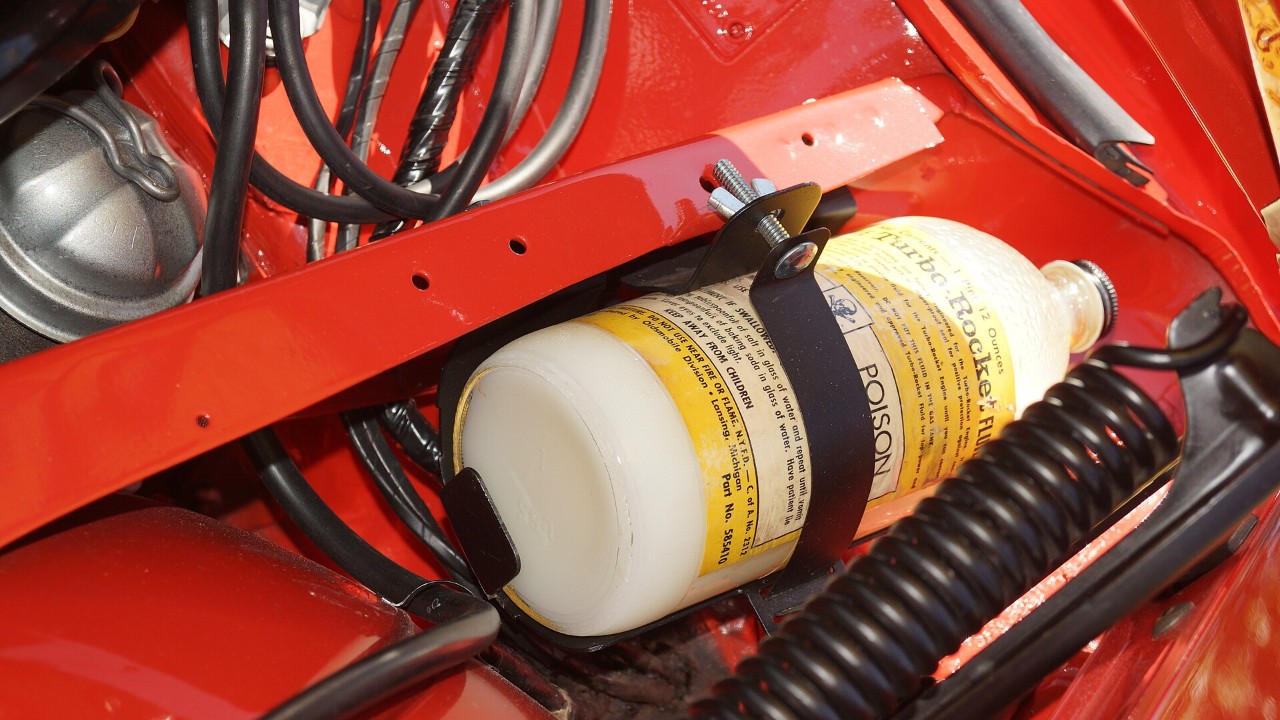
Every 1962 Oldsmobile Jetfire carried a second fluid tank under the hood. It held Turbo-Rocket Fluid, a mix of water and methanol that the engine sprayed into its intake whenever the turbocharger pushed hard. Without it, the high-compression V8 could start to knock and damage itself.
That small tank explains most of the Jetfire story. It is how Oldsmobile made a turbo work on a car with no knock sensor and no computer. It is also why many owners came to dislike the car.
This is a look at the plumbing rather than the headlines: what was in the fluid, how it reached the engine, and what happened when it ran out.
Why the Jetfire V8 needed help
The Jetfire started from the F-85’s 215-cubic-inch aluminum V8. Old Cars Weekly reports that Oldsmobile kept the compression ratio at 10.25:1, the same as the four-barrel version. That was a bold choice, because forcing more air into a high-compression engine raises the risk of detonation.
Detonation, or knock, happens when part of the fuel charge ignites on its own instead of burning smoothly from the spark. Later engines use electronic knock sensors to catch it. However, Curbside Classic points out that the Jetfire had no such sensor.
So the engineers cooled the charge instead. Speedhunters explains that the injected fluid absorbed heat from the incoming air and fuel, and that this helped control detonation at the engine’s high compression.
What was in Turbo-Rocket Fluid
The recipe was simple. Hagerty describes Turbo-Rocket Fluid as a 50:50 mix of distilled water and methanol with a rust inhibitor added. Speedhunters gives the same formula and adds that Oldsmobile dealers were the only source.
That detail mattered for owners. Because the fluid came only through the dealer, the Jetfire driver had one more liquid to track along with gas and oil.
How the Turbo-Rocket Fluid reached the engine
The delivery system used boost itself as the pump. According to Curbside Classic, the turbo pressurized the fluid tank whenever it was boosting. That pressure pushed fluid into the intake between the carburetor and the turbocharger.
Speedhunters adds that the spray rose in proportion to boost. In other words, the harder the driver pushed, the more fluid the engine got.
The layout also explains where the fluid entered. Curbside Classic says the Jetfire used a draw-through setup. A special single-barrel Rochester sidedraft carburetor sat ahead of a Garrett T05 turbocharger, developed with Garrett’s AiResearch department. The turbo then blew the air, fuel and fluid mix straight into the V8.
Boost stayed modest. Speedhunters says it began building at 1,000 rpm and reached 5 psi by 2,200 rpm. Old Cars Weekly reports that Oldsmobile capped it at 6 psi and added a wastegate. Hagerty notes that there was no intercooler, which left the fluid to do the cooling alone.
What happened when the tank ran dry
The tank was not large. Curbside Classic gives its capacity as five quarts and says average driving used it up in about 225 miles. Speedhunters says hard driving could empty it in about the same distance.
Oldsmobile built in a warning. An “Add Fluid” light sat on the console-mounted boost gauge, according to both Curbside Classic and Speedhunters. Hagerty adds that the gauge face read only ECONOMY and POWER.
Ignoring the light did not wreck the engine. Instead, a float-and-valve assembly closed and bypassed the turbo once the fluid ran out, Curbside Classic explains. The car kept running, but it lost its boost.
Why the fluid hurt the Jetfire’s reputation
The safeguard worked, but owners blamed the car anyway. Curbside Classic says a common complaint was a “lack of power,” often because the tank had simply run dry. Hagerty makes the same point, adding that many owners never refilled the fluid.
The fluid was not the only trouble. Curbside Classic reports that turbos could seize when owners rarely built boost, and that the engine ran hot like other Olds 215 V8s. Consequently, the article concludes that the complexity of the safety systems helped doom the car.
The numbers it protected
When the system was full, the gains were real. Old Cars Weekly lists 215 horsepower and 300 lb-ft of torque for the Jetfire, up from 185 horsepower and 230 lb-ft without the turbo. Curbside Classic places that torque peak at 3,200 rpm.
The car itself was based on the F-85 Cutlass coupe, Curbside Classic notes. Old Cars Weekly says it arrived in April 1962 at an F.O.B. price of $3,045 and weighed 2,744 pounds. Curbside Classic counts 3,765 Jetfires for 1962 and 5,842 for 1963.
Later, General Motors offered owners a way out. Curbside Classic says dealers removed the turbo and fluid system for free in 1965, fitting a four-barrel carburetor and conventional manifolds. Most owners took the deal, which is why a complete Jetfire is hard to find today.
Original systems do turn up. Hagerty reports that a garage-find survivor with its fluid reservoir intact sold on eBay Motors for $42,100.
More from Fast Lane Only