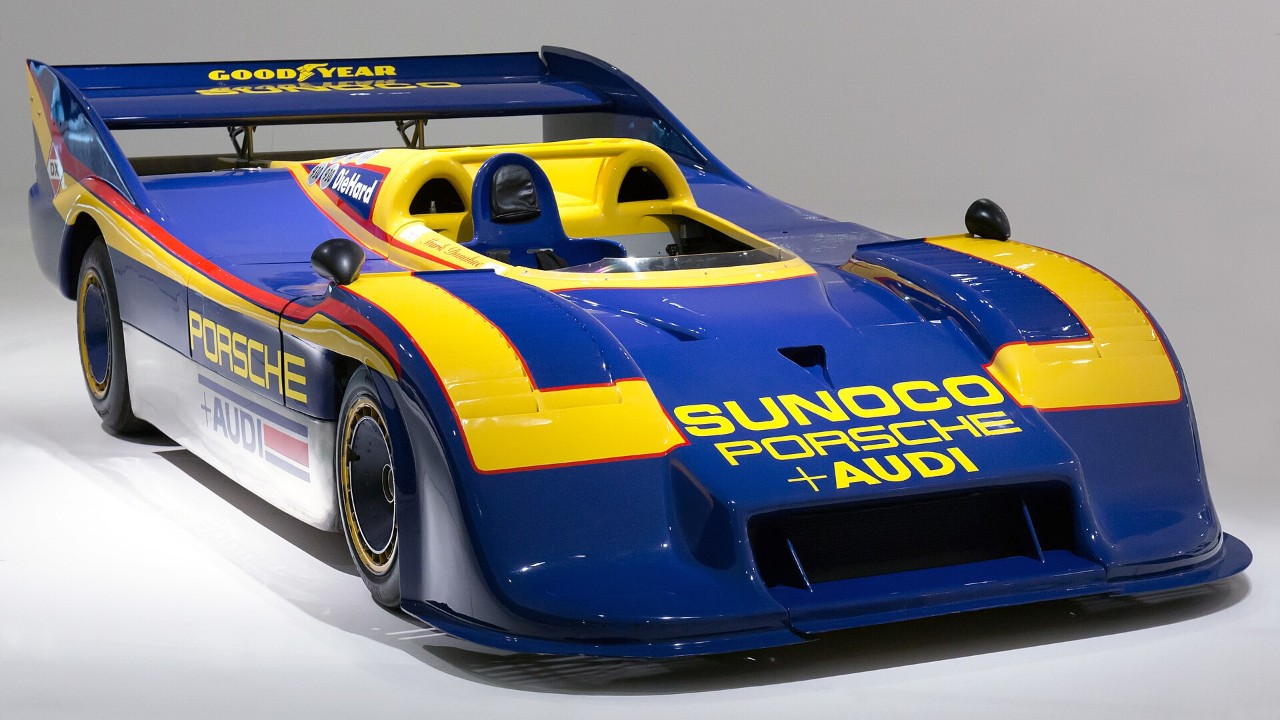
Porsche built the 917/30 Spyder for the 1973 Can-Am season, and its power figures run to four digits. Its turbocharged 12-cylinder engine displaced 5.4 liters. In race trim it made more than 1,100 horsepower, and Mark Donohue drove it to the 1973 title.
Then the rules changed. For 1974, the series added a fuel-economy limit of 3 miles per gallon, and that cap hit the thirsty turbo cars hardest.
The car’s story is short, but it is packed with numbers. Here is how Porsche built it, what it did in 1973, and why its time at the front ended so quickly.
What the Porsche 917/30 was built to do
Porsche developed the 917/30 for the 1973 season as an update of the earlier 917/10. According to Classic Motorsports, Donohue asked for better brakes. Meanwhile, the French firm SERA-CD worked on improved aerodynamics.
The car also needed a lot of fuel. Classic Motorsports says its capacity rose from 86 gallons in the 917/10 to 106 gallons, carried in five tanks. That figure explains a great deal about what came next.
Penske Racing ran the car for Donohue. Supercars.net also lists one example in its 1973 Penske Racing Sunoco livery.
A 5.4-liter turbo 12 with driver-set boost
Porsche’s own museum press kit lists the engine as a turbocharged 12-cylinder with a 180-degree V layout. It displaces 5,374 cc. Porsche rates it at 882 kW, or 1,200 horsepower, and gives a top speed of 385 km/h, about 239 mph.
Other sources give different power figures, because boost changed everything. Supercars.net describes “at least 1,100 bhp” from twin Eberspächer turbochargers. Its spec table lists 1,085 bhp at 7,800 rpm and a 6.5:1 compression ratio.
Silodrome reports that the engine was tuned to over 1,580 hp for qualifying. Teams usually turned the boost down and raced at around 1,100 hp, according to the same report. Classic Motorsports adds a key detail: the driver could adjust the boost from the cockpit, which it calls a new idea at the time.
How light and how quick
All that power went into a small, light car. Supercars.net lists a curb weight of 800 kg, about 1,764 pounds, on a 2,500 mm wheelbase. Classic Motorsports gives a round 2,000 pounds instead. Supercars.net works that out at about 1,356 bhp per tonne.
The acceleration figures follow from it. Classic Motorsports quotes 0 to 100 mph in under three seconds and 0 to 200 mph in 10.7 seconds. Silodrome gives a similar 10.9 seconds to 200 mph in race trim. Supercars.net also lists 810 lb-ft of torque at 6,400 rpm.
Even the official numbers vary with boost. At Porsche’s Rennsport Reunion, a placard quoted 1,250 to 1,560 horsepower depending on the setting, according to Classic Motorsports. Porsche, for its part, calls the car “one of the strongest racing cars of all time.”
The 1973 Can-Am season in points
The final 1973 table shows how one-sided the year became. Classic Motorsports lists Donohue with 139 points, George Follmer with 62 and Hurley Haywood with 47. Supercars.net adds that Porsche drivers filled the top four places in the final standings.
Part of the reason was a missing rival. McLaren pulled out before the 1973 season began, as Classic Motorsports notes.
At Watkins Glen, for example, Donohue won by 42.87 seconds over David Hobbs. He led all 202 miles of that race, according to the magazine. Porsche’s press kit puts the year in plainer terms. Its text says Donohue beat McLaren “with a long lead for the second time in the CanAm Series.”
Then Can-Am capped fuel use at 3 mpg
After that season, the sanctioning body acted. Porsche’s press kit says the Americans, tired of its dominance, changed the regulations, which shut out the 917.
The tool was fuel. For 1974, the SCCA introduced a maximum fuel-consumption rule of 3 miles per U.S. gallon, according to Silodrome. Classic Motorsports links the new standard to the OPEC oil crisis. Silodrome adds that the limit hurt the twin-turbo cars. Some teams even removed the turbos and ran naturally aspirated, but those cars never matched the earlier pace.
The cap was also a stopgap. Classic Motorsports calls 1974 an interim year, because a new formula with 3.0- and 5.0-liter engine limits was planned for 1975.
What happened to the cars
The 917/30 did race in 1974, but on smaller terms. Classic Motorsports reports that Brian Redman drove chassis 917/30-003, Donohue’s title-winning car, to second at Mid-Ohio that year. It also quotes writer Pete Lyons, who said Porsche let Penske out of the third year of the original contract.
Donohue later used a 917/30 for a closed-course speed record at Talladega, at more than 221 mph by Classic Motorsports’ figure. Today, Porsche owns chassis 2, Donohue’s first 1973 car, according to the magazine, and the Porsche Museum includes the 917/30 Spyder in its press kit with that rating of 1,200 horsepower.
More from Fast Lane Only