You can feel it the moment you picture one gliding up a White House driveway: a 1964 Lincoln Continental sedan, low and unhurried, radiating the kind of quiet confidence presidents like to project. Long before armored SUVs and tinted convoys, this car carried American power with a kind of measured grace, its calm presence doing as much talking as any podium speech. To understand why, you have to look at how its design, engineering, and history all converged around a single idea of presidential poise.
The calm in the motorcade
When you study the 1960s, you see that the Lincoln Continental became the default backdrop for American power. From 1961 to 1969, presidents relied on these cars for parades, state visits, and everyday duty, turning the fourth generation into a rolling symbol of the office. That continuity matters to you as a reader, because it explains why a single silhouette, repeated year after year, came to feel like a visual shorthand for the presidency itself, a kind of moving Oval Office that signaled stability even when politics did not.
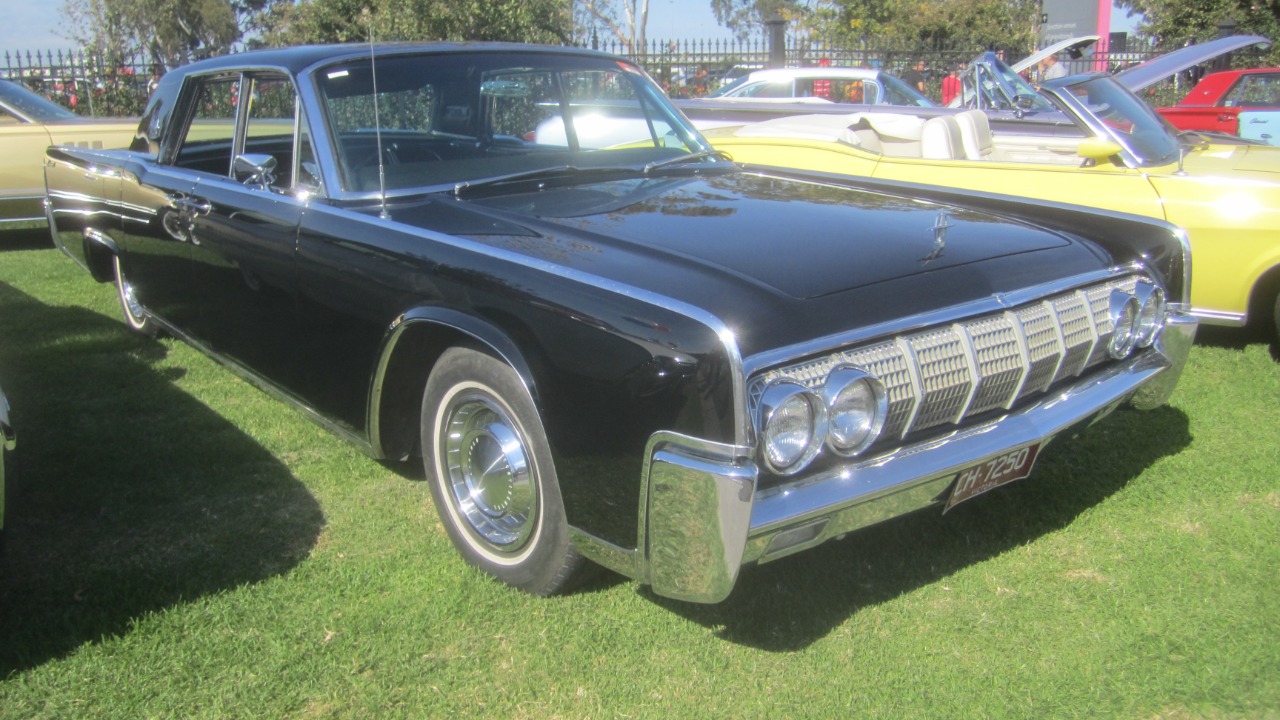
Part of that aura came from the way the 1964 Lincoln Continental sedan carried itself. Enthusiasts like to say the continental wasn’t about, it was about presence, and that is exactly what you see in archival footage of presidential motorcades. The car sits low, the roofline is straight, and the body sides are almost eerily smooth, so the whole machine looks unbothered by the chaos of sirens and crowds around it. In an era marked by Cold War tension and social upheaval, that visual calm was not an accident, it was part of the message.
Designing serenity in steel
If you trace that look back to its origin, you land in the Development studios at Ford, where design vice president Elwood Engel pushed for a clean, almost architectural form. You notice how the 1964 model continues the fourth generation’s straight lines and tight proportions, avoiding the fins and chrome excess that still lingered elsewhere in Detroit. That restraint is why the car still looks modern to you today, and why it felt so appropriate in front of embassies and capitols, where understatement reads as confidence rather than compromise.
By 1964, the 1964 model continued that language with only subtle refinements, which is part of why the sedan feels so composed. You get those famous rear hinged back doors, often called Suicide doors, that open wide to frame a president or dignitary like a stage. Contemporary admirers still describe the 1964 Lincoln Continental Sedan as Presidential Elegance with razor clean lines, and when you look closely, you see how every crease and panel gap is disciplined to keep your eye calm rather than excited.
Luxury that whispers, not shouts
Inside, the 1964 Lincoln Continental sedan invites you to experience power as comfort rather than aggression. The cabin is wide and low, with broad seats and a flat dashboard that keeps everything at a relaxed eye line, so you feel like you are in a lounge that happens to move. Enthusiast descriptions of the 1964 Lincoln Continental dwell on its sunny elegance and effortless V8 glide, which tells you how much the car’s character depends on smoothness rather than drama. For a president, that meant you could sit in the back, review a speech, and feel insulated from the noise outside without losing touch with the world rolling past the glass.
Under the hood, the calm continues in mechanical form. The 1964 Lincoln Continental convertible, closely related to the sedan, used a 430 cubic inch V8 engine producing 320 horsepower, paired with an automatic 3 speed transmission, a combination tuned for quiet torque rather than sprint times. Owners and fans still emphasize that the presence mattered more than outright speed, and when you imagine a motorcade easing through a city center, you can see why that philosophy fit the job perfectly.
The presidential connection
To grasp how deeply this car is tied to high office, you can look at specific examples that carried real political weight. One 1964 Lincoln Continental convertible was sold new to The LBJ Co of Austin, Texas, and used by President Lyndon Johnson at his ranch, turning a personal car into an extension of the presidency. Later descriptions of that same Lincoln Continental note how President Lyndon Johnson used it in Austin, Texas, which shows you that the car’s presidential role was not limited to formal limousines in Washington. Even in private settings, the same calm lines and relaxed ride framed the way a president moved through the world.
Collectors have not forgotten that connection. One enthusiast recalling a similar 1964 Lincoln Continental convertible, originally owned by Lyndon Johnson, has wondered what became of a car that had a mostly unknown part in history and estimated that such a vehicle could now be valued in the neighborhood of $500,000. When you see that kind of figure attached to a specific car, you are really seeing a price placed on proximity to power, and on the way the 1964 Lincoln Continental quietly carried that power through some of the most turbulent years in American life.
From presidents to popes
The calm authority of the 1964 Lincoln Continental sedan did not stop at Pennsylvania Avenue. You can follow its influence into religious and diplomatic history, where the same basic platform was adapted for global figures. A 1964 Lincoln limousine was stretched and modified for the use of Pope Paul, turning an American luxury car into a diplomatic tool. Video of that 1964 Lincoln limousine shows how the car’s long, flat surfaces and dignified stance translated seamlessly from presidential motorcades to papal visits, reinforcing the idea that this design language could carry almost any kind of moral or political authority without shouting.
That same vehicle is often described as the first specially built Popemobile, a 1964 Lincoln Continental Lim that carried Pope Paul VI during his visit to the United States. When you see the same basic car serving both Presidents and a Pope, you start to understand how its calm, almost neutral elegance made it a kind of universal diplomatic platform. The sheet metal did not change its tone depending on who rode inside, it simply offered a steady, dignified frame for whoever needed to project reassurance to the crowd.
More from Fast Lane Only