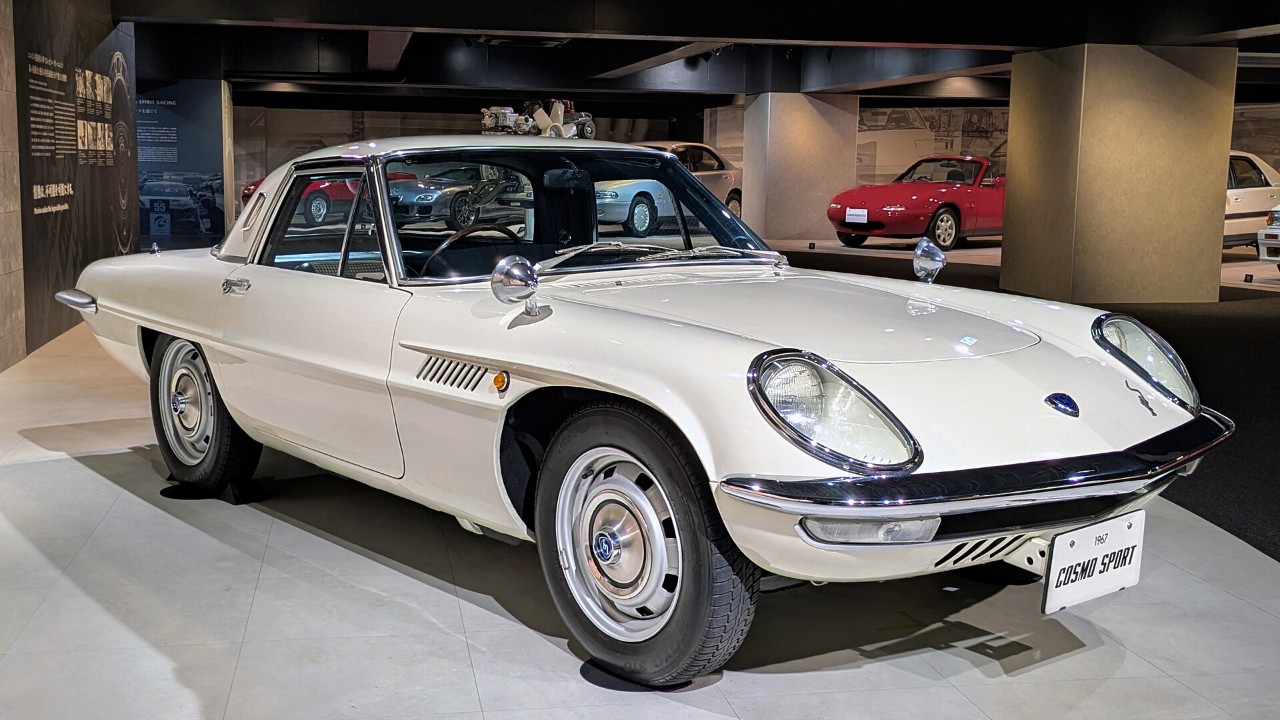
In 1968, Mazda sent two rotary Cosmo Sports to an 84-hour race on the Nürburgring. One went off the road with about two hours to go. The other ran the full distance and finished fourth overall, behind only Porsche and Lancia.
That result mattered more than the trophy. At the time, the public doubted that a rotary engine could last, and Mazda needed proof. Three and a half days of racing on one of the toughest tracks in the world was the test it chose.
Here is what Mazda brought, why it took the risk, and how the race played out, from Mazda’s own heritage files and a Hagerty account of the event.
The rotary Cosmo Sport Mazda brought to Germany
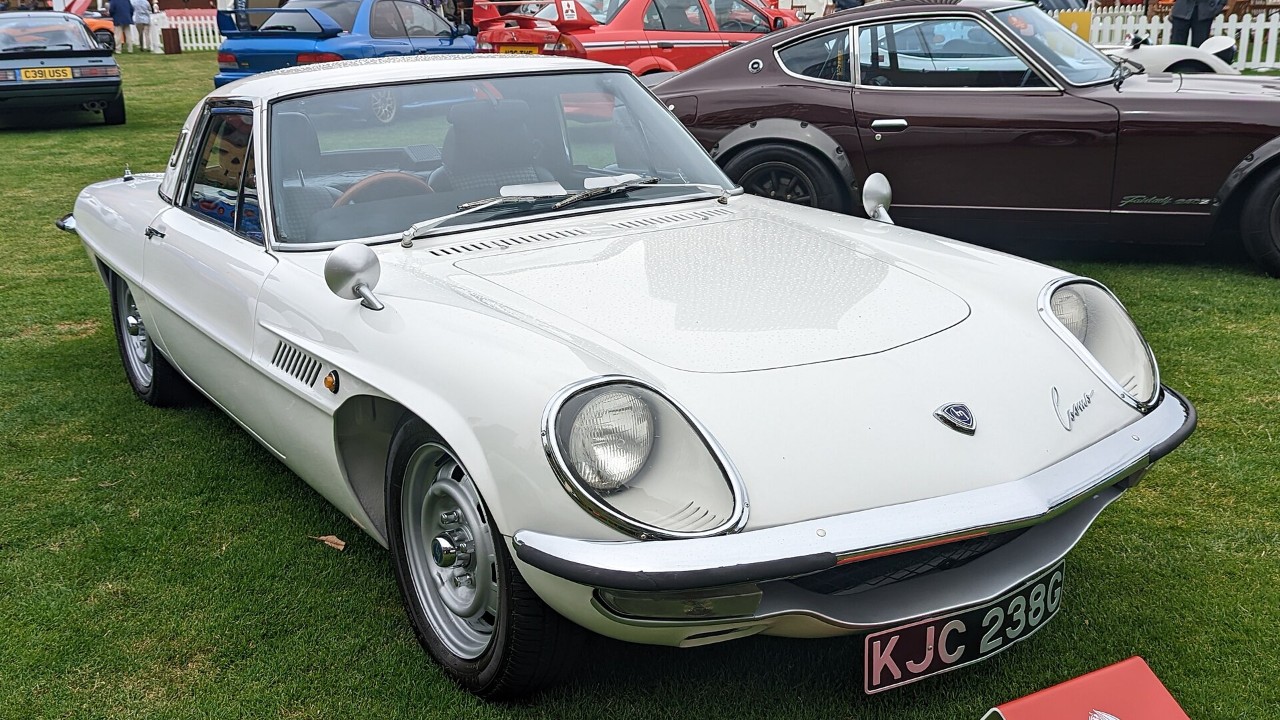
Mazda put the Cosmo Sport on sale on May 30, 1967. Mazda’s newsroom calls it the world’s first dual-rotor rotary-engine car. Outside Japan, it was known as the 110S.
According to Mazda’s own history of the car, its two-rotor engine was rated at 491 cc x 2. It made 110 PS, and the car could reach 185 km/h. However, it was no volume seller. Mazda says it sold roughly 30 a month, and Hagerty says it never sold in enormous numbers.
The company’s racing program started right after. In fact, a 2007 Mazda news release says its motorsport involvement began in 1968, following the Cosmo Sport’s release.
Why Mazda risked its new engine
NSU had already sold the first rotary-engine car. Still, the public doubted the engine’s reliability and durability. Toyo Kogyo, as Mazda was then called, wanted to erase that doubt in a high-profile international race.
The plan carried real risk. A poor result could hurt the rotary’s image, and Mazda’s centennial history admits the team knew it. Even so, the team said it wanted to show the world that rotary engines “can really pack a punch!”
Preparation took about a year. First, engineers developed a high-powered racing engine and ran bench tests and simulations. Then the Cosmo Sports went through durability testing at Mazda’s Miyoshi Proving Ground. Mazda Australia adds that engineers studied computer simulations of the circuit before the race.
Inside the 84-hour Marathon de la Route
The race was the Marathon de la Route, run on the 28-kilometer Nürburgring circuit. Mazda describes it as reputedly the toughest race in the world. It lasted about three and a half days, and 59 vehicles took the start.
The rules made it harder. According to a history of the event on Stuttcars, any pit stop longer than one minute cost a team one lap. Teams also had to complete as many laps in the last 12 hours as in the first 12.
Mazda entered two Cosmo Sports built for racing. Their engines displaced just a liter and made around 130 horsepower, about 20 more than the road cars, says Hagerty UK. An all-Japanese crew that included Nobuo Koga drove one car. Meanwhile, a trio of experienced Belgian drivers shared car No. 19.
Hour 82, and a fourth-place finish
Both Cosmos ran inside the top 10 partway through the race, according to Mazda. Then, in the 82nd hour, the Japanese-crewed car slid off the track. Mazda blames a rear tire problem, while Hagerty describes an issue with a rear wheel. Either way, it retired just short of the finish.
The Belgian-driven car kept going. It covered more than 9,700 km with no loss of engine performance, Mazda says. Hagerty puts the distance at more than 6,000 miles and says the car finished 12 laps behind the winning Porsche.
That was good enough for fourth overall. Only Porsche and Lancia finished ahead, with another 911 and a Lancia Fulvia on the podium beside the winner, Hagerty notes. Mazda Australia says the fourth place “put Mazda on the map” and showed the rotary’s reliability to the world.
What the rotary Cosmo Sport started
The Nürburgring result opened a long racing story. The next year, Mazda tried the 24-hour race at Spa-Francorchamps. There, a rotary Familia Coupe finished fifth, according to Mazda Australia’s racing history.
Later, Mazda returned to Spa in 1981 with a near-standard RX-7 and won. Meanwhile, the road cars kept selling. Hagerty says nearly half a million first-generation RX-7s found homes between 1978 and 1985.
The biggest result came at Le Mans in 1991. That year, the rotary-engined 787B won the 24-hour race, the first Le Mans victory for a Japanese maker and for a rotary-powered car, Mazda Australia records.
More from Fast Lane Only
- Unboxing the WWII Jeep in a Crate
- 15 rare Chevys collectors are quietly buying
- 10 underrated V8s still worth hunting down
- Police notice this before you even roll window down
This article was created with the help of AI and was reviewed and edited by Fast Lane Only editors before publication.