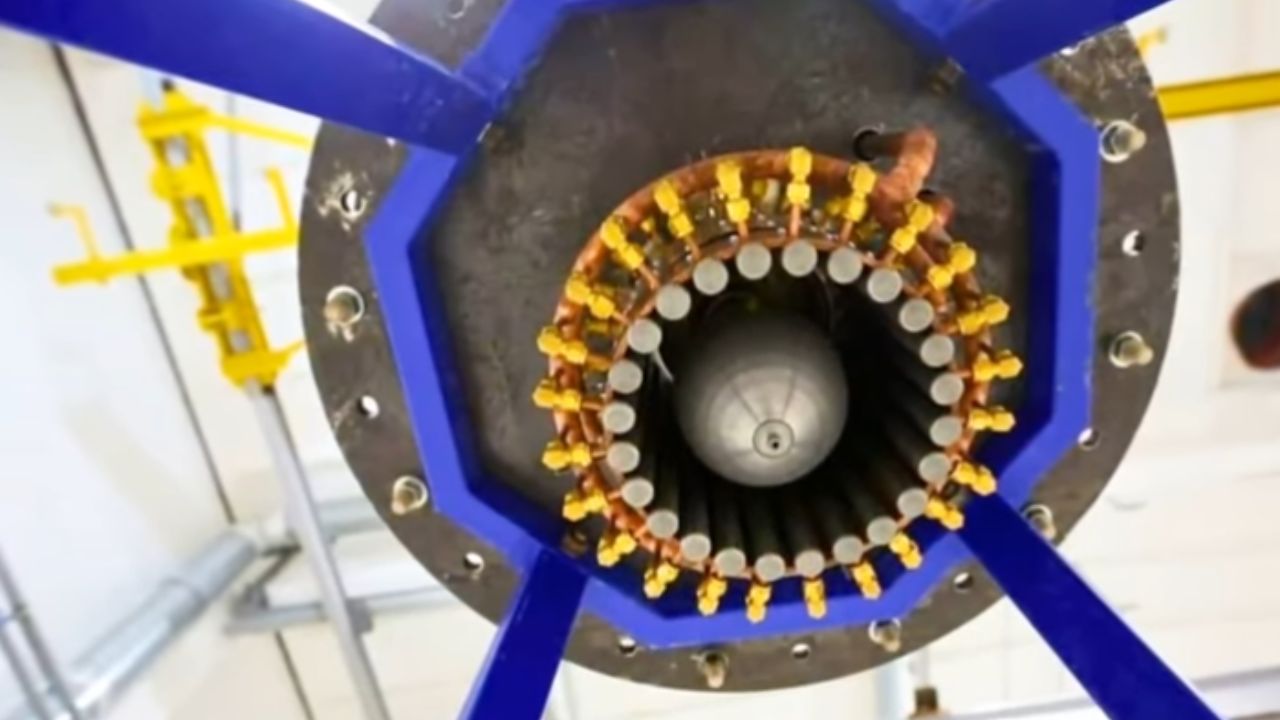
Russia is once again trying to vault itself to the front of the space race, this time with a plasma engine that officials say could reach Mars in roughly a month. If the technology performs as advertised, you would be looking at a shift from multi‑month cruises to something closer to an interplanetary sprint, with all the scientific and geopolitical consequences that implies. The claim is bold, the physics demanding, and the timeline ambitious, but the underlying engineering push is very real.
Instead of relying on brute-force chemical rockets, Russian teams are betting on plasma propulsion powered by nuclear energy to keep thrusting for weeks in deep space. That approach, if it scales, could let a spacecraft accelerate almost continuously, rather than coasting most of the way as current Mars missions do. For you as a future passenger, scientist, or policymaker, the question is not just whether the engine can work, but what it would mean if it does.
How Russia’s plasma engine is supposed to work
The core idea is to trade short, violent burns for long, efficient pushes. Russian engineers describe a nuclear powered system that ionizes a light gas, then uses electromagnetic fields to hurl that plasma out of the engine at extreme speed. In concept, you would launch from Earth on a conventional rocket, then switch to this drive in space, letting it build up velocity over days and weeks instead of seconds. Advocates argue that this continuous acceleration is what could shrink a Mars trip to roughly 30 to 60 days, instead of the many months you are used to hearing about.
In Moscow, Jan reports from WE THE NAGAS describe Russia’s Rosatom presenting the concept as a way to put the country at the forefront of deep space travel. The same briefing credits Russian scientists with targeting exhaust velocities up to 100 km/s, far beyond what chemical engines can manage. A related description of the project says the Russian state corporation believes such performance could cut the journey to Mars to only 30 to 60 days, a figure that underpins the current excitement.
The prototype, the fuel, and the promise of 30 days
Behind the sweeping claims sits a more modest but important step: a working prototype. Russian technical reports describe a plasma rocket engine demonstrator that uses Hydrogen as its propellant, heated and accelerated by a high power system until it reaches very high speed. For you, the key point is that this is not just a paper study. Engineers have built hardware, fired it in test facilities, and measured thrust and exhaust characteristics, even if those numbers are still far from what a full Mars mission would require.
One detailed account explains that Russia develops plasma hardware as a prototype specifically aimed at Mars transfer times of one to two months, with Hydrogen singled out as the working fluid that The Russian team believes can build up very high speed. A broader overview of the same effort notes that Russia is framing this as a Mars focused technology path, not just a generic satellite thruster. Separate coverage of the concept stresses that Russia’s plasma engine would use Hydrogen fuel and electromagnetic fields to accelerate particles out of the engine, a combination that, on paper, supports the 30 day Mars narrative.
From lab tests to “Russian Scientists Test Plasma Engine That Could Cut Mars Travel”
For any propulsion breakthrough, the leap from lab bench to operational system is where most grand visions falter. Russian teams are already talking about that transition, describing vacuum chamber runs and early integrated tests as proof that the concept is maturing. You can think of this phase as the equivalent of early jet engine trials in the 1940s: noisy, imperfect, but essential to move from theory to something that can actually fly.
Reports under the banner Russian Scientists Test describe ground tests that aim to validate whether the engine can realistically trim the journey to About 30 Days, with Photo Courtesy images credited to Autorepublika. A separate summary says Russia Is Building a Plasma Engine specifically to Get Humans to Mars in roughly 30 Days, describing how the system ionizes gas and then accelerates it using a magnetic field. Another account notes that Russia has developed a new plasma rocket engine that Scientists see as a way to make long duration space travel more practical, reinforcing that this is not just a one off experiment but part of a broader strategy.
What 30 days to Mars really means in spaceflight terms
To understand the scale of the claim, you need to look at the basic geometry of the Solar System. Mars is about 140 m from Earth according to one technical summary, a shorthand that in context refers to the enormous gulf between the two planets rather than a literal 140 meters. Covering that distance in 30 days would require an average speed of about 195,000 mile per hour, a figure that dwarfs the cruise speeds of current robotic missions and would push human crews into a regime where radiation, navigation, and life support all face new stresses.
Analyses of the Russian concept underline that Mars in 30 would demand sustained acceleration and deceleration, not just a single burn, and that the costs of their production will be a major factor in whether such engines ever fly routinely. A separate overview of the announcement notes that Listen to This Article style explainers have highlighted the about 195,000 miles per hour requirement as the key number that separates marketing from engineering reality. When you compare that to the speeds of existing Mars orbiters, you start to see why many experts treat the 30 day figure as a stretch goal rather than an imminent capability.
Risk, rivalry, and what it means for you
Even if the engine works, getting humans safely to Mars is a different challenge. History is littered with failed attempts to reach the Red Planet, and the statistics are sobering. One long running tally notes that more than half of the 40 m missions sent toward Mars, the Red Planet, since 1960 have failed, a reminder that propulsion is only one piece of a very complex puzzle. Faster trips could reduce radiation exposure and psychological strain for crews, but they also compress timelines for dealing with emergencies and demand extremely reliable hardware.
That context matters as you weigh Russia’s claims against other players. A detailed look at past efforts points out that 40 m attempts to reach Mars, the Red Planet, underline how unforgiving interplanetary flight can be. Commentary on Elon Musk’s latest plans stresses that these challenges highlight the immense difficulty of reaching Mars, the Red Planet, with current technology, and raise hard questions about mission sustainability for long term planetary exploration. Against that backdrop, Russian officials promoting a 30 day plasma sprint are not just pitching a new engine, they are staking a claim in a crowded and risky race.
More from Fast Lane Only